




Roon is probably the most comfortable, reliable and high-quality solution for music playback. But even Roon can’t satisfy everyone’s wishes. However, some special requests can also be realized with the rooExtend box. A short introduction.
ROOEXTEND BOX: CLEVER EXTENSIONS FOR ROON
The server-based music management and player software Roon is inherently an extremely versatile solution for anyone who wants to conveniently manage music via streaming and their own music files in the home network and enjoy it in the best possible quality. Roon, which was created from the previous high-end solution Meridian Sooloos, has been the undisputed gold standard for many years when it comes to precisely these tasks. So far there is no equivalent competition on the market, although some are trying other ways and at lower costs. Such as Audirvana or JPlay. But so far none of the competitors offer similar comfort combined with maximum reliability. There is only still criticism of the additional solution Roon ARC, with which your own music can be streamed from your home server to all over the world outside the home network, as this sometimes does not work reliably.
But even the best application can never make everyone happy. Time and again, social requests arise that are too individual to program an integrated solution or to fundamentally take them into account in the architecture. Fortunately, Roon can also be expanded externally. A very clever solution of this kind exists with the rooExtend box. This is an additional device for Roon that can take on the role of a central control unit.


To do this, you first have to understand how Roon works with external devices. As everyone knows, the market is full of network and streaming-capable digital audio components. These are all potential output devices for music supplied by Roon. In order for this to work in a consistent and reliable manner, such end devices must be “Roon Ready”. To do this, manufacturers send one of their devices to Roon so that they can then work together to optimize the interface parameters. This prevents poorly implemented or even faulty connections to Roon from coming onto the market. And every Roon Ready device can always be controlled in the same way via Roon (with certain variations, depending on the hardware).
There are now hundreds, if not thousands, of components with Roon Ready status. And almost every new streaming component that comes onto the market is Roon Ready certified, or receives this status shortly after launch. Because even if Roon is still a special solution and not a “world standard” due to its relatively high entry costs, hardly any manufacturer can afford to ignore Roon.
I described in detail elsewhere years ago how exactly Roon works, what is required and how much it costs. The short form is:
1. A license in the form of a subscription (from 12.49 US dollars/month) OR a lifetime license for currently around 770 euros (depending on the conversion rate). Plus, if necessary, a subscription to a music streaming service such as Qobuz or Tidal.
2. A sufficiently high-performance server. There are many solutions for this, ranging from simple Linux PCs to Macs (see additional articles below) to special servers for Roon.
3. Roon-compatible device(s) for music output
4. Devices for control with the Roon app (iPhone, iPad, Mac …)
I have been using Roon for almost 10 years now with a lifetime license, which has long since paid for itself. The system runs 24/7 on a Mac mini M4 (see supplementary articles). Personally, the control options integrated into Roon are completely sufficient for me, although I have now tested a large number of different Roon-Ready devices for numerous REWIND tests. Not a single one of them has ever caused problems with Roon and I am therefore able to always use my own playlists (which also contain tracks from my locally stored music) for all the different devices without having to laboriously transfer them every time.
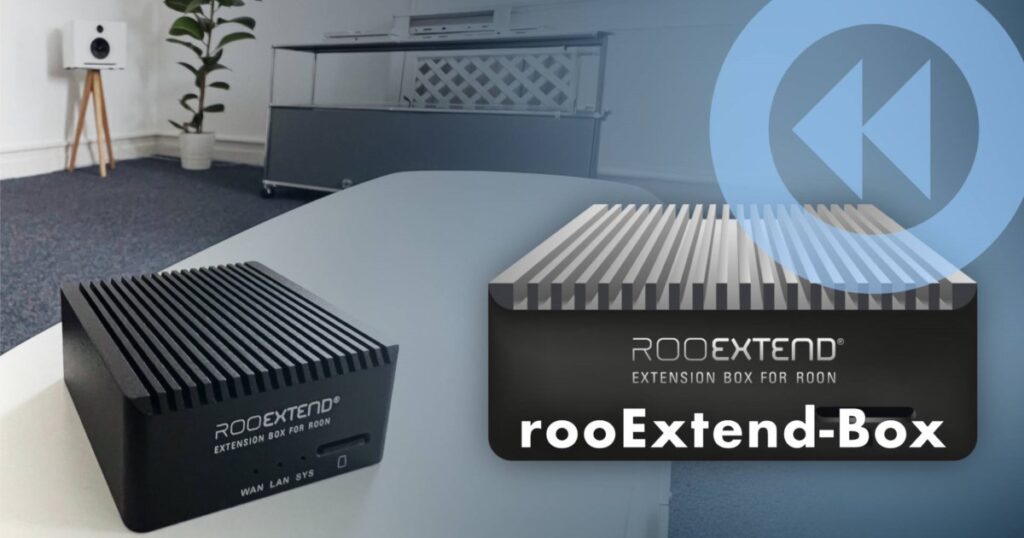
In addition, there is occasionally a desire for other control solutions, and this is where the rooExtend box comes into play. This is a small box made of solid aluminum that is integrated into the network. the rooExtend box costs just under 400 euros. Not a piece of cake either, but it is also a special solution. And what can the little box do? The website sums it up.
With rooExtend you can:
- Use the Microsoft Surface Dial as a wireless control device for Roon (rooDial).
- Use the SpaceMouse Wireless as a wireless control device for Roon (roo6D).
- Use the SENIC Nuimo as a wireless control device for Roon (rooNuimo).
- Control Roon with the Apple Watch (rooWatch).
- Operating USB DACs with Roon (rooPlay)
- Use UPnP player or streamer with Roon (rooUPnP).
- Play music from Apple devices via Roon and its DSPs (rooPlay).
- Play music from vinyl records via Roon and its DSPs (rooPlay).
- Record played records as FLAC on a USB stick (rooPlay).
- Play music directly from CD (without ripping) via Roon and its DSPs (rooPlay).
So a considerable expansion of the possibilities.
Hardware control via USB to trigger cable
A clever little solution has now been added. With a special USB-to-trigger control cable from definiteAudio GmbH, in combination with the rooExtend box, HiFi devices with a trigger input – such as amplifiers, preamps or power amplifiers – can be switched on and off conveniently and automatically. Suitable software is available upon request with which the trigger cable can also be integrated into individual Linux environments. This means that the solution is aimed not only at Roon users, but also at technically savvy HiFi enthusiasts with tailor-made systems.


The USB-to-trigger control cable costs around $30 (currently around €25), plus shipping.
Conclusion: There is always something more possible
The rooExtend box is a solution devised by Roon users for some special applications and is therefore a great way to further expand the “Roon Experience” and enormously expand device control.
The rooExtend box and the associated extensions still have a catch in addition to the additional costs. It increases the administration effort and makes Roon, which is in itself extremely user-friendly, a bit more of a fiddly solution, even if the developers of the extensions do everything they can to make them as user-friendly as possible. So actually exactly what Roon users wanted to leave behind. But the possibilities with the rooExtend box will usually only be explored by those users who absolutely want to implement one of the solutions mentioned.
The existence of the rooExtend-box also shows how important Roon has become among music fans all over the world.