


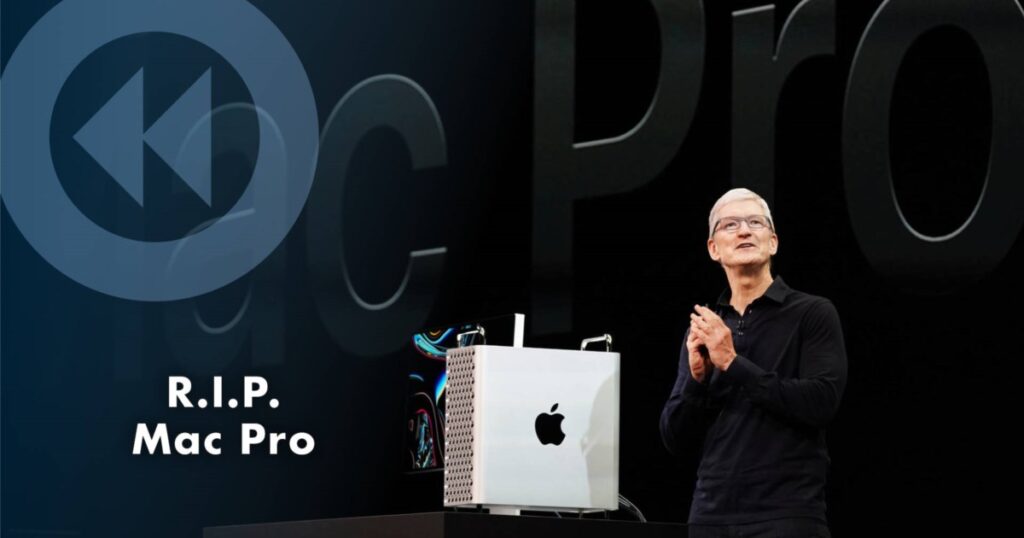


After the Mac Pro was discontinued last week, there was a huge outcry, albeit only from a manageably small group of users. But the end of the Mac Pro in tower format was long overdue, says REWIND.
It’s always difficult to let go of things you love. And many people are not fans of big changes anyway. So it was also clear that after the announcement of the (most likely) final end of the Mac Pro in the tower case, the previously satisfied users of this concept were not at all happy about it. But basically the concept of the “modular” Mac that could be retrofitted and upgraded with plug-in cards and drives was long outdated. And this author is of the opinion that so-called modular computers never really had or have much of an advantage over highly integrated designs like the Mac Studio.


I personally built Windows PCs professionally for a short time in the 90s. This means: tower PCs built from the ground up according to customer orders. Case, fan, power supply, motherboard, CPU, memory, graphics card, drives, etc. pp. This was called for because the customer could put together the best combination for him from certain parts within a certain framework, although we as the “manufacturer” had to make sure that everything really fits together, because not every CPU fits on every motherboard and not every power supply is powerful enough for the required power consumption.
Even back then, the basic idea was that the PC could always be brought up to date by replacing the cards thanks to modularity. But even back then it was more of a gray theory, because modular systems always suffer from one point, namely the interfaces. They get old quickly. Back then, it took even less time than it does today. One year the square CPU was popular for, for example, “Socket 4”, and the next year it was the CPU that required the next generation of sockets or even had a completely different form factor. In practice, this usually meant buying a new entire PC because, in addition to the CPU, the mainboard also had to be replaced, which in turn offered faster PCI and memory slots and required different memory and graphics cards, and ultimately possibly needed higher performance, which required different power supplies… and so on, and so on. The advantage of modularity for expandability and longevity was mostly wishful thinking.


In contrast, highly integrated computers like the Mac Studio have some tangible advantages. This means that the hardware can be optimally coordinated during the design phase and maximum performance can be achieved. Because don’t think that it would be enough to simply put the fastest components on the best available board to get the fastest PC. Are you kidding me? Are you serious when you say that. It wasn’t that easy to coordinate a “modular” PC with hardware and software so that it was really fast in all aspects (CPU, memory, graphics…).
In highly integrated systems, techniques can also be chosen that are simply not possible with modular systems, such as directly connecting the RAM to the CPU. No plug-in interface can keep up with this in terms of performance. And if it does, it will be out of date in a year anyway and limits the ability to upgrade it. There may be individual exceptions, but no single modular system in the computer world has ever proven to be truly durable enough to remain state-of-the-art. Not a single one.
Therefore, in 2013, the introduction of the Mac Pro in the compact, black cylindrical shape with little modularity seemed to me to be the logical and right way. Even if the concept failed, as it now turns out, it was the right approach, which is consistently continued today in the Mac Studio. The “table trash can” was unfairly the target of ridicule and malice. And it wasn’t the first time that Apple was too ahead of its time with a new product. Newton and Power Mac G4 Cube would be examples of this. But here and now the concept of the Tower Mac Pro is definitely – and with the exception of very few special applications – old news and no longer makes sense for manufacturers and users to pursue it further.


I’m not even talking about the usual problems, such as the exorbitantly high price and the fact that you couldn’t even plug other graphics cards into it. No, it’s all about the realization that the advantage of modularity comes at the price of far too many disadvantages and limitations and is ultimately just window dressing.
Kindness suggestion
Dear fans of the Tower Mac. The time is ripe for a rethink. Almost all of today’s common applications that don’t involve ultra-high-end computing or gigantic AI centers can be done at least as well with one (or more networked) Mac Studio. Probably even better. By the way, this eliminates the need for tinkering, which costs a lot of time that is lost in computing time.
Yes, I can already hear the objections of certain experts in the forum who will tell me that the Studio does not come close to achieving the performance of the best XY Enterprise PC solutions. But that’s not the point. Exceptions always prove the rule, but the Mac Studio is worth trying out for its quality in the tower domain. Who knows? In the end, you might be one of those wondering how you were able to stick with the oversized tower architecture for so long. – Just try it!