


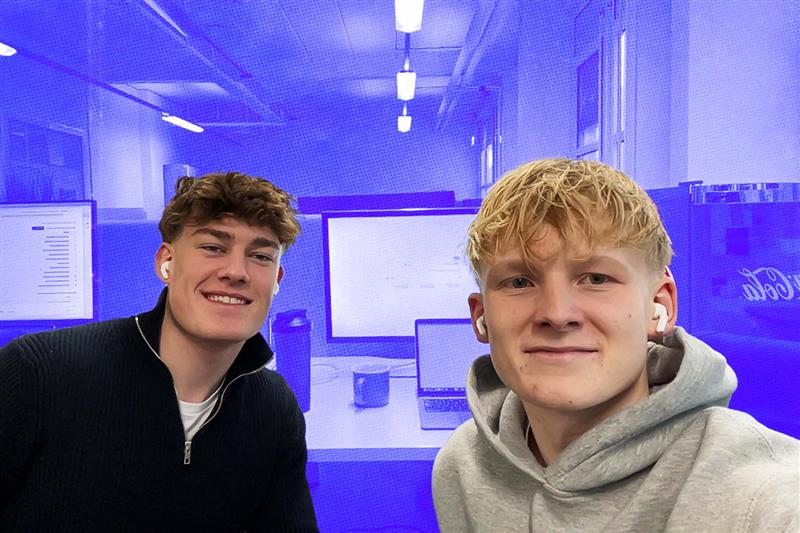
While others can relax after school at 17 (after homework, of course), for Jonathan Burchard and Maximilian Zimmermann the real working day is just beginning.
“We go to the office straight after school, work until 10 a.m. and then we go home again and maybe work again until midnight or 1 a.m. Depending on what the deadlines are,” Jonathan tells Gründerszene. The office is part of an accelerator space that you can use for free in the first year. The advantage on the weekend is that “we can start much earlier.”
Read too


The idea that came from caring for grandma
The story of your startup does not begin with a vision for the billion-dollar market, but with an idea that many families are familiar with: What if grandma or grandpa falls?
“We noticed that our parents were worried that grandma would fall on the stairs,” says Maximilian. “So we thought, okay, this is really a problem that we wanted to solve somehow.”
First they thought of prevention: non-slip mats for stairs. But they quickly realized that such products have been around for a long time. But the crucial point was another question: Why not build a solution that not only protects, but also detects when something happens?
Sensors in the carpet and an alarm if things get serious
Their idea: sensor-based carpet mats that detect falls and automatically call for help. “Then we thought: There is this home emergency number. But this is often simply rejected,” says Maximilian. “It is either forgotten or worn reluctantly.” The difference to the classic home emergency call: The system should be inconspicuous and therefore more accepted, say the founders.
Sensors in the mats provide data and an algorithm evaluates it. In an emergency, the alarm is automatically triggered and the emergency call center is alerted so that help can arrive in time.
It can be founded without any obligations
Why are the two founders doing this? “We both just have an extreme drive,” says Maximilian. “And I don’t really care how old I am.” And: “Age is an advantage, not a disadvantage.”
The only catch: Maximilian is not yet fully capable of doing business. “I’m not allowed to sign any contracts yet. Of course that’s annoying,” he says. Jonathan, on the other hand, is already 18.
Otherwise, they see their current phase of life as the perfect basis for a startup. “We have no obligations and can invest fully without anyone looking over our shoulders,” says Maximilian. The only hurdle is school. That’s why the two founders believe that it’s not brave to start a business young. You can’t lose anything.
School, office, gym – and friends in between
Her everyday life is strictly timed: lessons, straight afterwards to the office, and continuing to work in the evening. Nevertheless, they say: It’s not possible without a private life.
“We still have a social life,” says Jonathan. “We still meet up with friends, but it always depends on how busy we are.” If things get particularly stressful, things go differently: “Then we sometimes spend the whole weekend at our desk.”
Surprisingly, Maximilian sees school not only as a time waster, but also as an advantage. “In contrast to other young founders, the school is a plus point for me,” he says. “Because we meet our friends here every day.”
Another ritual in their everyday life: sport. “We both try to do exercise every day or at least every other day, just every now and then,” says Maximilian. “This serves as a little break for us.” The gym is practically around the corner: “Walk there for three minutes, train for a maximum of an hour and then go back to work.”
Low points? Every week.
Anyone who works so much will have doubts at some point. Jonathan and Maximilian speak openly about the fact that the euphoria is not the same every day. “We constantly have lows,” says Maximilian. “There was even a moment at the beginning when we thought: Now we’re driving the company into the wall.”
But for the two of them, moments like this are just part of it. “Then it just goes downhill and then you catch yourself again,” says Maximilian, describing the ups and downs. Jonathan sums it up like a basic law of their reasoning: “If you fall down, the faster you go up the mountain.”
In difficult times, the most important thing is not to stand still. “If there’s a lot going on, you still have to work through it,” says Jonathan. “You have to keep going and push through.” Both make statements as if they have been in the startup game for decades.
Learn what school doesn’t teach
For Maximilian, entrepreneurship is, above all, a crash course in skills that the classroom doesn’t teach. “100 percent,” he says when asked if they learn things that school doesn’t teach. “Just something like proper communication. If you have meetings every day, you automatically learn how to deal with people and convince them.”
There are also tough business skills: “Financial modeling, dealing with taxes and things like that you don’t learn at school,” explains Maximilian.
Jonathan adds that mentors also play an important role in not being overwhelmed: “We deal with a lot of great people with even more experience who support us a lot,” he says. “For example, we learn an incredible amount from our mentor.”
Why they do it: It doesn’t feel like work
When asked about her motivation, Jonathan has to think for a moment. “Good question. I don’t know exactly where that comes from,” he says. Maybe it’s even something banal: “When we were 13, we watched motivational talks. That’s how we were influenced in that direction.”
But what he knows for sure is that he loves building. “Building a functioning company, with processes that run and work, is so much fun that it doesn’t feel like work at all,” explains Jonathan. “The journey is particularly fun,” says Maximilian. “We can really help people and, in the best case, even save lives.”
Goal: Market launch this year
The two are no longer in the idea phase. They talk about sales, technology, research and a clear date. “Our goal is to bring the product onto the market this year,” says Maximilian. But there is still a lot to do until then. “There’s still a lot to do, but we’re on the right track,” says Jonathan.
Tips for other young founders: Talk, test, do
If Jonathan had to give advice to other young founders, it would be clear: “Just start.” And above all: “Don’t keep anything to yourself, just tell people about the idea directly.” He believes the fear that someone could steal the idea is overestimated.
“Ideas are free,” he says. “It’s about implementing them.” Those who talk about it early benefit the most: “If you bring the idea to other people as quickly as possible, you will get the most important feedback you will ever get.”