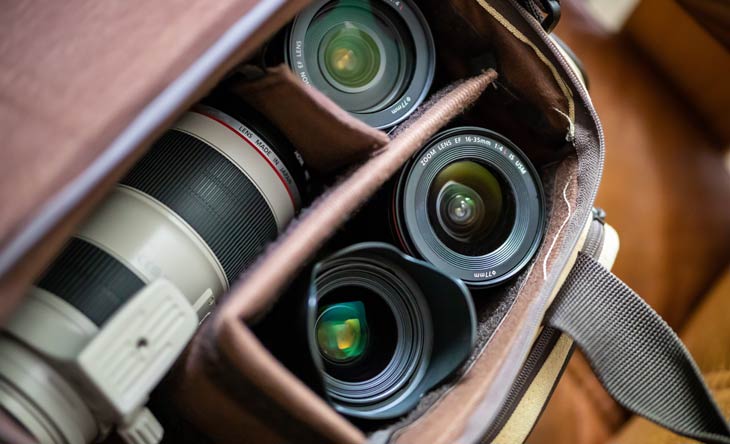
When you buy a high-quality camera, several lenses are often included in the scope of delivery. However, these are often not sufficient for special photographic tasks. If you want to achieve certain effects or take particularly high-quality images, you should use special lenses that were developed for specific applications.
Common camera lenses
Interchangeable lenses differ primarily in their focal length, which is measured in millimeters. It determines the image section and thus the area of application of a lens. A basic distinction is made between fixed focal lengths and zoom lenses.
Fixed focal lengths
Fixed focal lengths do not have a zoom function and have a fixed focal length. They are often characterized by high image quality, high light intensity and a simple optical construction.
Typical focal lengths are 24mm, 35mm, 50mm, 85mm, 135mm or 200mm.
Since each focal length offers a different image detail, many photographers use multiple lenses for different subjects and shooting situations.
Zoom lenses
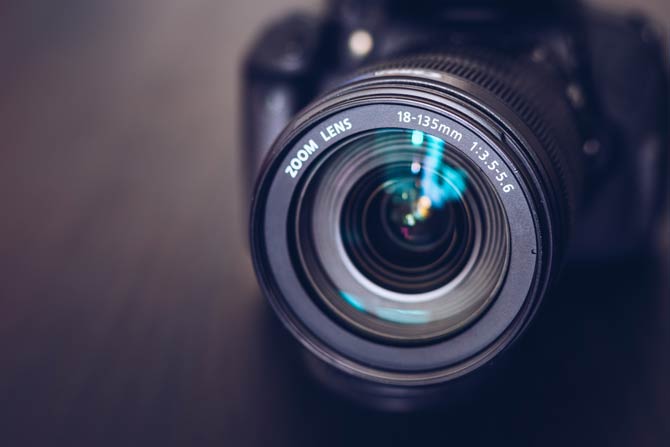
Zoom lenses make it possible to change the focal length flexibly. This allows the image section to be adjusted without changing the position. Typical focal length ranges are, for example, 17-40 mm, 24-105 mm or 70-200 mm.
They are particularly versatile and are suitable for wedding, portrait or nature photography, among other things. However, fixed focal lengths often offer slightly higher image quality and greater light intensity.
Many cameras with interchangeable lens systems come with inexpensive kit zoom lenses that cover a wide focal length range and are suitable for entry-level use.
Commonly used lens types
Depending on the subject and the desired image effect, different types of lenses are used.
Wide angle lenses
Wide-angle lenses have short focal lengths, usually between 12 and 35 mm. They enable a large angle of view and are particularly suitable for landscape, architectural or travel photography.
The shorter the focal length, the larger the image section captured. At the same time, however, distortions can occur, which are particularly visible in architectural photographs.
Telephoto lenses
Telephoto lenses cover the upper range of focal lengths and usually start at around 70 mm.
Many models go up to 500 mm or more.
They can be used to record distant subjects in a format-filling manner. Typical areas of application include nature, wildlife, sports or astrophotography. Due to the large focal lengths, these lenses are often relatively heavy, which is why a tripod or an image stabilizer can be helpful.
Nifty Fifty lenses
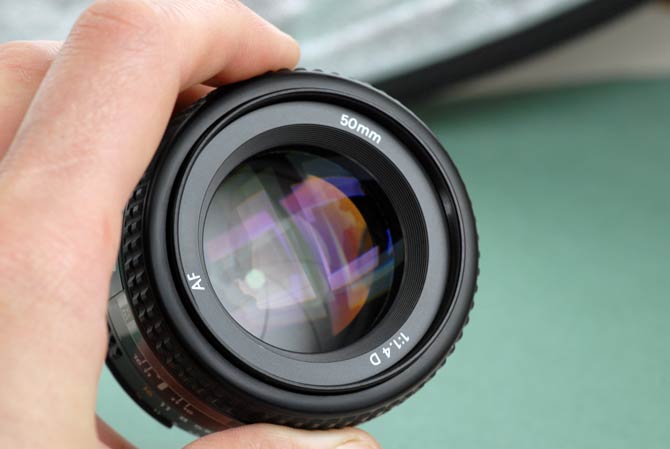
Lenses with a focal length of 50mm are often referred to as “Nifty Fifty”. They usually offer a large aperture, for example f/1.8 or f/1.4, and produce a shallow depth of field with pleasant bokeh.
Since their angle of view roughly corresponds to the human visual impression, photos appear particularly natural. At the same time, only minor distortions occur.
Special lenses for special tasks
In addition to the classic lens types, there are special lenses that were developed for specific photographic effects or technical requirements.
Tilt-shift lenses
Tilt-shift lenses make it possible to tilt (tilt) or move (shift) the lens system relative to the camera.
By shifting, the perspective can be corrected so that, for example, buildings can be photographed without falling lines. That’s why these lenses are often used in architectural photography.
When “tilting” the level of focus is specifically changed.
This allows creative effects to be created, such as the well-known miniature effect, in which real scenes appear like model landscapes.
Many models allow a tilt of around ±8.5 degrees and a displacement of around ±12 mm. High-quality lenses have precise adjustment wheels for precise adjustment. Tilt shift lenses are available from various manufacturers and in a larger selection at Kamera Express.
Fisheye lenses
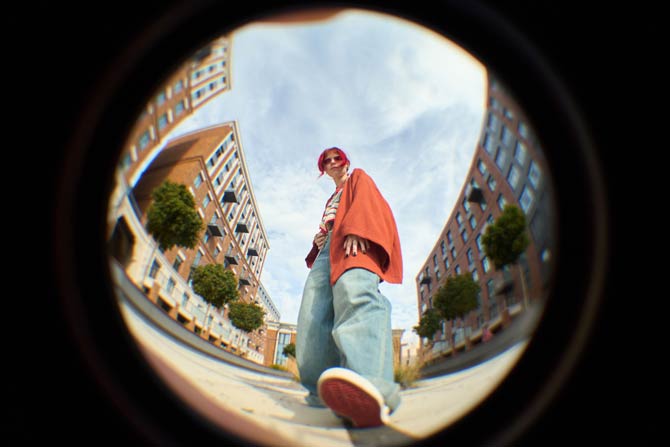
Fisheye lenses are extreme wide-angle lenses and usually have focal lengths between 4 and 14 mm. They capture a very large angle of view of up to 180 degrees.
Their special construction creates strong barrel-shaped distortions, which are deliberately used as a design element. This makes fisheye lenses particularly suitable for creative, abstract or experimental photography.
There are circular fisheyes, which create a circular image, as well as full-frame fisheyes, which illuminate the entire sensor.
Macro lenses
Macro lenses are designed for extreme close-ups. They usually enable an image scale of 1:1, where the subject is displayed in its original size on the sensor.
This allows the smallest details such as insects, plant structures or jewelry to be photographed precisely. That’s why macro lenses are often used in nature, product or scientific photography.
At high magnifications the depth of field is very shallow. In such cases, focus stacking is often used, in which several images with different levels of focus are combined into one shot.
A special variant are so-called test or trunk lenses, which have a long, narrow tube and enable recordings in areas that are difficult to access.
Lenses for portrait photography
Lenses with focal lengths between 85mm and 135mm are often used for portraits. They create a natural perspective and avoid facial distortion.
A large aperture allows for a shallow depth of field, making the subject stand out clearly from the background.
This creates the typical portrait look with soft bokeh.
Can software replace special lenses?
Many effects can now also be simulated using image editing software, such as bokeh, tilt effects or perspective corrections.
However, the physical properties of a lens can only be replaced digitally to a limited extent. Software solutions quickly reach their limits, especially in macro photography or with extreme focal lengths.
In practice, high-quality lenses and digital post-processing complement each other.