


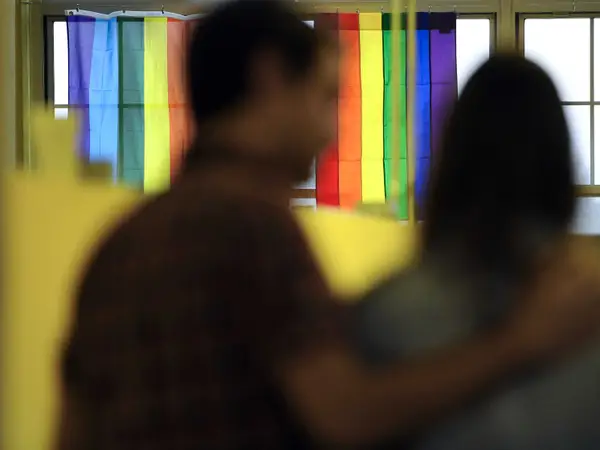

The queer community is mourning after the attack on Christopher Street Day (CSD) in Berlin. An Islamist attacker deliberately drove into a crowd of people on Saturday evening. He killed a woman and injured more than 30 people.
Since then, mourners have been laying flowers and lighting candles at the crime scene in the Großer Tiergarten and in front of the Brandenburg Gate. We asked queer people from the startup scene how they were feeling after the attack and how safe they felt on the streets and at work.
Founder after CSD rampage: “The tech scene is a bubble”
Marc Funk was at the CSD himself all Saturday. He is the founder and co-CEO of the AI startup Frontnow. “I’m shocked,” he says. “After the attack, I have the feeling that you celebrate life and are punished with death.”


And: “I find myself feeling like it’s the new normal and that you can quickly get back into everyday life because events like this happen so often. Even if it makes me sad, it’s bad and I’m stunned. That’s exactly what shouldn’t happen.”
As an entrepreneur, he works in the tech bubble, “which is very queer-friendly.” There is “a culture of acceptance there. I’ve never experienced anything different. It’s normal when I say that I’m going on vacation with my husband or bringing him to work events.” At the same time, the industry is a bubble. “That’s not reality,” he says. “What may be normal or accepted in the tech scene, in Berlin-Mitte or in Kreuzberg, is not accepted in other areas.”
Read too


He and his husband were insulted while holding hands in Neukölln. In the Tropical Island near Berlin, men with rune tattoos called him “fag.” Now he’s careful how open he appears on the street. “It’s always the question of how visible queerness is. And if it’s not so visible, then you won’t be bullied on the street.”
According to the Federal Criminal Police Office, the number of anti-queer crimes recorded has increased tenfold since 2010. The Amadeu Antonio Foundation writes that almost every second CSD in Germany is disrupted or attacked, particularly by right-wing extremists.
“I was attacked with glass bottles on the way home”
Tinush*Tina Weise is also still in shock. Weise is CEO of the startup Trueffles and founded the queer founders club “She/They”. “At the same time, over the past few years, I have repeatedly asked myself when something like this could happen at the CSD. It is shocking when a fear that you have carried with you for a long time suddenly becomes reality.” In recent years, her sense of security has continued to decline.


“I was followed and insulted on the subway, attacked with glass bottles in my neighborhood on the way home and was also exposed to digital attacks and hacks, sometimes even during meetings. Such experiences change how freely and naturally you move in everyday life.”
In the startup scene, Weise generally feels comfortable being openly queer. Other queer people felt less safe. “I am also visible because I want to be a role model for younger queer women and non-binary people,” says Weise. “I want to show that they can go their own way and start companies.”
“Queer visibility was never a given”
“We are still processing what happened as a community. It was a terrible, targeted attack on people who just wanted to celebrate who they are,” says Naomi Darko. With the Pulp app, Darko will soon launch a platform for queer leisure activities.
“It’s hard to deal with grief and anger at the same time while running a company that is based on the belief that queer joy in life should be possible in everyday life. This weekend was supposed to be a celebration – instead it was marked by fear. We try to give space to both feelings.”


Safety is never a given for queer people, but always depends on the situation. “Microaggressions continue to be a part of everyday life – especially when people are queer and a person of color. Queer people often have to think about risks in a way that others don’t even have to think about. This weekend made that clear to us once again.”
As a founder, Darko feels “pretty comfortable, although I am aware that this is also because I have built a company myself where queerness is the focus and not something that has to be hidden.”
Read too

But Darko also knows a lot of people who are starting up companies and are “still thinking about how open they can be to investors or business partners. That’s sad, but at the same time it’s a reflection of reality: There is still a lack of visibility and representation in the startup ecosystem, and that’s exactly what contributes to this reluctance.”
Remain visible as LGBTIQ+
Steffen Zoller is a founder, business angel and investor at Identity VC, which primarily finances startups run by queer founders. He says: “An attack on people who come together peacefully for visibility, equality and diversity is ultimately directed against our open society as a whole.”
Nevertheless, he didn’t want to let fear guide him. “Right now it is important that we remain visible as a community, show our presence and initiate social discussions instead of avoiding them,” says Zoller.


“I have the privilege of being able to live openly in many situations. Nevertheless, my sense of security has changed over the last few years. When violence or attacks are specifically directed against queer people or minorities, I automatically ask myself how I view certain situations differently today than before. This development makes me think.”
He himself has repeatedly experienced extremist violence. “The most formative experience was when someone from a group of young people pointed a gun at me while I was kissing my boyfriend at the time. Nevertheless, I don’t let that stop me from advocating for visibility. I notice that queer people are increasingly being targeted by ideologically motivated groups, regardless of which extremist spectrum they come from,” he says.
He experiences the startup scene as open and performance-oriented. “In my opinion, sexual orientation is not a decisive criterion. I never had the impression that it limited my entrepreneurial opportunities. At the same time, I know founders who think very carefully about whether and when they come out. That should actually no longer play a role in 2026. People should be measured by their ideas, their leadership qualities and their performance, not by their sexual orientation.” As a founder, he sees a responsibility to be visible. “Visibility creates role models and shows young founders that entrepreneurial success and an open life can go together.”
After the attack, fear increased. The message of all four founders is still the same: They don’t want to become invisible.