


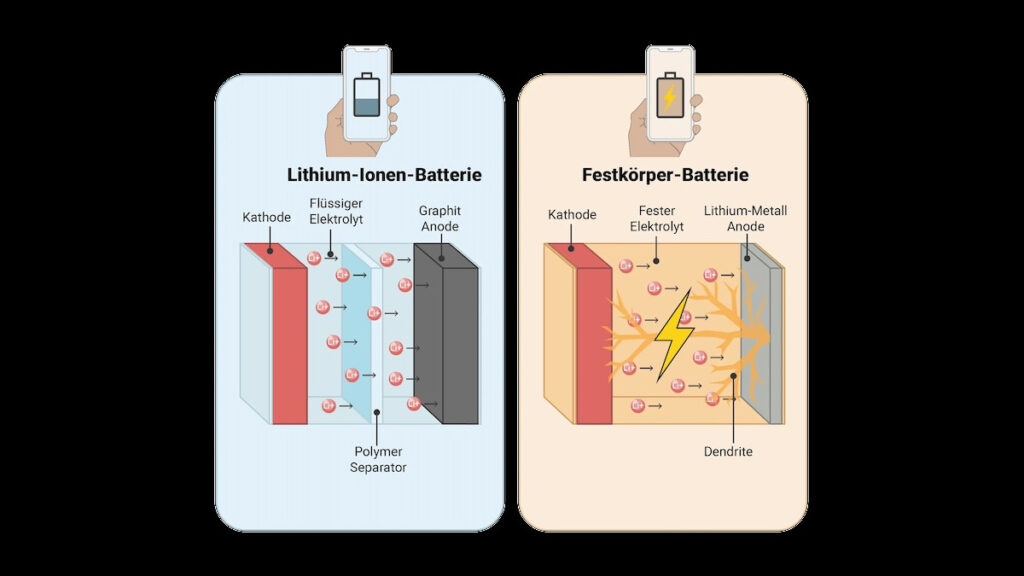
Solid-state batteries could revolutionize smartphones and electric cars. They promise more range, a longer service life and more safety. But tiny lithium needles, so-called dendrites, cause short circuits and have so far prevented a breakthrough. In a Nature study, a team from the Max Planck Institute has now, for the first time, deciphered why soft lithium can break through harder ceramics.
Every time a traditional smartphone is charged, billions of lithium ions move through the battery to store energy. However, future cell phones and electric vehicles could perform significantly better using solid-state batteries.
Cause short circuits: How dendrites destroy solid-state batteries from the inside
The technology promises longer-lasting devices, safer energy storage and, for electric cars, far greater ranges from a single charge. However, a persistent problem has so far prevented its widespread use on the mass market.
Because: Microscopically small structures, so-called dendrites, can destroy the battery from the inside. During the charging process, these needle-like branches grow from the lithium anode into the solid electrolyte.
As soon as they reach the opposite electrode, they trigger an internal short circuit and disable the battery. Researchers have long been puzzled as to how the soft metal can break through the much harder ceramic material.
Why soft lithium can break a hard ceramic
A team from the Max Planck Institute for Sustainable Materials has now decoded this mechanism in detail. The researchers developed a comprehensive experimental approach for their study. The materials were analyzed in vacuum and cryogenic temperatures to achieve precise results.
These special conditions prevented oxygen or moisture contamination during electron microscopy.
The scientists examined the lithium dendrites trapped in the ceramic electrolyte and did not detect any accumulations of lithium before the branching progressed. The results indicate a build-up of pressure inside the dendrites themselves. Yuwei Zhang, head of the research group, said in a statement:
Although the electrodes and the dendrites that form are made of lithium metal, which is soft as gummy bears, the dendrites are able to penetrate the hard, ceramic electrolyte. There are two hypotheses that try to explain this phenomenon: Either an internal tension builds up in the dendrites, which causes cracks in the solid electrolyte. Or electrons move along the grain boundaries in the electrolyte and promote the formation of lithium nuclei, which later combine with each other.
A calculated hydrostatic stress in the dendrites ultimately leads to a fracture of the solid electrolyte.
Three approaches to solid-state battery failure
The new understanding of this damage will enable science to research targeted countermeasures in the future. Potential solutions include increasing the crack resistance of the solid electrolytes in the cells. Alternatively, microscopic cavities could be inserted into the material to redirect the growth of dendrites, thereby reducing crack propagation.
In addition, protective coatings on the electrodes could limit the development of these defects from the outset. The researchers say their work underscores the importance of understanding how materials behave at a fundamental level when developing technologies for real-world use.
The detailed results of the investigations were published on April 22, 2026 in the journal Nature. Numerous experts were involved in the study and collectively compiled these new findings.
Also interesting: