


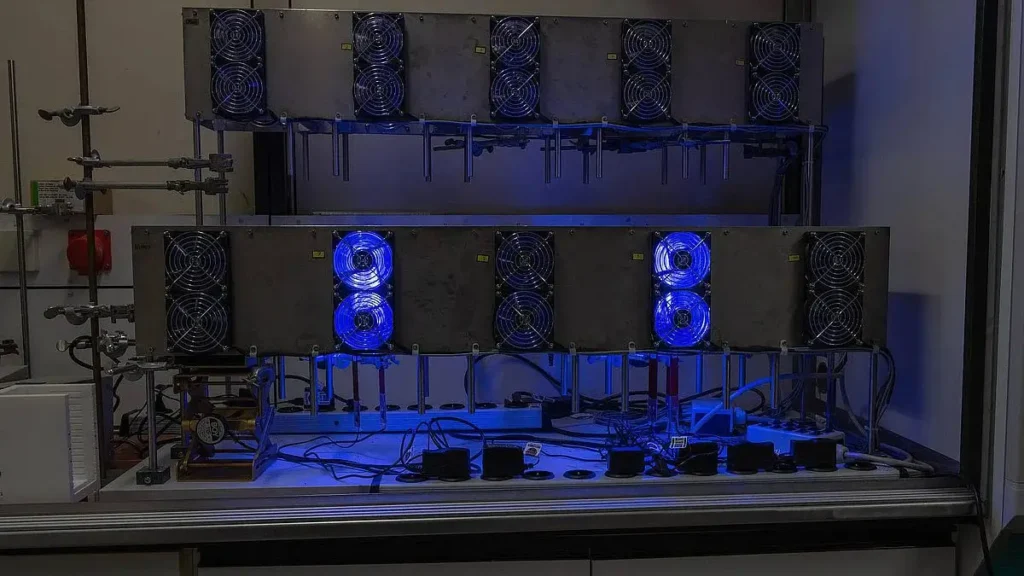
Researchers at Ulm University have developed a solar battery that can store energy for several days and output it in the form of hydrogen. The background is a newly developed polymer.
Researchers at the universities of Ulm and Jena have developed a new type of material that stores the energy of sunlight over several days and releases it as hydrogen when needed. Professor Sven Rau from the University of Ulm and Professor Ulrich S. Schubert from the University of Jena coordinated an interdisciplinary study.
The results recently appeared in the journal Nature Communications. The system works like a combination of solar cell and battery on a molecular level. To do this, the research team uses a water-soluble, redox-active copolymer as a medium for the temporary storage of electrons. These special macromolecules consist of different organic building blocks that form a stable framework.
The functional units within this structure give the material strong redox activity. The system captures the energy of sunlight and maintains this charged state stable for several days. The charging efficiency of the newly developed material is over 80 percent.
Solar battery delivers hydrogen at the push of a button – even in the dark
Anyone who adds an acid and a special catalyst releases the electrons stored in the polymer in a targeted manner. In this chemical process, the electrons combine with protons to form green hydrogen. This process achieves an efficiency of around 72 percent for on-demand extraction.
A decisive advantage for the flexibility of energy use is the independence from sunlight. Since the energy was previously stored in the polymer, hydrogen production can take place even in complete darkness if necessary. The system delivers the clean energy source exactly when industrial processes request it.
A pH switch allows the entire system to be easily reactivated for new charging and storage cycles. A change in acidity neutralizes the solution and prepares the material for re-exposure. The polymer-based redox reactions are completely reversible and allow multiple runs.
Green hydrogen for the steel industry
What is particularly practical for technical applications is that the polymer does not have to be laboriously isolated for this reset. The current state of the molecular battery can also be read directly with the naked eye. When discharging in the presence of the acid, a clear color change occurs from violet to yellow. As soon as light reloads the material, the purple color returns.
Demand-based hydrogen development could support energy-intensive processes such as climate-neutral steel production in the future. Such industries rely on an absolutely reliable and flexible supply of green hydrogen. The research results thus open up new perspectives for cost-effective and scalable solar storage technologies.
The project represents an important building block on the path to a sustainable, chemically based energy industry. The work was carried out as part of the joint special research center TRR/SFB 234 “CataLight” of the universities of Ulm and Jena. The group is dedicated to innovative methods of photocatalysis for the production of energy sources from sunlight.
Funding for research until 2026
The German Research Foundation is funding the CataLight network with over twelve million euros until 2026. A central research focus is on light-driven molecular catalysts in hierarchically structured materials. This describes the precise structure of the storage medium from the molecular level to the visible material structure.
In addition to the universities of Ulm and Jena, the project partners also include the universities in Vienna and Mainz. The Max Planck Institute for Polymer Research in Mainz and the Leibniz Institute for Photonic Technologies in Jena are also involved. In this network, the researchers investigate complex syntheses and the mechanistic background of energy conversion.
Combining this expertise from macromolecular chemistry and photocatalysis creates new approaches for the energy industry. The results of the study highlight the potential to efficiently capture sunlight and chemically preserve it for the future.
Also interesting: