


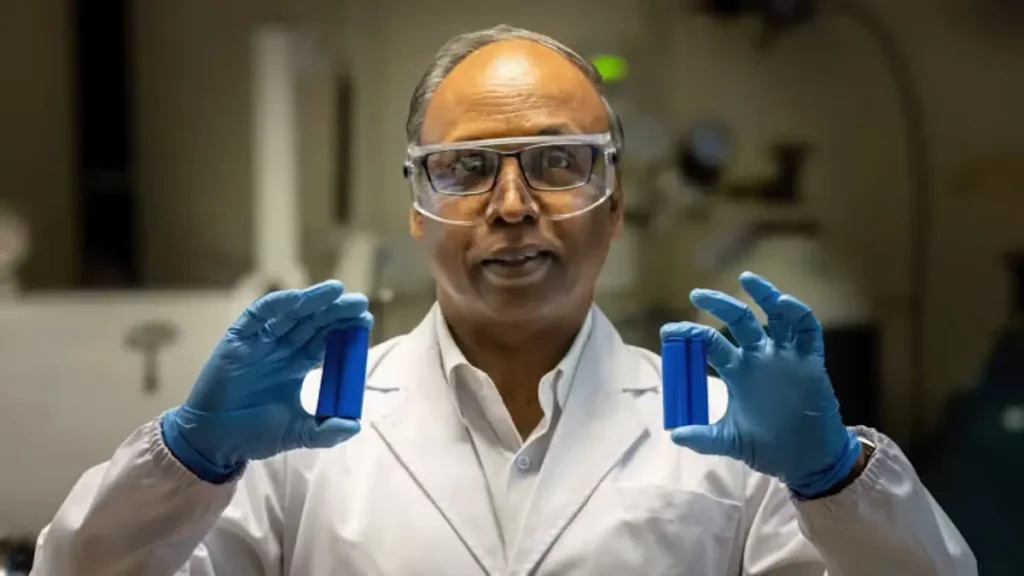
Lithium batteries are considered the standard for energy storage. However, they are relatively expensive, extremely dangerous and geopolitically sensitive. A team of researchers from Singapore has now developed a sodium-ion battery that is intended to solve all three problems. The cells can withstand more than 30,000 charging cycles and could make home storage and data centers significantly safer. What the technology can do, where it reaches its limits and when it will come onto the market.
The production of electricity by solar cells or wind turbines varies depending on weather conditions. High-performance industrial storage systems are therefore required to ensure a reliable energy supply. However, conventional lithium batteries pose risks as they can easily catch fire if damaged. In addition, the global supply chain is heavily dependent on individual countries that control processing.
A research team led by Palani Balaya from the National University of Singapore is therefore looking for alternatives and is relying on sodium. The element is chemically similar to lithium, but is abundant worldwide and significantly cheaper. A newly developed sodium-ion cell is intended to massively reduce the risk of uncontrolled overheating. It would be particularly suitable for stationary energy storage in residential buildings.
30,000 charging cycles: What tests of the sodium battery show
As an electrolyte, the researchers use the solvent Glyme with a high flash point, which is significantly less susceptible to fire than the highly flammable organic liquid electrolytes used in traditional lithium-ion batteries.
In addition, the team developed a novel positive electrode with an additive of zinc. This modification is intended to improve capacity and enable fast charging and discharging. In tests, the battery withstood more than 30,000 charging cycles while retaining a remaining capacity of 50 percent.
One disadvantage is that sodium batteries are slightly larger in relation to their weight. However, for stationary use in residential buildings, this factor would usually be of secondary importance. Many data center operators are also hesitant to use lithium storage because of potential fire risks. The supposedly safer sodium variant is likely to allay these concerns and accelerate the energy transition.
When will the sodium battery come onto the market?
When it was ready for the market, the scientist founded the spin-off company SgNaPlus. The prototypes currently achieve an energy density of 90 to 100 watt hours per kilogram. The company’s goal is to increase this to at least 125 to 150 watt hours per kilogram. This would mean that sodium technology would slightly exceed the capacity of robust lithium-ion batteries.
Palani Balaya emphasizes the importance of a crisis-proof supply chain for the global energy transition. The new system should therefore aim to minimize or even completely remove components that are either geographically restricted or potentially toxic. The researcher sees the technology as a viable basis for the global market:
We want to make a safer battery that is suitable for industrial use, but it also needs to be sustainable and not have supply chain issues. After all, there is no point in replacing a material that poses geopolitical challenges with another material with similar problems in another location.
Also interesting: