We’re introducing a skill-based approach to MuleSoft Vibes, designed to streamline the Agentic SDLC. By modularizing development tasks, this approach significantly enhances output quality and speed, driving substantial productivity gains.
Skills are reusable instruction sets that an Agentic AI coding assistant like MuleSoft Vibes, Cursor, Claude Code etc activate only when they apply to your task. The activation model is incremental; Skills load as needed, which leaves more context available for other work. When your request matches a skill’s description, the agentic AI coding assistant loads the instructions and runs them for that task.
MuleSoft Vibes Skills in any agentic coding assistant with the LLM of your choice
Modern engineering teams no longer rely on a single development environment; their developers use different Agentic coding assistants, with popular choices including Claude Code, Windsurf, GitHub Copilot, Codex, and Cursor. To maintain consistency across this landscape, Skills provide a portable framework that works with all such tools. This portability means that the exact same skill-based workflows prepackaged with MuleSoft Vibes in Anypoint Code Builder (ACB) also work seamlessly in any Agentic Coding assistant and LLM of your choice.
The skills-based approach recognizes a fundamental shift in the industry: every developer on your team is going to be using AI-assisted development. Whether they prefer Vibes in Anypoint Code Builder, Claude Code in the terminal, Windsurf in a desktop IDE, or an emerging tool that doesn’t exist yet, the underlying challenge remains the same: ensuring organizational standards are not lost in translation and Mule best practices are leveraged. Without this MuleSoft Vibes skills-based framework, an agentic coding assistant might only understand default MuleSoft patterns, potentially generating code that is technically functional but organizationally incorrect.
By adopting this portable framework, you ensure that your organization’s standards and our best practices for Mule development will travel directly into any AI-assisted environment. To begin implementing this portable skill based approach across your teams, review our documentation.
Core dev journeys (covered as part of Skills) lay the foundation for spec-driven development
The skills cover core developer journeys that define the integration lifecycle:
- Design your integration: This journey focuses on the critical pre-coding phase. MuleSoft Vibes helps identify necessary connectors, target systems, and authentication providers to ensure a comprehensive technical design is established before a single line of code is written
- Build a new project: Accelerate development by scaffolding projects directly from Anypoint Exchange templates. Vibes can generate complex flow logic, secure sensitive credentials, and automatically document flows to maintain high standards from day one
- Update an existing project: Maintenance and iteration become seamless as Vibes assists in modifying existing flows, DataWeave transformations, and connector configurations. This allows developers to refine runtime settings and logic without the need to start from scratch.
While MuleSoft provides these robust prepackaged capabilities to jumpstart productivity, the system is designed for extensibility. Customers can define their own custom skills to encode their unique organizational DNA across two distinct scopes:
- Global skills function as the enforcers of universal organizational policies
- Workspace skills are tailored to project-specific patterns and local requirements
Leverage custom skills today
By leveraging these custom Skills, organizations ensure that agentic AI coding assistants internalize their specific engineering culture, enforcing standards at the exact moment of creation rather than relying on retrospective reviews.
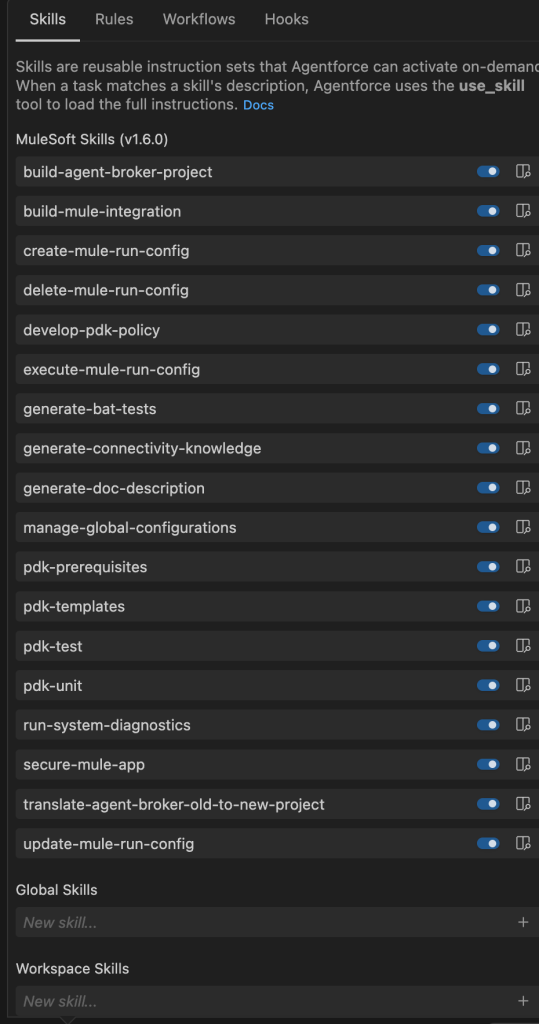
To explore the full breadth of these capabilities, review our Skills Catalog for more information.