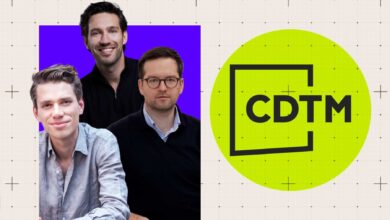
The news was huge: On January 9th, US VC Andreessen Horowitz (A16z) announced that it had raised $15 billion. 15 billion dollars – this sum is unheard of. A16z itself writes that this corresponds to around 25 percent of what was raised in the entire American venture capital market in 2025. The sum will be distributed in varying sizes across five growth and venture funds.
In total, the firm now has $90 billion in assets under management. A16z has outperformed Sequoia Capital ($56 billion) and left General Catalyst ($43 billion) far behind. Lightspeed had raised nine billion in 2025, Thiel’s Founders Fund almost five billion – peanuts on the other hand. Only SoftBank plays in the same league; it broke all records with its 100 billion “Vision Fund” in 2017.
If Marc Andressen and Ben Horowitz weren’t already among the most influential people in Silicon Valley and the tech scene, they definitely are now with this firepower.
The content is one thing, the tone of the message is another
So while the news of the new giant fund hit with a loud bang, there was an undertone of the announcement that resonated quietly: founding partner Ben Horowitz wrote an open letter, the tone of which can be perceived as at least unusual for a press release.
He writes: “In this time of great technological opportunity, it is essential to humanity that America wins.” And further: “If America does not win technologically, it will lose economically, militarily, geopolitically and culturally. And the whole world will lose too.”
The USA has always given people the chance to build something. The investor would also see himself in this tradition: they want to enable people, i.e. founders, to create something that is bigger than themselves.

Namely in the USA: “As the American market leader in venture capital, the fate of new technologies in the United States rests on our shoulders,” writes the investor. “Our mission is to ensure America owns the next 100 years of technology.” This would begin with the USA having to secure “key technologies of the future”, AI and crypto. The application of these technologies in biology, health, education and entertainment continues. “And it culminates in the American government using these technologies to defend and advance American interests.”
Horowitz also writes that he is particularly interested in winning against rival China in the struggle for global tech supremacy.
Proximity to the Trump administration is not new
They are pithy words and it all sounds very political – certainly for a private capital investor. On the other hand, we have long known about the Trump administration’s closeness to the tech bros from Silicon Valley. Those who stood clapping in the front row at Donald Trump’s second inauguration. And those – mostly the same ones – who were invited to dinner at the White House.
And in the specific case of A16z: There are demonstrably some connections between the VC and the Trump administration. Marc Andreessen and Ben Horowitz donated to both Trump’s campaigns around 2024 (although Horowitz also donated to Kamala Harris a short time later). Additionally, two former A16z partners serve in the Trump administration: Scott Kupor is director of the United States Office of Personnel Management, while Sriram Krishnan now serves as Senior White House Policy Advisor on Artificial Intelligence.
And if you look back a little, you could also see an ideological proximity to the Trump camp in certain actions of Silicon Valley investors. For example, Marc Andressen and Peter Thiel have repeatedly invested together (e.g. in Meta, Stripe and Linkedin) – including in the investment company Narya Capital, founded in 2019 by current Vice President JD Vance (ex-employee of Peter Thiel).
And yet the announcement makes you sit up and take notice. So is this the new tone in the US tech scene? Have all the masks fallen, is Silicon Valley now MAGA land?
As a USA correspondent, Julian Heißler has reported for a long time on the tech industry there and has observed how the leaders in this segment are gaining more and more influence on politics. His book was published last fall: “America’s oligarchs. Money, power and the collapse of democracy. How Elon Musk, Jeff Bezos and big business are promoting division in the USA.” We spoke to him about the A16z letter.
Julian, you were the USA correspondent for Wirtschaftswoche for more than seven years and know Silicon Valley and the players there very well. Did the tone of this letter surprise you?
Julian Heissler: No, not actually. That’s exactly the line of argument that’s working right now: America should win everywhere. And the fact that Andreessen Horowitz in particular fits in well with the picture.
Like that? In your book “America’s Oligarchs” you describe that Marc Andreessen has been close to the libertarian thinking of the Peter Thiel circle for years. But has it always been lived so openly? Or is the Valley currently changing and are certain things becoming more sayable?
Julian Heissler: Seems like it, yes. Only Peter Thiel showed open support for the Trump and America First course in the first election in 2016. The others may have thought it, but they didn’t say it. Now more and more tech entrepreneurs are positioning themselves publicly. In my opinion, this is because the social climate is such that supporting Trump is considered acceptable or at least there is no need to fear any disadvantages as a result.