


Fuel cells are considered a key technology for the energy transition. But expensive platinum makes them too expensive for the mass market. A team of researchers from Japan has now used AI to identify promising replacement materials and in the process refuted a decades-old chemical dogma. Their finding: double-atom catalysts work according to completely different rules than previously assumed.
Researchers at Tohoku University have analyzed more than 200 double-atom catalysts in a systematic study to unravel the hidden mechanisms of the oxygen reduction reaction. Their goal: more powerful and cheaper fuel cells.
The team used extensive data from a digital platform called Digital Catalysis. Using modern theoretical simulations and machine learning, a prediction model initially filtered out 42 variants with a specific dissociation mechanism from a total of 216 systems. In the end, the prediction model identified 14 potential double-atom catalysts with high predicted activity.
How the new catalytic converters are replacing the old Vulkan model
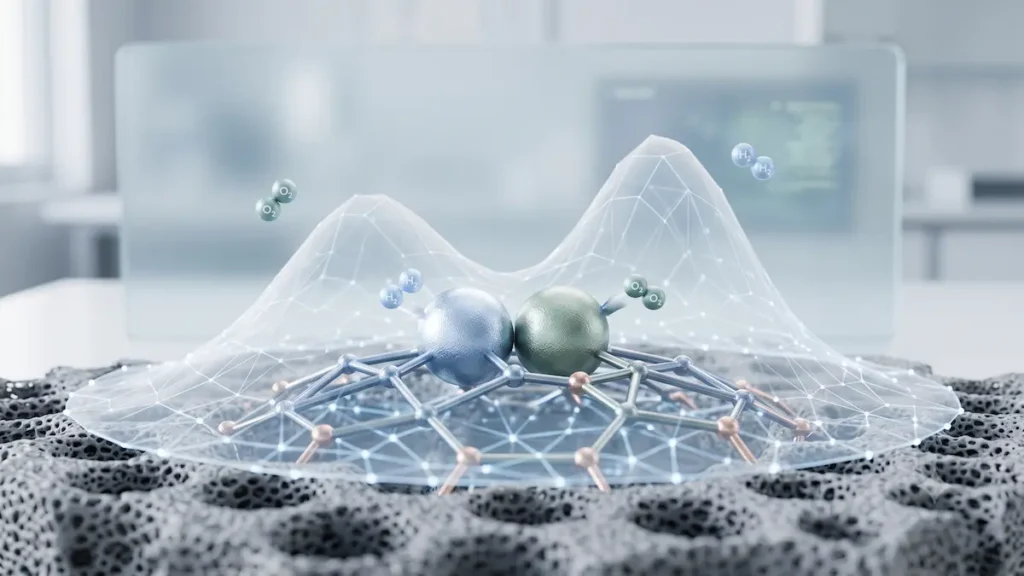
The most important key message of the study breaks with a long-standing dogma in chemistry. Until now, researchers have incorrectly described the activity of such systems using the traditional single-peak volcano model, which is known from single-atom catalysts. However, the new work shows that the principle of the so-called dual Sabatier optimala applies to double systems.
Because the rate-determining step in the process changes dynamically, the catalytic activity is divided into two separate, optimal tip regions. This difference arises because a dissociation mechanism primarily regulates the reactions.
Efficient fuel cells through smart double-atom catalysts
Individual atoms, on the other hand, usually follow an association mechanism. The newly proven principle proves to be universally applicable. It applies to a variety of systems that contain transition metals, metal-like elements or even non-metal atoms, and thus offers a completely new basis for material design. Study author Hao Li emphasized the practical implications of these new design rules:
For a long time, researchers assumed that double-atom catalysts followed the same activity rules as single-atom catalysts. Our work shows that completely different mechanisms can arise when two atoms work together, opening new possibilities for the design of highly efficient materials for clean energy technologies.
In the future, this AI-supported approach will be expanded to even more complex, multimetallic catalyst systems. The research team’s long-term vision includes building a fully autonomous digital framework on the platform that combines learning software agents and electrochemical simulations.
By rapidly filtering optimal structures, the discovery time of new materials can be dramatically reduced to replace expensive platinum and accelerate the transition to green energy.
Also interesting: