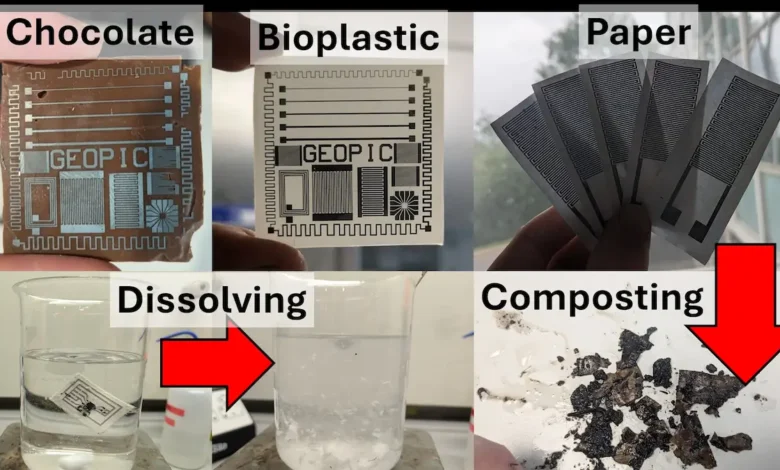
Researchers at the University of Glasgow have developed compostable circuits by printing conductor tracks on chocolate and other biodegradable materials.
In 2024, 62 million tons of electronic waste were disposed of worldwide. The European Union so far recycles less than 17 percent of this waste. A team of researchers at the University of Glasgow is now presenting a solution to this growing problem using biodegradable circuits. As the scientists explain in the journal Communications Materials, they use a special process called “growth and transfer additive manufacturing process”.
Using this method, researchers were able to print conductive metal traces onto environmentally friendly surfaces such as paper or bioplastics. The method eliminates the need for traditional circuit boards, which often end up in landfills and release harmful chemicals. The compostable circuits are said to have comparable performance to traditional circuit boards.
Compostable circuits: Zinc as an environmentally friendly alternative
The research team also used zinc instead of copper to ensure the electrical conductivity of the components. The metal traces are only five micrometers wide. The scientists see their work as a major step towards a circular economy for electronics. They emphasize that developers should design devices from the start for reuse or safe dismantling.
The organization UK Research and Innovation supports the responsible center for electronics with over six million pounds. These financial resources support the search for new ways to make industries more sustainable. The center is investigating complementary technologies such as the efficient processing and recycling of old devices.
After use, users could safely dispose of 99 percent of the materials via regular soil composting. Alternatively, regular vinegar will dissolve the circuits completely. Conventional printed circuit boards, on the other hand, often pollute the environment because their materials are difficult or expensive to recycle.
Conductor tracks on chocolate
A study by the researchers proves the ecological advantages of the new technology compared to standard circuit boards. The biodegradable components reduce CO2 emissions in this area by 79 percent. They also reduce resource consumption by 90 percent.
Professor Jeff Kettle highlights that the process accepts almost any substrate. The team even successfully applied the circuits to chocolate for demonstration purposes. The boards have already proven themselves in practical tests in temperature sensors, LED counters and tactile sensors.
The performance of the materials remains stable for more than a year under normal environmental conditions. The team is now exploring other areas of application such as biosensors or malleable electronic components. Compostable circuits could significantly reduce the environmental footprint of future devices.
Also interesting:

Interest rate hit at NIBC!
Open yours now free NIBC daily money and receive up to 2.75 percent interest for your money – with daily availability!
Secure interest now
Requirements apply, advertisement