


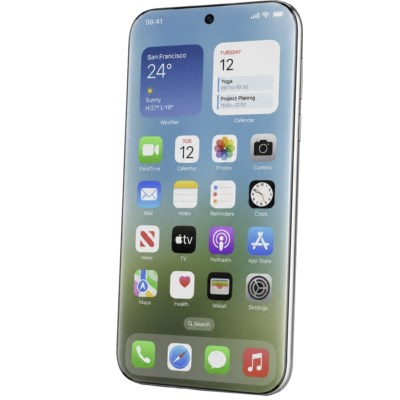


Not just “curved”
It’s not just a classic, strongly curved display, as seen on some Android smartphones. Instead, a much more subtle solution is planned, in which the glass shape, light refraction and light-conducting structures make the visible edge of the iPhone almost disappear. What we know about the optical effects of liquid glass from iOS and macOS continues in the design of the housing – in the truest sense of the word as a flowing glass surface. However, that doesn’t mean doing without edges; there’s no talk of a “glass block iPhone”.
Samsung is contributing innovative displays
A year ago, Bloomberg reported on a curved iPhone made largely of glass with no visible display cutouts. Apple is implementing what was already seen as wishful thinking in the early days of the iPhone. In addition, according to recent reports, Apple is said to be using an OLED approach called COE (“Color Filter on Encapsulation”) developed by Samsung. This eliminates the classic polarization layer of the OLED panel, which enables a lower overall height with higher light intensity – and reduces energy requirements.
Name not confirmed, but possible
It has not yet been confirmed by other sources that Apple is officially using the product name “Liquid Glass” for hardware. However, that would be quite consistent and would emphasize even more the need to develop hardware and software from a single source. For this reason, the information sounds quite credible and realistic. It will at least be very interesting to see how Apple celebrates the 20th anniversary of the iPhone in just under a year and a half.