


Every enterprise has the data. The gap is in turning it into a decision an AI agent can make safely without acting on stale records, PII-restricted accounts, or signals that haven’t passed a quality check. That’s the fundamental challenge solved by a governed, orchestrated approach to the ecosystem.
This post walks through how a governed orchestration approach works across three MCP servers: PostHog (signals), Informatica (metadata), etc Microsoft (identity), to transform raw product signals into a governed, auditable sales decision.
The MCP ecosystem now spans thousands of specialized MCP servers across the community’s authoritative index. MuleSoft Agent Registry provides a curated, enterprise-ready path to these capabilities, covering analytics, billing, security, and more. While this growth means unprecedented access to enterprise data sources, it also introduces a critical challenge: How do you connect multiple MCP servers together in a way that is secure, governed, and produces output that you actually trust?
Implementing Informatica MCP
The answer is an integrated orchestration pattern that combines identity resolution, domain expertise, and centralized governance to unlock intelligent automation that evolves beyond the reach of isolated, single-system agents. This approach represents a more integrated way for MuleSoft and Informatica to work in tandem. By incorporating the Informatica MCPAI agents can better align with governed metadata, leading to more reliable decisions based on trusted, high-quality data.
What an expanding MCP ecosystem means for your AI agents
While an MCP server often acts as a specialized gateway to a specific system, it can also represent a broader boundary of context. But when you orchestrate multiple MCP servers together, you create workflows that reason across organizational boundaries.
With this pattern, your agent can now answer questions like “Which high-value users are showing signs of churn based on product usage and support ticket sentiment?” or “Is this suspicious login attempt from a legitimate employee who is traveling, or should we lock the account immediately?”
A single-server approach provides agents with data access, while a multi-server approach unlocks true contextual intelligence. Multi-server orchestration achieves this by transforming fragmented data into actionable insights. This allows agents to correlate information across systems, apply human context through identity resolution, and execute decisions under enterprise governance policies.
From fragmented tools to governed intelligence
The transition from standalone AI tools to integrated enterprise assistants requires a move toward structured orchestration. The following scenario illustrates this orchestration pattern in practice, showing how these integrated layers turn fragmented signals into secure, actionable intelligence while maintaining strict enterprise safeguards.
Use case: Intelligent Sales Assistant
The diagram below depicts an intelligent sales assistant built using three MCP servers within an agent network. The agent is designed to automate the manual, time-consuming research sales teams conduct when evaluating qualified leads by orchestrating data across multiple systems.
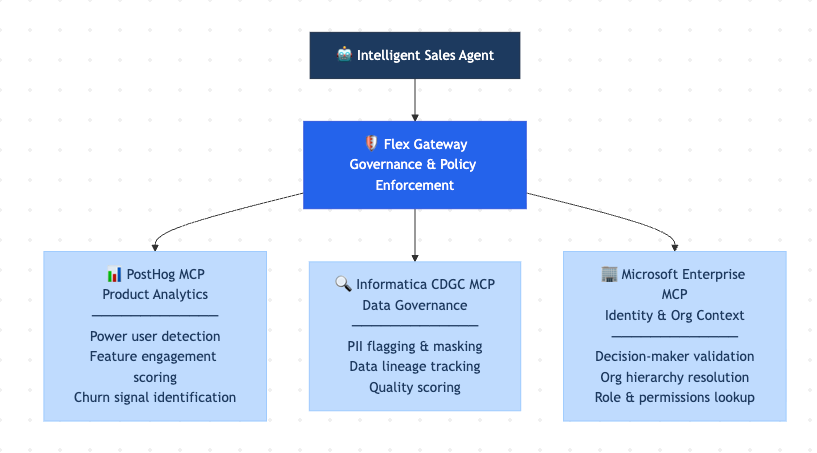
- PostHog: Used for product analytics to track real user activity and identify power users. For example, the system can detect high engagement, such as numerous dashboard creations and team invites, which signals potential for expansion
- Informatica CDGC: Acts as a data governance and trust layer providing metadata, flagging PII, and displaying data lineage to ensure data quality and reliability
- Microsoft MCP: Provides organizational context, such as identifying and validating decision-makers within a company
- Flex Gateway sits across all three server connections, enforcing security and compliance policies without requiring custom middleware for each integration
What does this mean for your enterprise?
The expanding MCP ecosystem unlocks three fundamental shifts in how enterprises build automation.
From data access to contextual intelligence
The expanding availability of specialized servers scales the potential for sophisticated, cross-system orchestration. The growth of a curated registry allows agents to mature beyond simple information retrieval within a single silo. By synthesizing specialized domain expertise with organizational context and centralized governance, agents can reason across boundaries to deliver decisions that reflect the interconnected reality of how a business actually operates.
From weeks of integration to hours of evaluation
Traditional enterprise automation requires custom integration code, API plumbing, and lengthy security reviews for each data source. MCP standardizes connections, and Flex Gateway provides platform-level governance. Developers can now evaluate new automation opportunities in hours instead of waiting weeks for approval.
From shadow IT to governed innovation
Traditional integration approaches often force a choice between speed and security, developers need to move fast, while platform teams need to maintain control. Multi-server MCP orchestration provides a “paved path” where both goals align: developers can experiment with new automation using standardized MCP connections, while platform teams maintain visibility and enforce policies through Flex Gateway. This eliminates friction and accelerates innovation within enterprise guardrails.
Unlock intelligent automation with multi-server MCP orchestration
As the MCP ecosystem continues to expand, the question is not whether your enterprise will adopt multi-server orchestration, but how quickly you can leverage it to unlock competitive advantage.
To learn more, explore the growing ecosystem of public MCP servers in the MuleSoft Agent Registry and see how Flex Gateway and Informatica MCP servers can provide the governance and data trust layer your enterprise needs to deploy AI agents with confidence.
Additional resources: