


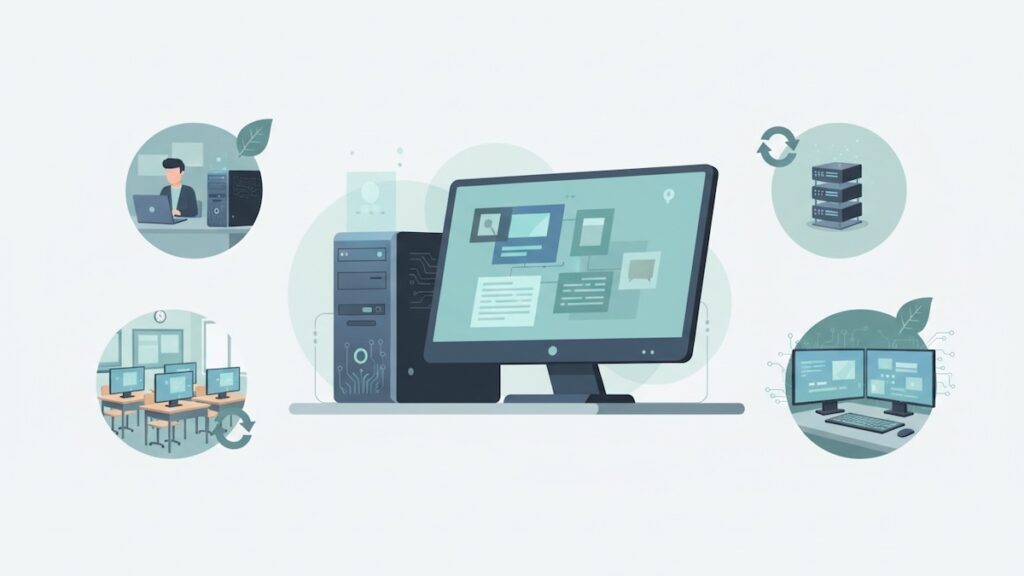
Hardware prices have been rising steadily for years, while many companies and private individuals are looking for powerful computer solutions. This is exactly where an interesting gap arises in the market: professionally prepared devices often offer identical performance like new – only at a fraction of the price. Anyone who decides to order a tested refurbished PC often ends up with former business hardware that is being refurbished after three to five years of leasing. Originally designed for long-term office use, these computers feature high-quality components and still have years of potential useful life ahead of them.
What makes refurbished devices particularly technically reliable?
The difference between a used PC from the flea market and a professionally refurbished system could hardly be greater. While private sellers usually pass on their old hardware without a guarantee and without thorough testing, refurbished devices go through a multi-stage control process. Not only are obvious defects repaired, but components susceptible to wear such as fans, thermal paste or memory modules are also systematically checked and replaced if necessary. Data carriers are securely deleted according to military standards, so that no residue from previous users remains. The systems also receive current operating systems – freshly installed and ready for use.
Things become particularly interesting when it comes to current software requirements. With Windows 11, Microsoft introduced hardware requirements that exclude many older systems – such as TPM 2.0 or certain CPU generations. Anyone who can buy a modern Windows 11 PC refurbished today is guaranteed to receive compatible hardware that is also ready for future updates. The dealers specifically sort out models that meet all technical requirements, saving buyers the hassle of research and compatibility problems.
Sustainability as an underestimated added value
Beyond the financial advantages, the ecological aspect is playing an increasingly important role. The production of a new computer causes considerable environmental impact: from the mining of rare earths to energy-intensive manufacturing processes and long transport routes. Various studies put the CO₂ footprint of a desktop PC at 200 to 400 kilograms during the manufacturing phase – that’s equivalent to several thousand kilometers of driving. The usage phase, on the other hand, only accounts for a smaller part of the overall environmental impact, provided the computer runs for several years.
By extending the life cycles of devices that have already been produced, this ecological backpack can be spread over significantly more years of use. Anyone who uses a refurbished PC for five more years not only avoids having to produce a new device, but also avoids having to dispose of it properly, which in turn ties up resources. Companies can also incorporate such decisions into their sustainability reports – a factor that becomes relevant as ESG requirements increase.
What you should actually pay attention to when buying
Not every refurbishment offer automatically delivers what it promises. The market has different quality levels, ranging from simple resale of barely cleaned devices to complex general overhauls with a spare parts guarantee. Reputable providers classify their goods transparently – for example according to their visual condition in categories such as “like new”, “very good” or “good”. These classifications mostly refer to Case condition and visible signs of use, not the technical functionality, which should be flawless throughout.
The guarantee provided is crucial. While private sales usually exclude any warranty, professional refurbishers offer a guarantee of at least twelve months – some even up to three years. This protection signals confidence in the quality of your processing and protects buyers from unexpected defects. In addition, detailed information about the hardware configuration should be available: processor model, RAM size, memory type and capacity, and existing connections. This is the only way to assess whether the system meets individual requirements.
Performance versus price – what is the optimal ratio?
The question of the best price-performance ratio cannot be answered in general terms, but depends on the intended use. For typical office work – word processing, email, web browsing, video conferencing – systems with sixth to eighth generation Core i5 processors are sufficient. These are available for under 300 euros and can handle standard tasks effortlessly. More demanding activities such as image editing, CAD applications or virtual machines benefit from more modern CPUs and at least 16 GB of RAM, which raises the price range to 400 to 600 euros.
The comparison becomes interesting with equivalent performance: a current new computer with a twelfth generation Core i7 and 16 GB of RAM can quickly cost over 800 euros. A refurbished system with a ninth or tenth generation Core i7 delivers for many applications practically identical results at around 60 percent lower acquisition costs. Technological progress in desktop processors has slowed significantly in recent years – the generational leaps are smaller than they were a decade ago. This means that older systems remain competitive for longer.
Application scenarios beyond the home office
Refurbished PCs are not only useful at home desks. Educational institutions are increasingly relying on refurbished hardware to stretch IT budgets and at the same time equip more students with digital work devices. If a school has to set up 50 workstations, the cost advantage over new material can quickly amount to five-digit amounts – money that can flow elsewhere into licenses, training or network infrastructure.
Even in software development, some teams consciously use older systems for testing purposes. If you want to ensure that applications run smoothly even on hardware that is not the latest, you need appropriate testing equipment. Refurbished PCs are ideal for this without the need for expensive new purchases. Even as dedicated media centers or home servers for data backups, decommissioned business PCs often provide years of reliable service – applications where raw performance is secondary, but stability and low acquisition costs are convincing.
Long-term prospects and upgradeability
An often overlooked advantage of professional desktop systems is their modularity. Unlike many consumer complete computers or even laptops, tower cases can be easily opened and equipped with additional components. RAM expansions are usually easy to do, hard drives or SSDs can be added or replaced, and even graphics cards can be retrofitted in many cases. This flexibility also extends the service life: instead of purchasing a completely new system after three years, targeted upgrades of individual components are often sufficient.
However, there are limits to upgradeability. The processor is typically permanently connected to the mainboard and replacing it is rarely economically viable. The chipset and socket used also set limits as to which CPUs are even compatible. If you plan from the start to expand the system later, you should make sure there are enough free RAM slots, additional drive slots and a power supply with reserve. This information can be obtained from reputable refurbishers – and anyone who invests here creates a basis for gradual modernization instead of abrupt complete replacements.