


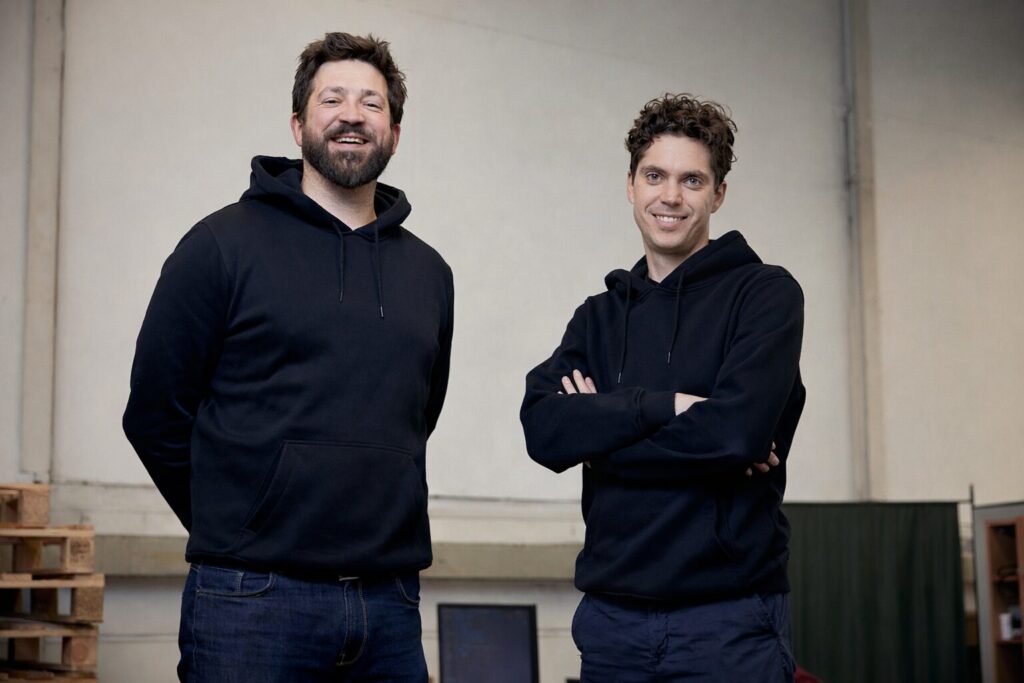
The German-Luxembourg robotics company R3 Robotics (formerly known as Circu Li-ion), founded in Luxembourg in 2021 by Antoine Welter and Xavier Kohll, relies on “AI-supported robotic platforms for the safe, efficient and industrial dismantling of electric vehicles at the end of their life cycle”.
HG Ventures, Suma Capital, Oetker Collection, European Innovation Council Fund (EIC Fund) as well as existing investors BonVenture, FlixFounders and EIT Urban Mobility recently invested 14 million euros in the company. The team also secured 6 million in public funding.
In an interview with deutsche-startups.de, founder Antoine Welter speaks in detail about the state of affairs at R3 Robotics.
How would you tell your grandmother R3 Robotics explain?
To this day, we humans extract thousands of tons of raw materials from our “Mother Earth” every day, although over time we have already manufactured many products whose materials could in many cases be reused. The problem is that the different substances that make up the products are not so easy to separate after use. It’s not worth doing the separation by hand, and it’s usually rather difficult to do it by machine. With our company, we are developing a solution to this problem: With our technology, we give robots “eyes, a brain and hands” to take this task off people’s hands and to enable clean and economically efficient material flows for recycling.
Was this your concept from the beginning?
Our concept has strategically expanded. We started under the name Circu Li-ion with a clear focus on dismantling lithium-ion batteries. This was the logical entry point at the time because batteries are the most critical components of, for example, electric vehicles and battery-powered tools and contain the largest amounts of valuable materials. However, with increasing market experience and after working with various industrial partners over several years, it became clear to us: the problem is significantly bigger. The entire automotive industry faces the same challenge – not just with batteries, but with all electrified components. E-motors contain rare earths, and strategic semiconductor materials are used in power electronics. That’s why we systematically expanded our scope and renamed ourselves R3 Robotics at the beginning of 2026. R3 stands for “Repair, Reuse, Recycle” – powered by industrial robotics. This is a logical evolution of our vision. We have transferred the automated dismantling of complex electrified systems – which is our core competency – to a broader field of application. The technology foundation has remained the same, but the addressable market has grown manifold.
How has R3 Robotics developed since it was founded?
After initial angel investments in 2021, we raised a total of 8.5 million euros in 2023 – including seed financing of 4.5 million euros and 4 million euros in funding, which included 2.5 million euros from the European Innovation Council (EIC). This was the decisive milestone for us to move our technological solution from research into real industrial implementation. In June 2023 we opened our dismantling facility in Karlsruhe, which received all full BImSchG and EfB certifications in February 2024. We therefore operate a fully certified recycling company in Germany. This was followed in June 2024 by the opening of our new R&D facility in Luxembourg in the presence of the local Minister of Economic Affairs. At the beginning of 2026, we were able to raise a further 20 million euros – consisting of 14 million euros Series A financing and EU funding of 6 million euros. This combination of private capital and public support underlines our strategic importance for European supply chains. Since our founding, our number of employees has grown steadily alongside the increasing number of batteries we process – we currently have 41 team members. Today we are massively scaling the team in the areas of engineering, artificial intelligence (AI), software and operations. With Peter Mohnen, the former CEO of KUKA, we have also brought one of the most renowned experts in industrial robotics onto our Advisory Board.
How did you get in touch with your investors?
The Series A financing was led by HG Ventures and Suma Capital. Both of these investment firms approached us. HG Ventures is the corporate venture capital arm of Indianapolis-based Heritage Group, a family-owned company with a long history in industrial materials and recycling. In addition to growth capital, this investor also brings with him an understanding of industrial processes and access to the US market, which is important for us. Suma Capital from Barcelona specializes in ecological transformation – circular economy and critical raw materials fit well into the portfolio. Additionally, Oetker Collection, the European Innovation Council Fund (EIC Fund) and our existing investors BONVENTURE, FlixFounders and EIT Urban Mobility also took part in the financing round. The contact came about partly through our network and partly through direct contact with investors. The topic of critical raw materials and European supply chains has become more relevant due to current guidelines such as the Critical Raw Materials Act and the EU Battery Regulation, which reinforces investor interest.
Please take a look back: What really went wrong in the last few years?
Most entrepreneurs start their business somewhat naively – otherwise they would probably never do it. That’s how it was with us too. If we had known beforehand how complex it was and how difficult it would be to get OEMs to pay for the first time, we probably wouldn’t have done it. In addition, we expected stronger growth in the market for electric vehicles, which unfortunately has not materialized so far. We had to adapt to this slowed ramp-up. It wasn’t easy, but that’s how you learn.
And where have you done everything right so far?
We have worked closely with OEMs from the beginning. This direct collaboration helped us understand the real needs and develop our technology accordingly. Without this input, we would have developed past the market and wasted a lot of time and resources.
What general tip would you give other founders?
Get started and then constantly adapt – depending on what you learn. Many are waiting for the perfect plan or technology. Reality doesn’t show you what really works until you start. Then it’s time to listen, learn, adapt and do it again and again.
Where it says R3 Robotics in a year?
Our facility in Karlsruhe runs on an industrial scale. We have several deployments with European partners, particularly in Germany and France. We have entered the US market and we have our first partnerships with American recyclers and OEMs. The most important positions in the team have been filled. And we will probably already be thinking about the next round of financing to further accelerate the expansion. Our ambition is clear: by 2030 we want to be the leading provider of automated dismantling of electrified systems in Europe and North America.
Startup jobs: Looking for a new challenge? In ours Job exchange You will find job advertisements from startups and companies.