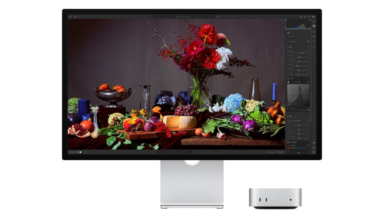
In June 2019, Apple presented the “Pro Display It remained unchanged in the product portfolio for a good six years until it disappeared from the online shop yesterday. The Pro Display XDR attracted attention – and not just positive ones.
 There was something special about the 32-inch screen. Apple already set accents on the exterior: the back was made of an aluminum block, which was given a maximum air permeability and eye-catching structure thanks to offset ball millings. Individually calibrated blue LEDs were used for the backlight to ensure the most accurate display possible. To ensure the highest possible brightness range, it was also divided into 576 zones that could shine at different levels of brightness. And for the first time, Apple offered an option with nano-textured glass – a matte surface without glued-on films.

Mechanical masterpiece (not included)
The stand for the large screen was similarly impressive: a mechanical double joint allows the height and tilt angle to be adjusted almost effortlessly. At a certain height you could flip a mechanical slider to turn the screen from landscape to portrait mode. This had its price: Apple wanted $1,000 for the stand – it was not included in the scope of delivery. The Pro Display
Some things remain
With the Studio Display XDR, Apple has retained or expanded some features of the Pro Display. Instead of 576 dimmable zones, the new XDR model can illuminate 2,304 areas separately. The maximum brightness increased from 1,600 nits to 2,000 nits, and the optional nano-texture surface only costs 300 euros extra. Apple gave up the 32-inch size and 6K resolution, but doubled the maximum refresh rate. New speakers, monitors and a FaceTime camera were added. The three-dimensional grid on the back is a thing of the past, as is the active fan cooling and the ability to rotate the screen. The height-adjustable stand is now included in the price of the XDR model – and if you purchase the cheaper new studio display (without XDR), you can also purchase the height-adjustable stand variant for an additional charge.

Goodbye, Pro, Hello Studio?
The Pro Display In advance, Apple had specifically addressed developers and creative people to find out their needs. The result was Mac Pro and Pro Display XDR. Since then, Apple has moved away from this segment again, rarely if ever updating the two. Instead, the company relies more on the Studio series, which offers slightly fewer professional features but also serves the needs of the average user – probably in the hope of achieving greater sales.
Apple displays
| Model | Pro Display XDR | Studio display | Studio Display (J427) | Studio Display XDR |
| Introduced | 2019 | 2022 | 2026 | 2026 |
| diagonal | 32 inches | 27 inches | 27 inches | 27 inches |
| resolution | 6K | 5K | 5K | 5K |
| frame rate | 60Hz | 60Hz | 60Hz | 120Hz |
| Max. brightness | 1,600 nits | 600 nits | 600 nits | 2,000 nits |
| Brightness zones | 576 | 1 | 1 | 2,304 |
| Color range | P3 | P3 | P3 | P3 |
| Speakers | no | 6 | 6 | >6? |
| Connection | Thunderbolt 3 | Thunderbolt 3 | Thunderbolt 5 | Thunderbolt 5 |
| Exits | 3xUSB-C | 3xUSB-C | TB 5, 2xUSB-C | TB 5, 2xUSB-C |
| Speakers | 0 | 6 | 6 | 6 |
| Microphones | 0 | 3 | 3 | 3 |
| camera | – | 12 MPixels | 12 MPixels | 12 MPixels |
| Height adjustable | (opt.) | no | no* | Yes |
| Tilt adjustable | (opt.) | no* | Yes | Yes |
| Rotatable | (opt.) | no | no | no |
* optional for an additional charge.