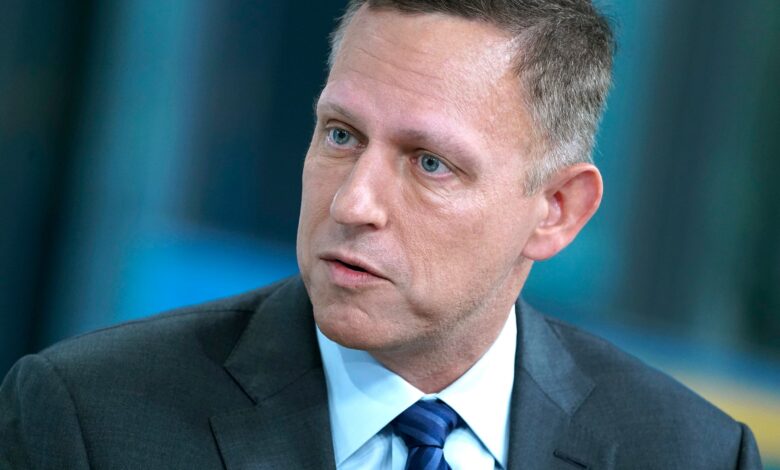
Investor Peter Thiel is selling part of his Palantir shares – causing unrest among shareholders.

Peter Thiel has often proven his sure hand for investments and start-ups. The 58-year-old tech entrepreneur sensed the potential at Meta, PayPal and Palantir and made himself a multi-billionaire with this extraordinary hit rate.
The investor most recently demonstrated his exceptional instinct in November 2025 with the complete sale of his Nvidia shares – the stock has not reached the level it was back then to this day. And if that instinct hasn’t left him by now, Palantir shareholders may now have to worry. There are a lot of them in Germany: According to a survey by Gründerszene, Palantir was one of the 15 most popular stocks among German investors last year.
Thiel sells two million shares of Palantir
Because it is precisely this company that he co-founded that Thiel is now leaving again – even if only partially. On Monday, Thiel filed an application with the U.S. Securities and Exchange Commission announcing the planned sale of two million Palantir shares for an estimated market value of about $280 million. That corresponds to a price of around $140 per share.
Technically speaking, this is no surprise: the sale is part of a trading plan agreed in November 2025 that allows insiders to sell shares under predetermined conditions without being exposed to accusations of insider trading.
What is reassuring for normal investors is that even Peter Thiel is not an investment god. There were significantly better times to sell in the last six months. Since Palantir shares hit an all-time high of $207.52 in November 2025, they have fallen by around 30 percent. So Thiel isn’t selling at the high – he’s selling after a significant pullback, at a price of around $140 per share. A price at which it may already be undervalued: Analysts see the average price target at $190, a good 30 percent above the current level.
The majority opinion of the professionals is: Palantir is cheaply valued. In addition, the current environment tends to play into the company’s business model: The company specializes in AI-supported analysis tools for military and civilian applications – data evaluation for secret services, armed forces, security authorities.
Since the beginning of the year, Palantir shares have fallen by more than 18 percent
Uncertain geopolitical situations and growing terrorist threats are structurally good news for Palantir. Both have become more acute following the outbreak of the Iran war this week. If there’s a moment when demand for what Palantir sells increases, this is it. This was also evident on Tuesday, when the share showed relative strength in a strongly negative environment and was quite stable in the afternoon.
And the numbers confirm that. The fourth quarter of 2025 was strong: $1.4 billion in sales, up 70 percent year-on-year, numbers that were above expectations. Adjusted earnings per share were $0.25, beating forecasts. The company delivers – operationally. Since the beginning of the year, Palantir shares are down more than 18 percent, after a price increase of over 135 percent in 2025.
The high volatility is no coincidence: Palantir is not valued by investors like an ordinary technology company – it is considered a bet on the future of government AI infrastructure. Such stocks react to moods, to general political weather, to the ups and downs of risk appetite.
Why exactly now is unclear
What concerns investors is less the sale itself than the pattern. Thiel has sold Palantir shares before – the largest tranche to date in autumn 2024 was worth more than a billion dollars. Even after the current sale, he remains the largest individual shareholder with around three percent of the shares. The oldest shares that he is now selling date back to 2009 – five years after the company was founded, eleven years before the IPO. At what cost can only be guessed at. The winnings are extraordinary in every scenario.
However, the question remains that Thiel does not answer and that the market will not ignore: Why now? Is the investor restructuring his portfolio as planned – or is he seeing something that the analysts with their price targets of $190 don’t see? At Nvidia, Thiel timed the exit better than almost anyone else. That’s not proof of anything. But it’s also not a coincidence that should be ignored.
Palantir shareholders should therefore pay closer attention in the next few days. Not because a planned share sale by a founder is necessarily a warning signal. But because Thiel has proven in the past that he knows when it’s time to buy. And for sale.
This article was written for the WELT and Economic Competence Center Business Insider created.
Michael Höfling writes for WELT about real estate, economic policy and gold. Together with Michael Fabricius, he is responsible for the real estate newsletter “Question of Location”, which you can subscribe to here.