


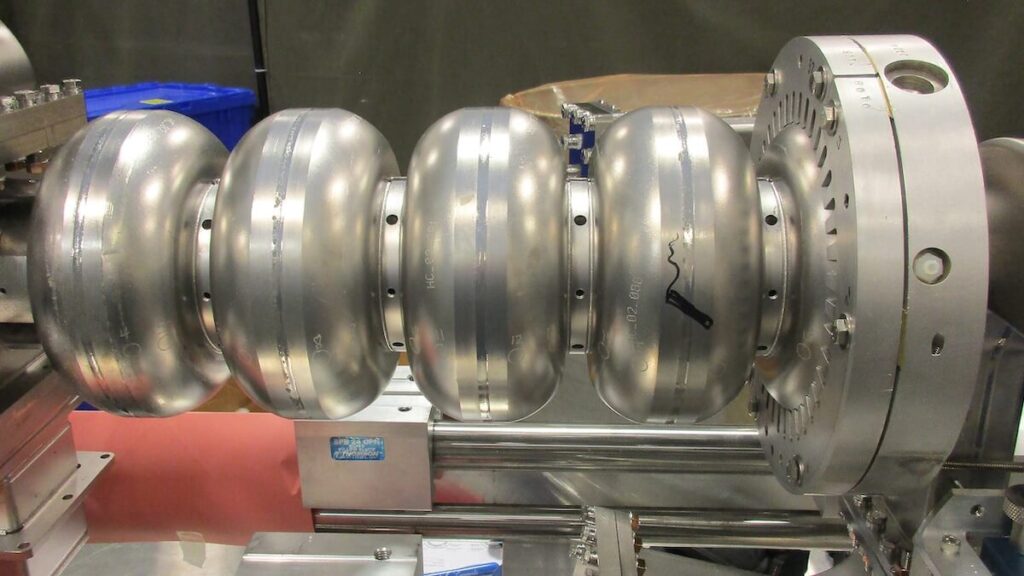
A research institute in the USA is working on a new method in which particle accelerators greatly reduce the radiation from highly radioactive nuclear waste. In the long term, the project could shorten the storage times of nuclear waste to a few hundred years.
Highly radioactive nuclear waste is created primarily during the operation of nuclear power plants when the fuel elements used have given up their energy and can therefore no longer be used. Despite the withdrawal of individual countries, nuclear power still plays an important role worldwide.
In many countries it is considered a reliable source of low-emission electricity and contributes a significant proportion to global energy supply. In 2024 alone, around 2.76 petawatt hours of electricity were generated worldwide through nuclear power; in 2020 it was around 2.54 petawatt hours. For comparison: Germany’s gross electricity consumption in 2024 was around 528 terawatt hours, i.e. 0.528 petawatt hours.
Nuclear waste is considered one of the biggest unsolved environmental problems of our time. Because highly radioactive waste remains dangerous for tens of thousands of years. Researchers at the Jefferson Lab in the USA are now working on behalf of the Department of Energy on a new technology that is intended to greatly reduce the radiation from highly radioactive nuclear waste.
Particle accelerator is intended to render nuclear waste harmless more quickly
A typical modern light water reactor produces around 20 tons of highly radioactive waste in the form of spent fuel per year. In addition, other low- or medium-level radioactive waste is generated.
Researchers at Jefferson Lab are currently working on a way to change how we deal with this waste. To do this, they received funding of $8.17 million from the Nuclear Energy Waste Transmutation Optimized Now (NEWTON) program.
With the help of this funding, they will develop a technology over the next 30 years to process all of the US nuclear waste. Particle accelerators that can significantly reduce radioactive radiation will be used. The researchers speak of up to 99 percent.
“Building on our own successes in developing state-of-the-art accelerator technologies for scientific discoveries, we are convinced that we can make a valuable contribution with our decades of experience,” explains Rongli Geng, one of the main people responsible for the funding project and head of the SRF Science & Technology department in the accelerator operations, research and development department at Jefferson Lab.
Transmutation is intended to make nuclear waste less harmful
The researchers are working on further developing their existing systems. The aim is to develop an economically viable process that makes the transmutation of nuclear waste profitable.
The aim is to convert highly radioactive elements into less radioactive, shorter-lived materials with the help of particle accelerators. As a by-product, additional electricity will also be generated at the same time.
So-called accelerator-driven systems (ADS) will be used. These hybrid reactors consist of a particle accelerator that directs a beam of high-energy protons at a target material, such as liquid mercury. This in turn releases neutrons, which are directed at containers with spent nuclear fuel.
“These neutrons react with the unwanted isotopes and convert them into more manageable isotopes that can either be tested for useful use or stored underground. For example, instead of having a storage period of 100,000 years, this can be shortened to 300 years,” said Geng.
Also interesting: