


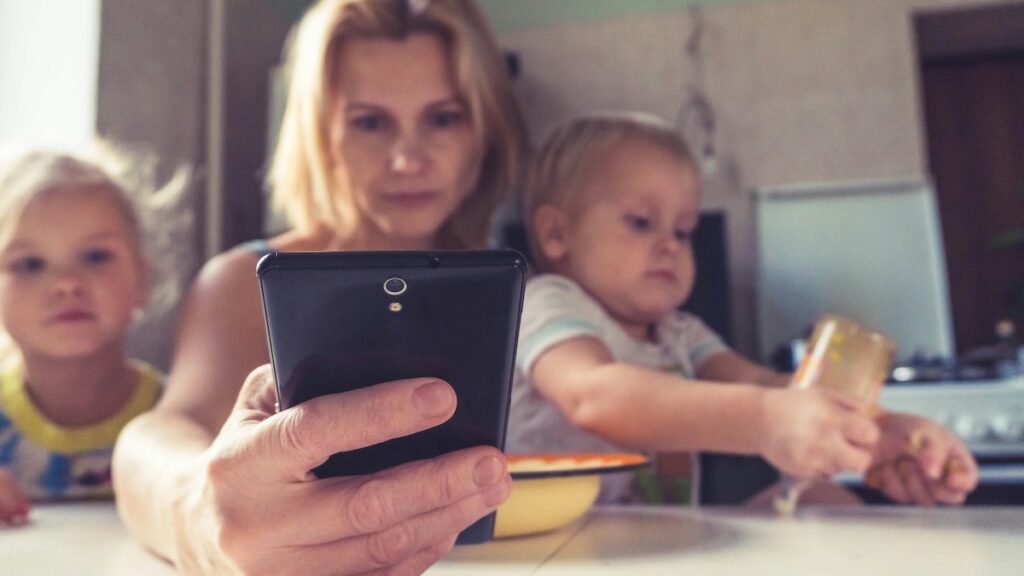
If parents are constantly looking at their smartphones, it can weaken the relationship with their children. This is shown by a current study from the USA. The background is an effect called Technoference. We’ll explain to you what it’s all about.
For many people, a world without smartphones is no longer imaginable. Especially for the new generation, cell phones are a natural part of life.
To date, the focus of debates about device use and screen time has primarily been young people. Less attention was paid to how children perceive their parents’ usage behavior.
This is exactly what a research team led by Don Grant from Newport Healthcare in the USA has now investigated. A study titled “Mom, Do You Love Your Phone More Than Me?” shows: Young people who perceive their parents or caregivers as frequently distracted by mobile devices are significantly more likely to show insecure attachment patterns.
Parents on the smartphone: How this endangers the bond with the child
Insecure attachment has been linked to difficulty forming healthy relationships, increased anxiety, and poorer long-term mental and physical health.
“Our study suggests that parents’ usage habits also influence important aspects of adolescent development,” explains Grant in a press release.
The basis for this is attachment theory: Children need reliably available and attentive caregivers in order to build a secure attachment. According to the study, if a parent is regularly distracted by a smartphone, children experience this as a lack of attention.
What is Technoference?
It is precisely these repeated small interruptions that seem to be problematic. Two terms have been established in research for this phenomenon.
Technoference generally describes how digital devices disrupt human interactions. The term has been around among researchers since 2012. It was coined by Brandon T. McDaniel, a scientist at the Parkview Mirro Center for Research and Innovation.
McDaniel uses this to describe everyday disruptions to direct, personal communication in the real world through the use of technology. In short, moments in which devices interfere with conversations or time spent together.
The researcher developed the concept because he was interested in whether it has meaning when a beep, a notification, or the mere presence of a device interrupts an interaction.
Phubbing, in turn, is a subtype of technoference. The portmanteau of “phone” and “snubbing” stands for ignoring a person in favor of the smartphone.
Why the phenomenon is so easily overlooked
Unlike mental illness or family crises, device use is, according to the current Grant study, completely controllable and still socially acceptable, which is why it is easily overlooked. However, the researchers emphasize that the data only shows a connection, not a cause.
It remains unclear whether parents’ perceived distraction leads to insecure attachment or whether adolescents with insecure attachment are more likely to perceive their parents’ behavior as distracting.
600 young people surveyed: What parents should do now according to the study
For the study, the team surveyed 600 US teenagers between the ages of twelve and 17. Among other things, they filled out a newly developed questionnaire, the so-called Device Attachment Interference Scale.
The result: The more the young people perceived their parents’ device usage behavior as disruptive, the less secure their relationship with the caregiver was. This applied to mothers as well as fathers.
An older study by the Pew Research Center from 2024 also supports this picture. At that time, 46 percent of US teenagers surveyed said their parents were at least occasionally distracted by their cell phones while talking.
The research team led by Don Grant emphasizes that parents don’t have to immediately put down their cell phones every time they ask for attention. It is more important to acknowledge the child’s request and actually respond to it as soon as possible.
Also interesting: