

Rigoletto rises Victor Hugo’s play Le Roi s’amuse from 1832 back.
The piece premiered and was then banned for 50 years. That says everything about the plot. In 1851, more than 20 years later, Giuseppe Verdi composed his 16th opera from it. Hugo, an advocate of copyright, which did not yet exist at the time, had no part at all in this opera, which was performed frequently. This opera has been performed worldwide for almost 200 years and now there has been a new production in Munich.
The stage design is minimalist, with only walls being pushed back and forth and lighting and projections being played with. The opera guest should concentrate on the music and not be distracted by the stage design, at least that’s what the dramaturg says during the introduction. The palace of the Duke of Mantua consists of silver walls and sloping floors, in the other files gray-black walls are displaced, only Gilda’s room is yellow. Here she sings the great aria Caro Nome and here, of all places, the wall was written on during the aria – in English, too. I haven’t read it, but this aria is far too beautiful to be distracted by any lyrics.
So you ask yourself: ‘minimalist stage design’, the opera guest should concentrate on the music?
The men all wear suits with white shirts and ties, some tuxedos with bow ties. Only Rigoletto stands out with a white tuxedo jacket. The men all look almost the same from a distance.
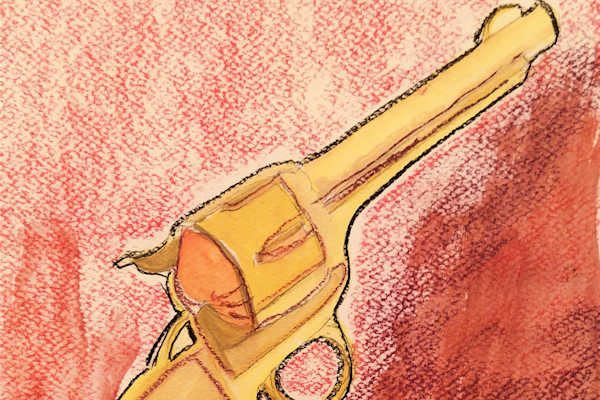
Of course, this piece doesn’t work without a weapon, this time a pistol, which remains rather invisible until the duke drops it and someone else picks it up. Completely unnecessary and clumsy.
Plot
The plot is bad, the Duke goes wild with women, abuse, prostitution and doesn’t let anything go wrong. The Duke of Mantua (Duke of Mantua) is an unscrupulous seducer. The Court jester Rigolettowho was the only one who could have shown the Duke his limits, holds back. He would rather mock the Duke’s victims than stand up to him.
Rigoletto has one Daughter, Gildawhich he hides so that it doesn’t fall into the Duke’s hands. The only exit Gilda has is into the church. And that’s exactly where she meets the Duke, who disguises himself as a poor student. The very place where she is supposed to find protection becomes a trap.
The misfortune takes its course, she falls in love with him, is kidnapped from the court and brought to the duke. As naive and inexperienced as she is, she doesn’t enjoy being lied to. Rigoletto takes Gilda disguised as a man to the pub where the Duke frequents. There Gilda sees how the Duke is already ensnaring the next woman, Maddalena. Rigoletto hires a murderer to assassinate the Duke, but he confuses the two and stabs Gilda. Gone stupid.
What’s bad about the production is the scene in the bar. Black walls again, and several women in latex skins with chains and shackles and animal heads. The stage suddenly seems like a mixture of a fetish cellar and apocalyptic fantasy. Something in between Borg and sadomasochism.
Does this have anything to do with the history of the opera?
So is this the modern-day version of Rigoletto, as the dramaturg explained?
If you want to see a horror performance, this production is right for you. However, if you want to enjoy Verdi’s opera, you have to have a lot of patience.
Maddalena was seen up close as she bowed: black latex mini dress and over-the-knee boots. She had a big bruise on her thigh.
Was she beaten? Is the production really that realistic?
And with that you leave the opera – still shocked, irritated and with the image of a bruise on your thigh in your head.
Trailer ARD media library (approx. 2 min)