


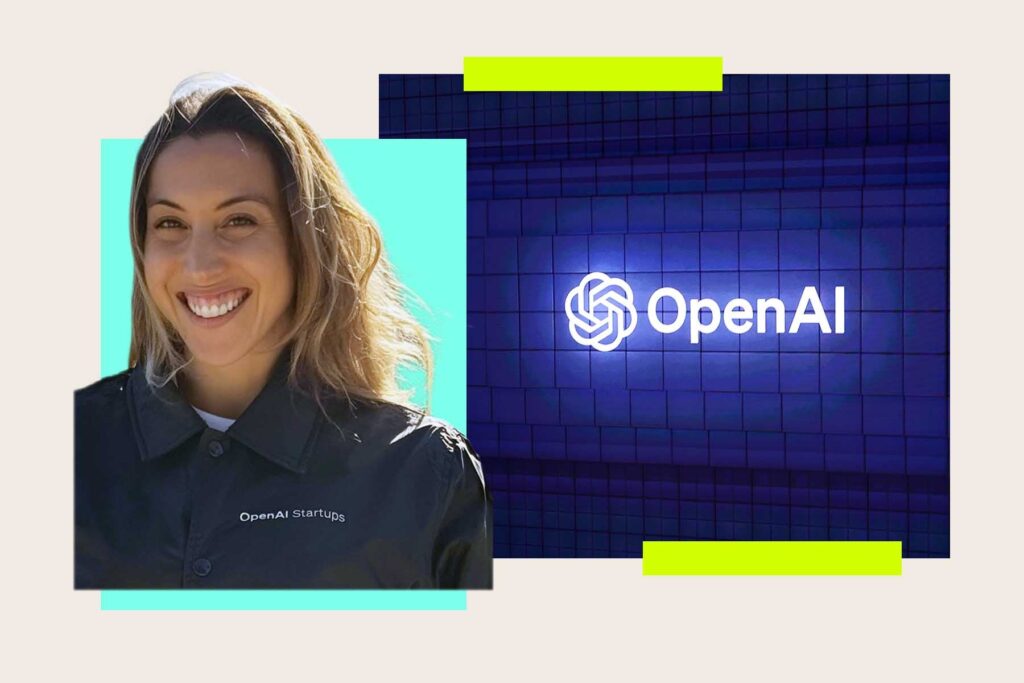

Anyone who wants to understand the next generation of AI startups today will quickly end up with her: Laura Modiano is responsible for the startup business in Europe, the Middle East and Africa at OpenAI. She sees how founders build on the OpenAI infrastructure and which ideas really carry weight. We met Modiano in Berlin and talked to her about why AI makes founding easier and harder at the same time, how European founders are underestimated and how dependent startups are on OpenAI.
Founder Scene: What was the last thing you asked ChatGPT?
Modiano: “I use ChatGPT a lot for writing, for example for strategy documents. I often first speak in voice mode for five to ten minutes about everything that comes to mind, from the problem to the target group and structure to the logic of success. I then have an outline created from this. I then revise it, add notes and have the text restructured so that the strategic goal becomes clearly visible.”
You support founders from Europe who build their products on ChatGPT. What makes them different from those in the USA?
Modiano: “If you look at the speed at which some companies in Europe are either becoming unicorns or rising to the top of their industry, then this development is clearly going up.
I think overall in Europe we have an education system that promotes critical thinking and a technical mindset. And we have more science, technology, engineering and mathematics graduates than the US or China. Many founders are also so strong because they have worked in startups before. This creates a flywheel of experience, innovation and start-ups. We are truly experiencing a renaissance in the European technology sector.”
Is it easier to build a very good tech company these days with AI, or even more challenging because there is a lot of competition?
Modiano: “AI makes starting up easier because it speeds up development and reduces costs. I was at a dinner recently where to my right someone was building a construction tech AI company based on OpenAI and to my left someone was building a social commerce app. Two completely different applications, but under the surface they both use the same technology.”
Many startups build their products on the OpenAI API and depend on your models. What happens if your models and prices change?
Modiano: “I would talk about empowerment rather than dependence. The business model, for example, shouldn’t change just because the model changes. The way founders monetize and go to market remains essentially the same – unless an additional skill comes along that suddenly gives them a new way to monetize. Then that would be more of an advantage.
It is important to distinguish between ChatGPT and the API. The API world works fundamentally differently than ChatGPT as an end-user product. There are different models, price points and possible uses. You can specifically choose what suits your own product.”
OpenAI has evolved from open source to closed source. What role does open source still play for OpenAI?
Modiano: “Open source continues to play an important role for OpenAI. We published several open models last year. At Codex, many core developer tools are open source, so developers can build flexibly and according to their own ideas. Not only the model itself is important, but also the support of the community and different builder use cases.”
In which sectors do you currently see real opportunities to start something new in Europe?
Modiano: “In every market there is room for new services. Either you are building something completely new, or you are solving a new problem that has just emerged, or one that was previously impossible to solve. Personally, I find it particularly exciting to bring AI into areas that classic SaaS solutions have never really been able to solve – i.e. everything related to blue-collar work, production, construction, security, training or health.
I’m also excited about the idea of using AI to solve scientific problems. I think there is a limitless opportunity here that can once again move the whole economy forward and benefit society.”
What skills do founders really need these days if they want to build a tech company?
Modiano: “The most important thing for founders these days is to learn how to learn because technology is evolving so quickly. Prioritizing things and deciding where to spend your time is a key skill.
The second point is that AI tools make it easier for people to collaborate. Roles used to be more separated. Today, in startups, anyone can contribute to the product, even without a tech background. I know startups where all employees, without exception, are part of product development.
And the next thing is: Knowing how to actively listen and translate feedback into the product. So: really understand how customers interact with the tool and know exactly what feedback you have taken and when and incorporated it into the product.”
What’s the biggest challenge posed by AI that a team or founder doesn’t necessarily think of first?
Modiano: “This tends to affect larger teams, but given the speed these days, a company has to constantly change. A process that was right at the beginning may no longer be as soon as you have a minimal viable product. That’s why you have to keep looking at the team culture, processes and way of working. And you have to understand that learning always means unlearning.
Unlearning is one of the most important skills for growing companies. Processes and playbooks must adapt to the growing product and user base and continually bring the two closer together.”
Read too

