Around 2.2 billion people worldwide do not have access to safe drinking water. Current desalination plants use a lot of energy and leave toxic brine behind. A team of researchers at the University of Rochester has now developed a solar thermal system that desalinates seawater without chemicals, cleans itself and even produces lithium for batteries. We’ll explain to you how the technology works and why it could solve two global problems at once.
According to estimates by the United Nations, around 2.2 billion people worldwide lack access to safely managed drinking water. To address this shortage, many communities from California to the Middle East are turning to desalination plants to convert ocean water into fresh water.
However, common processes such as reverse osmosis or thermal distillation are very energy-intensive. They also require complex preparation and post-treatment of the water. A central ecological problem of these established technologies is the creation of highly concentrated salt broth, the so-called brine.
When this brine byproduct is released back into the ocean, it wreaks havoc on marine life. It dramatically increases the salinity of seawater locally while simultaneously reducing vital oxygen levels. A team of researchers from the University of Rochester has now presented a sustainable alternative.
Laser-etched solar panels extract lithium from seawater
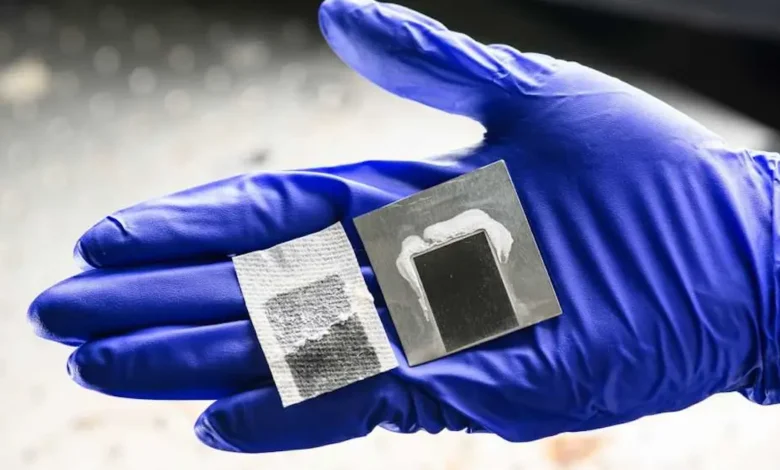
The newly developed system works purely solar thermally and does not require any chemical additives. The researchers led by Chunlei Guo, professor of optics and physics at the local Institute of Optics, use special solar panels made of black metal.
These panels are precisely etched in advance using femtosecond lasers. This surface treatment makes the metal intensively light-absorbing and develops supercapillary properties so that it strongly attracts water. During operation, the treated active region of the panel draws an extremely thin layer of water over the surface. This layer absorbs almost all incoming solar radiation, causing the water to distill.
Other solar thermal concepts often fail in practice because magnesium and calcium compounds contained in seawater form crusty, non-porous deposits. These residues clog the surface in a similar way to limescale in a tea kettle, eventually preventing the water from seeping through.
Why the coffee ring effect prevents constipation
To prevent these crusts, the team used a well-known physical phenomenon called the coffee ring effect. When a drop of coffee evaporates, the coffee particles are concentrated on the outer edge.
The precisely etched grooves of the solar panels direct the salts and minerals dissolved in the water into the untreated, passive edge areas. This means that the active zone remains permanently free of blockages and the system maintains its continuous function.
The system demonstrated its self-cleaning power in practical tests with water samples from the Atlantic, Pacific and Indian Oceans. The salts were completely deposited in the passive region without affecting the transport efficiency of the solar distillation.
Chunlei Guo explained that exactly this principle is used to transport the salts into the passive region, where they can later be easily collected in solid form. In this way, the disposal of liquid brine waste is completely eliminated.
Lithium from seawater: A valuable byproduct
The complete recovery of the solids offers significant economic and ecological advantages over conventional methods. In addition to ordinary table salt, valuable raw materials can also be isolated from the residues.
In an accompanying study in the Journal of Materials Chemistry A, the scientists describe how they modified the solar panels to specifically separate lithium. To do this, the team embeds nanoparticles made of hydrogen titanate in the microscopic metal grooves that isolate the lithium ions.
In initial tests with highly saline water from the Great Salt Lake, the researchers were able to successfully extract around 50 percent of the lithium present. Since conventional mining of this metal on land requires a lot of energy, extraction from salt water represents a future-oriented route.
Supported by the National Science Foundation, the Bill & Melinda Gates Foundation and the Worldwide Universities Network, the scalable technology could now be further developed to secure global drinking water supplies and raw material chains for batteries.
Also interesting: