


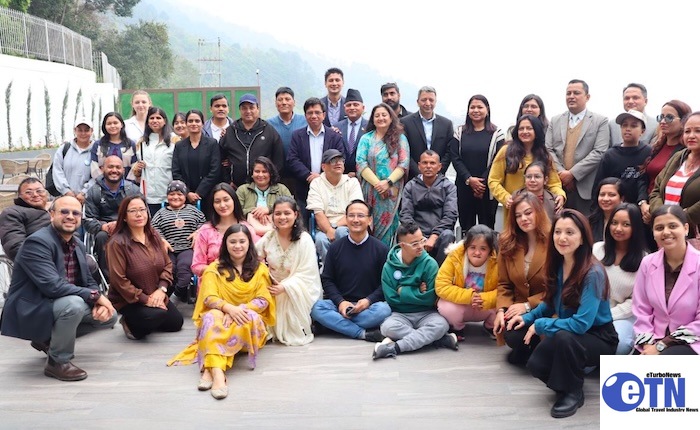
Kathmandu, Nepal — On a clear March morning in the valley of Godawari, where terraced hills descend towards the capital and the Himalayan looms faintly in the distance, a quiet but consequential gathering took place. There were no ribbon cuttings or grand inaugurations—only a steady insistence on something more radical: that travel, in all its forms, must belong to everyone.
The 8th National Accessible Tourism Day 2026convened by a coalition of Nepali organizations including the International Development Institute, Impact Adventure, Spinal Injury Sangh Nepal and Global Compact Nepal, marked a turning point not merely in rhetoric, but in positioning Nepal as one of the most ambitious countries in the world in rethinking tourism through the lens of accessibility.
Its theme, “Travel without Barriers: Designing a World for Everyone,” carries a quiet urgency. In a country long defined by its extreme geography—towering peaks, uneven footpaths, centuries-old heritage sites—the idea of universal accessibility might seem improbable. Yet, increasingly, Nepal is not just participating in the global conversation on inclusive tourism. It is helping lead it.


A Movement Born from Terrain and Necessity
Accessible tourism in Nepal did not begin as a policy. It started as improvisation.
For decades, Nepal’s tourism identity revolved around endurance: trekking in the Annapurna Circuit, summiting Everest, and navigating narrow alleys in medieval cities. Accessibility, in the conventional sense, was rarely part of the equation.
That began to change in the aftermath of the 2015 Nepal earthquake.
The disaster, which reshaped both landscapes and infrastructure, also reshaped thinking. Reconstruction opened a narrow but critical window: what if rebuilding could be done differently? What if accessibility were embedded from the start?
Out of that moment innovations emerged that would later define Nepal’s leadership—none more emblematic than the development of South Asia’s first accessible trekking trail in Kaskikot, near Pokhara. The project challenges a deeply held assumption: that mountainous terrain and accessibility are incompatible.
They are not, as Nepal has begun to demonstrate.
The Visionary at the Center


At the heart of this shift is Pankaj Pradhanangaa tourism entrepreneur whose work has increasingly drawn international attention.
Pradhananga, founder of Impact Adventure, has spent years reframing what adventure tourism can mean. His concept is deceptively simple: inclusion is not an add-on—it is a design principle.
Inclusive Travel in Nepal, Tibet & Bhutan | Impact Adventure
Explore Nepal, Tibet & Bhutan with accessible tours for all. Impact Adventure makes travel inclusive—welcoming all ages, abilities, and mobility levels.
In Godawari, he spoke not in abstractions, but in systems.
Three pillars, he said, determine whether accessible tourism succeeds: infrastructure, communication, and a willingness to learn.
It is the third that sets Nepal apart.
“Accessibility is not a finished product,” he has argued in multiple forums. “It is a continuous process of listening, adapting, and improving.”
That ethos has shaped initiatives like WheelTreka Nepal-born concept that adapts trekking experiences for wheelchair users, combining local innovation with community-based tourism. What began as an experiment is now cited as a model across South Asia.

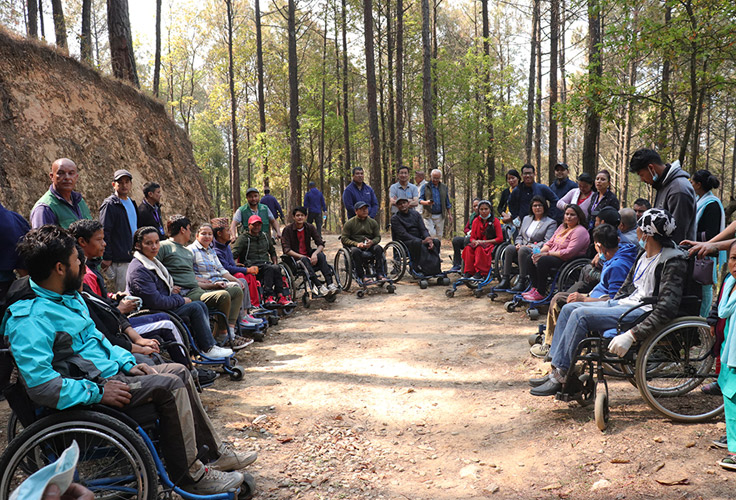
“Wheeltrek Trail” at Kavre: An initiation for Accessible Tourism – Spinal Injury Sangh Nepal
The Sixth Accessible Tourism Day of Nepal was celebrated on 30 March 2023 with travel along the ‘wheeltrek trail’ at Basuki Thumka, a hill flank at Sanga
Pradhananga’s influence extends beyond Nepal. As the Nepal chapter chairman of the World Tourism Network, he has helped elevate accessible tourism as a global agenda item, connecting grassroots innovation in Nepal with international policy conversations. His work has also been formally recognized with the Tourism Hero Award, an honor given to individuals shaping a more inclusive and resilient tourism industry.
In positioning accessibility as compatible with—even enhancing—Nepal’s rugged identity, Pradhananga has helped shift the narrative from limitation to possibility.
A Global Context: Where Nepal Stands
Globally, accessible tourism has long been recognized as both a rights issue and an economic opportunity.


The World Tourism Organization (now branded as UN Tourism) has, for over a decade, promoted “Tourism for All,” emphasizing universal design and inclusive infrastructure. Its guidelines stress that accessibility benefits not only persons with disabilities, but also aging populations, families with children, and travelers with temporary impairments.
Similarly, the World Travel & Tourism Council has framed accessibility as a market imperative. Estimates suggest that travelers with disabilities and their companions represent a multi-trillion-dollar global market—one that remains significantly underserved.
Yet implementation has been uneven.
- In Spain, widely considered a leader, accessibility is embedded into urban planning, public transport, and heritage sites, supported by strong regulatory enforcement.
- The United States relies on legislative frameworks like the Americans with Disabilities Act, which mandates accessibility but often produces inconsistent real-world experiences.
- In Japan, accessibility has advanced rapidly, particularly in transport systems, driven by aging demographics and events like the Tokyo Olympics.
- Across much of South Asia, however, accessibility remains fragmented, often limited to pilot projects rather than systemic change.
This is where Nepal’s approach is notable.
Rather than beginning with regulation alone, Nepal’s accessible tourism movement has been shaped by collaboration across sectors—civil society, private enterprise, and government—combined with a willingness to experiment in difficult environments.
The reality on the ground
Despite its leadership narrative, Nepal’s progress is neither linear nor complete. At the Godawari event, speakers offered a candidate assessment.
Wheelchair users described the daily negotiations required to travel: inaccessible toilets, a shortage of adapted hotel rooms, and the absence of reliable information. Policies exist, they are noted, but enforcement remains weak.
“There are ramps on paper,” one participant remarked, “but not on the street.”
This gap—between policy and practice—is not unique to Nepal. But in a country where infrastructure challenges are compounded by geography and limited resources, the stakes are higher.
Heritage presents a particular dilemma. Many of Nepal’s most iconic sites—temples, courtyards, ancient palaces—were built centuries ago, long before accessibility was conceived as a design requirement. Retrofitting them without compromising their historical integrity requires both technical innovation and political will.
The Role of Institutions
Institutions are beginning to respond.
The Nepal Tourism Board has signaled a growing commitment, including calls for dedicated budget lines for accessible tourism and stronger coordination with local governments.
Meanwhile, organizations like the Spinal Injury Sangh Nepal have ensured that lived experience remains central to policy discussions, pushing beyond symbolic inclusion toward practical outcomes.
The private sector, too, is evolving.
Through initiatives aligned with the United Nations Global Compact, businesses in Nepal are increasingly framing accessibility not as corporate social responsibility, but as core strategy. Hotels, trekking companies, and tour operators are beginning to recognize that inclusive design expands markets rather than constrains them.
Internationally, Nepal’s efforts are gaining visibility. UN Tourism has highlighted the importance of inclusive destinations, and Nepal’s experiments—particularly in accessible adventure tourism—offer a case study in how emerging economies can leapfrog traditional models.
Beyond Infrastructure: A Cultural Shift
What distinguishes Nepal’s approach may ultimately be less about ramps and more about mindset. Accessibility, as several speakers emphasized, is not merely technical. It’s cultural.
In many societies, disability is still framed through pity or charity. Nepal is working—unevenly but deliberately—to replace that with a framework of rights and participation.
This shift is evident in the language of the National Accessible Tourism Day itself. The focus is no longer on accommodating a minority, but on designing systems that work for all.
It is a subtle but profound change.
The Road Ahead
Nepal’s leadership in accessible tourism remains, in many ways, aspirational. Significant gaps persist—in infrastructure, enforcement, and awareness.
Yet leadership is not defined solely by completion. It is defined by direction.
In choosing to tackle accessibility within one of the world’s most challenging geographic contexts, Nepal has positioned itself as a laboratory for inclusive tourism. Its successes—and its failures—carry lessons for countries far wealthier and more developed.
For Pankaj Pradhananga and others driving this movement, the goal is not perfection, but momentum.
“Accessibility is a journey,” he said. “And like any journey in Nepal, it requires patience, resilience, and the willingness to keep moving forward.”
As the gathering in Godawari concluded, there was no declaration of victory. Only a shared recognition: that the path ahead is long, but that Nepal, improbably and unmistakably, is helping to chart it.