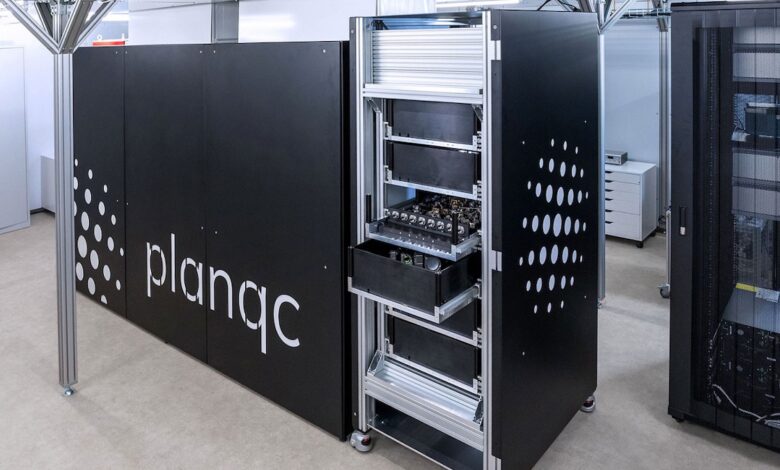
Quantum computers are set to revolutionize pharmaceutical research, climate models and the world of finance. But so far there is no evidence that they are really superior to classic supercomputers. The Munich start-up planqc wants to change that. In our start-up check, we look at what is behind the technology, where the money comes from and how realistic the plans are.
Start-ups: That sounds like inventiveness, future technologies, new markets. But in reality, many of the start-ups unfortunately often turn out to be a mixture of an e-commerce idea, haphazard founders and shaky future prospects.
They certainly do exist: the thought leaders who work on the big problems and revolutionize business models. Finding and presenting them is the task of the “Start-up Check” format. Today: planqc, deep tech start-up in the field of quantum computing.
Who is behind planqc – and where does the expertise come from?
- Industry: Quantum Computing/DeepTech
- Founder: Alexander Glätzle, Sebastian Blatt and Johannes Zeiher
- Year founded: 2022
- Business model: Development of scalable quantum processors based on neutral atoms; medium-term provision of quantum computing as a service via the cloud
- Goal: Quantum computers with more than 1,000 qubits that provide practical computing advantages over classic supercomputers in chemistry, pharmaceuticals, automotive and the financial industry
Quantum computers are supposed to cure cancer, revolutionize climate models and reinvent the world of finance. However, when exactly this will happen remains unclear.
planqc from Garching near Munich has long been one step further and scores points with concrete orders, delivery commitments and a running schedule. The start-up, founded in 2022 as a spin-off of the Max Planck Institute for Quantum Optics (MPQ) and the LMU Munich, has quickly developed into one of the most important European quantum computing companies – with a technological bet that is increasingly seen as promising in the scene.
There are scientists behind planqc who have been working with quantum systems for a long time: CEO Dr. Alexander Glätzle and his co-founders come directly from the research group led by the renowned physicist Immanuel Bloch at the MPQ, one of the world’s leading institutes in the field of quantum optics. This gives the company a scientific credibility that cannot simply be bought.
How does a quantum computer made of light and atoms work?
The best-known quantum computers, such as those from IBM or Google, are based on superconducting circuits and have to operate at extremely low temperatures close to absolute zero.
planqc takes a different approach. The company relies on neutral atoms as qubits, the smallest computing units in a quantum computer. In contrast to classical bits, qubits can not only assume the values zero or one, but also both states at the same time.
The planqc principle: Individual strontium atoms are captured in a vacuum with laser light and positioned in so-called optical lattices, a “crystal of light”. Each atom acts as a qubit. Precise laser pulses manipulate the quantum states of atoms and carry out calculation operations.
Saying goodbye to the millikelvin constraint
The key advantage is that neutral atoms are naturally identical. No atom deviates from the next, which is a significant source of error in other qubit technologies. This leads to long coherence times, high stability and an architecture designed for over 1,000 qubits.
For comparison: In a research project at the MPQ in which planqc was involved, a register with 1,200 neutral atoms was operated stably for over an hour. A scaling result that has attracted attention in the industry.
Another advantage over superconducting systems: operation is possible at almost room temperature, at least compared to the millikelvin temperatures that competitors like IBM require. This simplifies the infrastructure significantly and could reduce operating costs in the long term.
Classification and added value
planqc positions itself as a bridge builder between basic research and industrial application and has specific target sectors: chemistry and pharmaceuticals (molecule simulation, active ingredient design), battery technology and climate tech, automotive and the financial industry. The first use cases around quantum machine learning for climate simulations and battery optimization are already in development.
Whether and when quantum computers will really be superior to classical supercomputers in these applications is an open question for the entire industry, planqc included.
The so-called “quantum advantage” for industrially relevant problems has not yet been proven anywhere. Like all of its competitors, the company is still in the phase of building systems that will provide this proof at some point.
However, planqc has a clear niche in the European competitive environment: The focus on neutral atoms distinguishes the company from providers such as IQM (superconducting) or Quantinuum (ion traps) and allows a “Made in Germany” narrative that creates trust among European industrial customers – especially compared to US and Chinese providers.
90 million euros and two government contracts: This is how planqc finances itself
planqc is remarkably well capitalized for a four-year-old deep tech company. The Series A round of 50 million euros (2024), led by Catron Holding and the DeepTech & Climate Fund, supplemented by funding from the BMBF, adds up to around 80 to 90 million euros in total capital, including public funding.
More importantly, the company has already won concrete public contracts. planqc received an order worth 29 million euros from the German Aerospace Center (DLR) to build a quantum computer in Ulm – the first European order of its kind.
The Leibniz Computing Center (LRZ) also commissioned the start-up to develop a 1,000-qubit quantum computer with a target of 2027. Both projects are not pilots, but real infrastructure measures with concrete delivery obligations.
planqc is closely embedded in the Munich quantum ecosystem: as the first spin-off of the Munich Quantum Valley Initiative, with technology partners such as Menlo Systems (laser systems) and ParityQC (software/architecture) as well as the ongoing scientific connection to the MPQ. This networking is not a marketing argument, but rather a structural part of the development strategy.
planqc: Between scientific pioneering work and industrial proof
planqc addresses one of the most technologically demanding challenges of the digital economy: the construction of quantum computers that actually deliver industrial added value beyond research laboratories. The neutral atoms platform is scientifically based, well financed and already anchored in practice through public contracts.
The decisive factor will be whether planqc can make the transition from impressive qubit numbers to demonstrable computing advantage and whether the target industries are ready to transfer quantum computing from the roadmap to their actual IT infrastructure.
If this succeeds, planqc would be well positioned to emerge as the European champion in a market that has so far been dominated by American heavyweights.
Also interesting: