


Automation is about building systems that are resilient, scalable, and easy to maintain. That’s where the MuleSoft RPA Bot Framework becomes a game-changer for modern enterprises. By eliminating repetitive setup tasks and enforcing strong development standards, it allows engineers and automation teams to focus on what truly matters: delivering business value.
Whether you’re an RPA developer, architect, or business leader, understanding this framework can significantly elevate your automation strategy. In this article, we explore how MuleSoft RPA Bot Framework simplifies automation design while improving performance and reliability.
MuleSoft RPA Bot Framework overview
The MuleSoft RPA Bot Framework is a pre-built automation foundation that helps developers create efficient and standardized robotic process automation solutions. Instead of starting each automation from scratch, the framework provides ready-to-use templates, configuration handling, logging mechanisms, and exception management features.
This significantly reduces development time while improving overall process quality. Developers can focus entirely on business logic rather than worrying about repetitive setup tasks or structural design. As a result, projects move faster from concept to production with fewer errors and lower maintenance costs.
Beyond speed, the framework enforces consistency and best practices across all automation projects. It standardizes variables, global values, logging formats, and exception handling, making automations easier to understand, test, and support.
The framework also manages end-of-execution processes such as closing unnecessary applications, storing configuration data, and generating execution reports. This ensures every automation run is properly monitored and documented. Together, these features create a stable foundation for scalable enterprise automation, leading us naturally to the core advantages that make this framework so powerful.
2 types of RPA Bot Frameworks
There are two types of bot frameworks we’ll discuss today: Simple and Transactional. Let’s look at both in closer detail.
Simple bot framework
Simple bot framework is designed for batch processing where no multiple records need to be processed. The workflows which are highlighted as gray are common workflows (Activity Library).

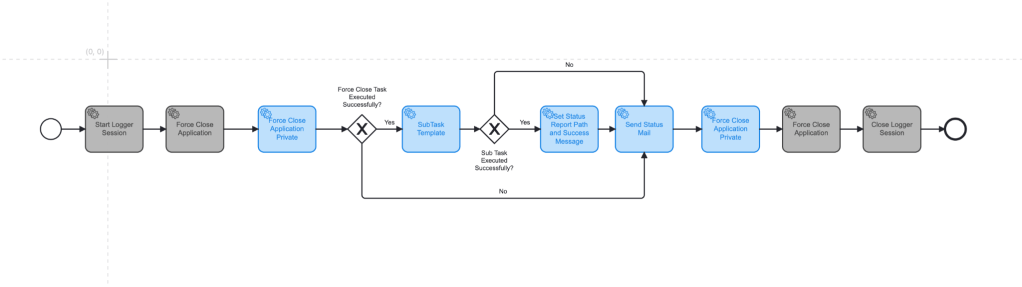
Here are different components involved in the framework:
- Start logger session: Initiate Logger session so that logs can be stored
- Force close application: This workflow closes all common Windows applications so that they don’t interfere during the start of the automation execution
- Force close application private: This workflow includes applications that need to be closed before start of automation execution
- Subtask template: This workflow acts as a container where developers can write the business logic
- Set status report path and success message: End of run report path and success message details are stored in this workflow so that these can be used to send end email to business stakeholders
- Send status email: This workflow sends email to required recipients on the automation status. Email might include the report and the success message
- Close logger session: Closes the earlier initiated logger session
Transactional bot framework
Transactional bot framework is designed to handle processing where multiple records need to be processed by automation. Each workflow in the framework has proper error handling and logging to make sure that automation is handling exceptions and able to log the error details as well.

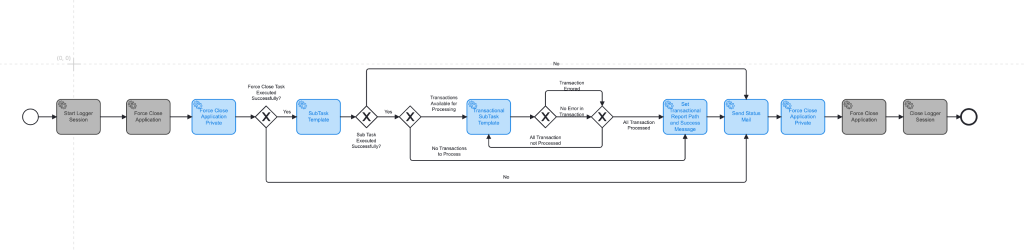
Here are different components involved in the framework:
- Start logger session: Initiate Logger session so that logs can be stored
- Force close application: This workflow closes all common Windows applications so that they don’t interfere during the start of the automation execution
- Force close application private: This workflow includes applications that need to be closed before start of automation execution
- Subtask template: This workflow acts as a container where developers can write the business logic
- Transactional subtask template: This workflow contains the logic or actions which are performed for each record. There’s a Gateway being added to make sure to have a clear path on what needs to be done for Failure and Success scenarios. This template workflow also involves a mechanism to move to another record in case of any error in any record processing
- Set status report path and success message: End of run report path and success message details are stored in this workflow so that these can be used to send end email to business stakeholders
- Send status email: This workflow sends email to required recipients on the automation status. Email might include the report and the success message
- Close logger session: Closes the earlier initiated logger session
Advantages of the MuleSoft RPA Bot Framework
One of the biggest strengths of the framework is how it accelerates development while increasing reliability. It includes ready-made templates that handle configuration reading, business logic execution, exception processing, and cleanup operations. Developers simply plug into their business workflows without rebuilding core functionality.
This approach dramatically reduces development effort and ensures that every automation follows the same robust design principles. Teams can therefore onboard new developers faster and maintain large automation portfolios with confidence.
The framework also improves operational visibility through built-in logging and status reporting. It records all transactions – including successful, failed, and exception cases – and can automatically send detailed status emails after execution. These logs help teams monitor performance, identify issues quickly, and maintain strong governance across automation operations.

Exception handling and intelligent recovery
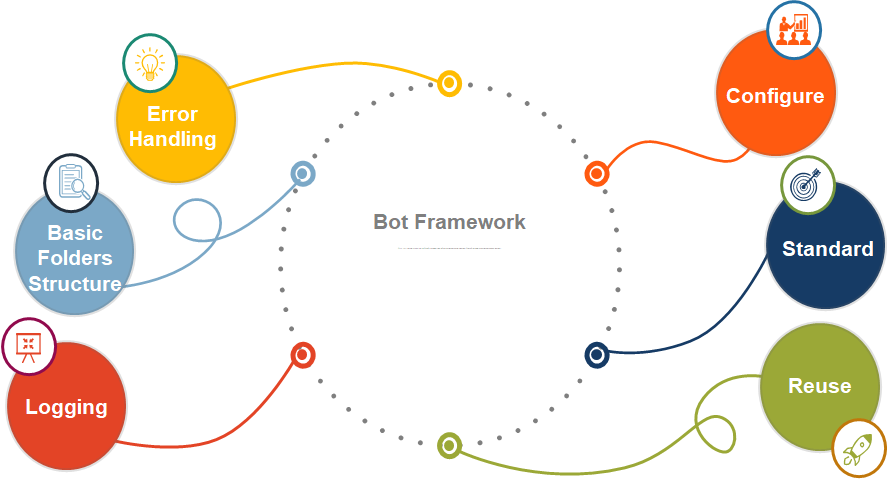
Exception handling is one of the most critical aspects of any automation solution, and the MuleSoft RPA Bot Framework makes it remarkably simple. Every template includes built-in error handling that automatically manages system exceptions while allowing developers to throw business rule exceptions when required. This prevents process halts and ensures automations recover gracefully from unexpected events. Additionally, the framework captures screenshots at the exact moment of failure, giving developers instant visual insight into unattended automation issues.
Easy configuration and environment management
The framework simplifies configuration management across build, test, and production environments. Using MuleSoft RPA’s built-in activity parameters, developers can easily manage configurable variables and map them to global variables and credentials. This eliminates hard-coding, reduces deployment errors, and makes environment transitions seamless. Configuration changes can be applied quickly without touching the core automation logic.
Scalability through reusability and standardization
A major advantage of the MuleSoft RPA Bot Framework is its strong focus on reusability and standardization. Since business logic is clearly separated from framework operations, developers can reuse components across multiple processes with minimal changes. This dramatically lowers long-term development and maintenance costs while encouraging the creation of a shared automation library within the organization.
The framework’s standardized variable naming, global settings, logging formats, and control room structures ensure that all automations follow the same architectural model. This makes handovers between developers easy, improves code readability, and strengthens governance. As organizations expand their automation footprint, these qualities become essential for long-term scalability and success.
Logging, monitoring, and governance
The built-in logger component provides powerful logging and exception notification capabilities. Every transaction is tracked, every failure is documented, and every exception is reported. This gives operations teams complete visibility into automation performance and health. Strong monitoring combined with consistent standards creates a secure and auditable automation environment.
Best practices in check with the MuleSoft RPA Bot Framework
The MuleSoft RPA Bot Framework ensures the best practices are being followed with minimal configuration changes by ensuring most of the required components are already in place. This pre-built foundation dramatically accelerates the development lifecycle, allowing teams to deliver resilient and scalable automation solutions faster.
By standardizing logging, exception handling, and core process flows, the framework not only reduces errors but also improves maintainability and governance across the entire automation portfolio. Ultimately, adopting the MuleSoft RPA Bot Framework empowers organizations to focus their expertise on business logic, leading to quicker time-to-value and a more robust, future-proof automation strategy.