27
Jewish Vienna tells a long and layered story. It begins in the Middle Ages. It continues through intellectual brilliance. Yet, it is also marked by devastation. Therefore, exploring Jewish Vienna is essential for understanding the city itself. Furthermore, each museum and memorial adds depth, context, and meaning. Because Jewish Vienna: Memory Matters.

Ultimately, Jewish Vienna is not just about the past. It’s about now. It is about memory carried forward, even when it is heavy. These museums and memorials do more than preserve history. They ask us to pause. They ask us to listen. Most importantly, they ask us to remember.

Today, when antisemitism is again visible across Europe and beyond, Jewish Vienna feels painfully relevant. Each artifact, each name, and each empty space tells a story that could have been forgotten. Yet, it was not. Therefore, remembrance becomes an act of resistance. Furthermore, it becomes a responsibility shared by every visitor.
Jewish Museum Vienna

To begin with, the Jewish Museum Vienna offers the most comprehensive introduction to Jewish life in the city. Founded in 1896, it is considered the world’s first Jewish museum.
Inside, visitors encounter ceremonial objects, Torah crowns, Kiddush cups, textiles, and personal belongings. Furthermore, interactive exhibits explore religious practices, migration, assimilation, and identity.

Importantly, the museum addresses Jewish life before and after the Holocaust. As a result, it presents Jewish Vienna as both historical and contemporary.
Jewish Museum of the City of Vienna (Jewish Museum Vienna)
Address: Dorotheergasse 11, 1010 Vienna, Austria
Hours: Sun–Fri 10:00 a.m. – 6:00 p.m. (closed Saturdays)
Memorial Against Fascism

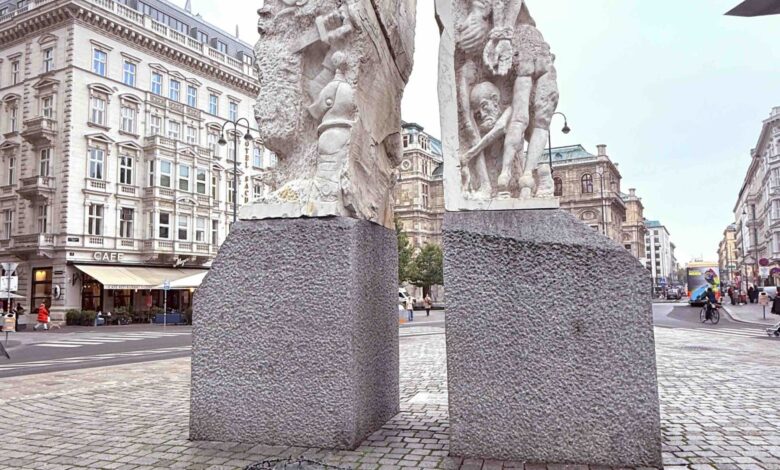
Meanwhile, the Memorial Against Fascism at Albertinaplatz confronts the consequences of hatred and dictatorship. Created by Austrian artist Alfred Hrdlicka in 1988, the monument marks the site where Vienna’s Jewish population was once forced to scrub pro-Nazi slogans from the streets.
Through abstract and figurative sculptures, it honors victims of fascism, including Jewish Austrians. Consequently, the memorial emphasizes accountability. Furthermore, it refuses silence or simplification.
Monument Against War and Fascism (Memorial Against Fascism)
Address: Augustinerstraße 8, 1010 Vienna, Austria
Hours: Public outdoor memorial — accessible 24 hours
Jewish Vienna: Memory Matters – Sigmund Freud Museum

The Sigmund Freud Museum highlights Jewish intellectual life in Vienna. Located at Berggasse 19, Freud lived and worked here until fleeing Nazi persecution in 1938.
Inside, visitors explore original rooms, personal objects, letters, and first editions. Additionally, exhibitions examine Freud’s Jewish identity, exile, and influence. Thus, the museum connects Jewish history with global cultural impact.
Sigmund Freud Museum
Address: Berggasse 19, 1090 Vienna, Austria
Hours: Wed–Mon & public holidays 10:00 a.m. – 6:00 p.m. (closed Tuesdays)
Jewish Medieval Museum (Judenplatz Museum)

Next, the Jewish Medieval Museum at Judenplatz uncovers Vienna’s earliest Jewish community. Built directly over the remains of a 13th-century synagogue destroyed in 1421, the museum centers on archeology.

Beneath the square, visitors see original synagogue walls, foundations, and household artifacts. Additionally, maps and documents explain medieval trade, scholarship, and daily life. Therefore, this site powerfully demonstrates how deeply Jewish history is woven into Vienna’s urban fabric.
Museum Judenplatz (Jewish Medieval Museum)
Address: Judenplatz 8, 1010 Vienna, Austria
Hours: Mon–Thu & Sun 10:00 a.m. – 6:00 p.m.; Fri 10:00 a.m. – 5:00 p.m. (may vary by season)
Shoah Memorial (Holocaust Memorial)

Similarly, the Shoah Memorial at Judenplatz focuses on absence and loss. Designed by British artist Rachel Whiteread, the concrete structure resembles a sealed library. Its books face inward, their spines unreadable.


Surrounding the monument, inscriptions list Austrian towns where Jews were murdered. Therefore, the memorial becomes both local and universal. Above all, it serves as a quiet but powerful space for remembrance.

Judenplatz Holocaust Memorial (Shoah Memorial)
Address: Judenplatz, 1010 Vienna, Austria
Hours: Outdoor memorial — open 24 hours (no ticket or gate hours)
Conclusion: Jewish Vienna reminds us that what was lost was not abstract. It was life, culture, creativity, scholarship, humor, and belief. Through these sites, we see how deeply Jewish citizens shaped Vienna’s identity. At the same time, we confront how quickly that world was destroyed. Consequently, forgetting is not neutral. Forgetting is dangerous.

Jewish gravestones desecrated to construct buildings
Furthermore, these spaces teach us that remembrance is not passive. It requires intention, education, and empathy. By standing in Judenplatz, by reading names, by seeing what remains, we become witnesses. Therefore, we carry these stories beyond Vienna’s streets.
In the end, Jewish Vienna matters because memory matters. It matters for the victims. It matters for their descendants. Above all, it matters for the future. When we remember, we honor lives stolen. When we learn, we challenge hatred. And when we refuse to forget, we help ensure that history is never repeated. #remembertheirnames
If you found this Jewish Vienna: Memory Matters post interesting, then also check out some of these others:

VIENNA’s TREASURES

A VISIT TO YAD VASHEM

5 FABULOUS VIENNA STOPS