


For decades, Libya has been one of the Mediterranean’s great untapped tourism stories. Home to some of the world’s best-preserved Roman cities, spectacular Saharan landscapes, and centuries-old cultural traditions, the country once appeared destined to become one of North Africa’s premier destinations.
Instead, years of international isolation, revolution, civil conflict and political fragmentation transformed tourism from a promising economic sector into one of Libya’s biggest missed opportunities.
Now, amid cautious efforts to stabilize parts of the country, Libyan authorities are beginning to test a different approach—not through large-scale international marketing campaigns, but through domestic cultural initiatives aimed at reconnecting the country’s regions and rebuilding confidence from within.
The latest example is the announcement of a nationwide Cultural and Artistic Tourism Caravan, a modest but symbolically important initiative that reflects a broader effort to revive Libya’s tourism sector.
A country built for tourism


Few countries possess Libya’s diversity of tourism assets.
Stretching nearly 2,000 kilometers along the Mediterranean coast while extending deep into the Sahara, Libya combines classical archaeology, desert adventure, Islamic heritage and living indigenous cultures.
Among its best-known attractions are the UNESCO World Heritage sites of Leptis Magna, Sabratha, Cyrene, Old Town of Ghadames and the prehistoric rock art of the Tadrart Acacus.
Before the upheavals of the last two decades, international tourism planners frequently described Libya as one of the Mediterranean’s most promising “hidden” destinations.
A slow opening before 2011
For much of the 1970s and 1980s, tourism remained a low national priority.
International sanctions, limited air connectivity and restrictive visa policies constrained visitor numbers, while the country’s economy relied overwhelmingly on oil exports.
The picture began changing during the late 1990s and 2000s after international sanctions were eased and Libya gradually reopened to foreign visitors. Authorities developed tourism master plans, encouraged hotel investment and promoted archaeological tourism built around the country’s Roman and Greek heritage. Direct air links expanded, and foreign tour operators increasingly included Libya in specialist cultural itineraries.
Although visitor numbers remained modest compared with neighboring Tunisia or Egypt, industry observers believed Libya possessed enormous long-term potential.
Revolution changes everything
Those expectations collapsed in 2011.
The uprising that toppled Muammar Gaddafi quickly evolved into prolonged instability that devastated the tourism industry.
Libyan Tourism – Information about Libya
Traveling to Libya is one of the most fascinating experiences of your life. Our website has all the information you need to travel.
Successful rounds of political division, armed conflict and insecurity led most governments to advise against travel to Libya. International airlines reduced services, tourism investment stalled and archaeological sites received fewer visitors while preservation became increasingly difficult.
Hotels that had anticipated growing international business instead faced years of uncertainty.
For much of the following decade, tourism virtually disappeared from Libya’s economic landscape.
Gradual rebuilding
Since 2023, Libya’s internationally recognized government has sought to place tourism back on the national economic agenda.
The Ministry of Tourism and Traditional Industries has pursued cooperation agreements with countries including Tunisia, Turkey, Pakistan, China, and Italy, while also participating in regional tourism organizations and exploring opportunities linked to sustainable coastal tourism and the “blue economy.”
Officials have also promoted traditional industries, handicrafts and heritage preservation as part of a broader strategy to diversify the economy beyond hydrocarbons.
While international visitor numbers remain relatively small and security concerns continue to limit travel, these initiatives suggest tourism has returned to government planning after years of neglect.
A cultural caravan as a first step
Rather than launching an international tourism campaign, Libya’s latest initiative focuses first on domestic tourism.
Minister of Tourism and Traditional Industries Nasr al-Din Milad al-Fazani recently met Minister of Culture and Knowledge Development Salem al-Alam at the Ministry of Tourism headquarters in Tripoli to finalize plans for a joint Cultural and Artistic Tourism Caravan.
Scheduled to depart from Zuwara at the end of July and travel eastward across the country, the caravan aims to strengthen cooperation between Libya’s western, southern, and eastern regions while showcasing the country’s cultural identity.
The program will feature:
- Folk performance groups from Ghadames and Ghat.
- Musicians, artists, and writers.
- Mobile book exhibitions.
- Theater and artistic performances.
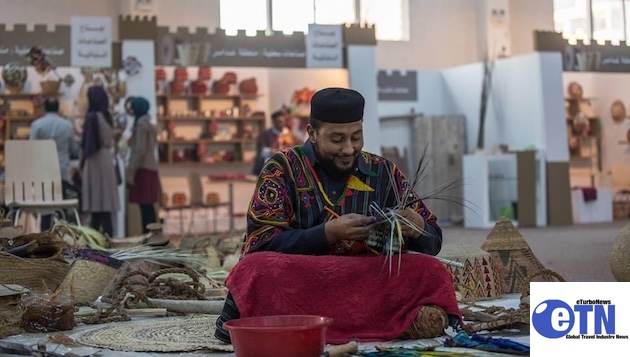
- Heritage and handicraft displays.
- Visits to archaeological sites and tourism destinations.
- Activities designed to encourage domestic travel.
Officials say the initiative is intended not only to promote tourism but also to strengthen national cohesion by encouraging cultural exchange between Libya’s diverse regions.
At the conclusion of their meeting, both ministers described the caravan as an example of institutional cooperation that supports national identity, cultural communication and sustainable development.
More than tourism


The significance of the caravan lies less in the number of visitors it may attract than in what it represents.
Successful tourism industries depend on functioning institutions, reliable transport, cultural preservation and public confidence.
By encouraging Libyans to visit archaeological sites, cultural events and historic towns within their own country, authorities appear to be adopting a gradual “domestic-first” strategy before attempting to rebuild international tourism.
It is a markedly different approach from the ambitious investment plans discussed before 2011.


Challenges remain
Despite renewed activity, Libya faces substantial obstacles to international tourism recovery.
Security conditions remain uneven across the country, many governments continue to advise against non-essential travel, infrastructure requires further investment and the hospitality sector needs years of rebuilding.
Visa procedures, transport links and heritage conservation also remain areas requiring sustained attention.
Competition is equally intense, with neighboring destinations such as Tunisia, Egypt, and Morocco already attracting millions of visitors annually.
Cautious optimism
Few expect Libya to become a major tourism destination overnight.
Yet the Cultural and Artistic Tourism Caravan represents something that has been largely absent for years: a coordinated national tourism initiative built around culture rather than politics.
Whether it becomes the foundation for a broader revival remains uncertain.