


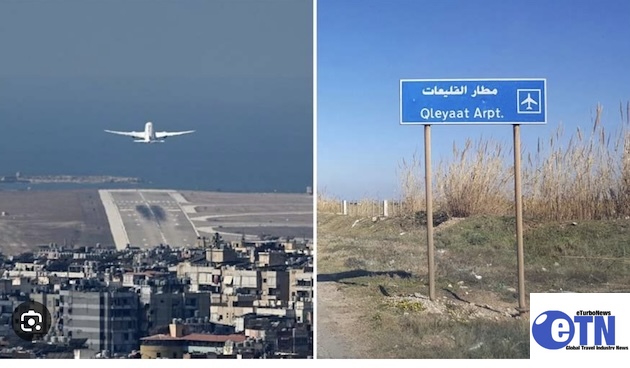
BEIRUT— As Lebanon continues to navigate economic hardship, political uncertainty and recurring security threats, the reopening of René Moawad Airport in Qlayaat as a civilian airport has emerged as a rare story of optimism, regional development and national resilience.
Prime Minister Nawaf Salam officially inaugurated the airport on Saturday, making it Lebanon’s second civilian airport after Beirut-Rafic Hariri International Airport and ending decades of demands from residents of northern Lebanon for a direct gateway to the world.
A government aircraft carrying Salam touched down at the airport in front of an audience that included diplomats, representatives of international organizations, business leaders, aviation executives and local officials. The ceremony took place under extensive security measures, with Lebanese Army units deployed around the facility and helicopters conducting aerial patrols above the area.
For Lebanon, however, the reopening represents far more than the launch of a new airport.
It is a strategic investment in economic recovery, national infrastructure, regional equity and transport resilience at a time when the country remains exposed to periodic Israeli military operations and regional instability.
A National Development Project
Describing the inauguration as “a political, developmental and national decision of the highest significance,” Salam said the project signals a new era for Akkar, one of Lebanon’s most disadvantaged regions.
“The Akkar region will no longer be absent from the state’s development priorities,” he declared.
Salam linked the reopening directly to broader questions of national unity and balanced development.
“The state will not abandon its duty to safeguard Lebanon’s right to its land, sovereignty and the security of its people, as it does not neglect its responsibility to advance development, economic growth and social justice,” he said.

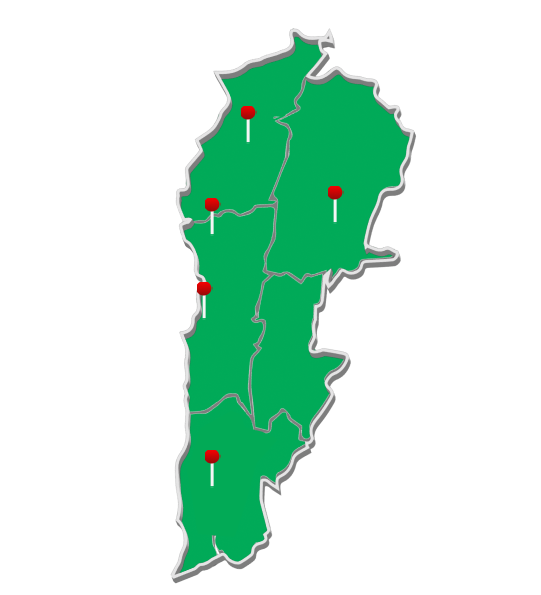
Explore Lebanon – Ministry of Tourism Lebanon
INTERACTIVE MAP DISCOVER LISTED SITES by MOT EXPLORE LEBANON Lebanon’s diverse patchwork of Mediterranean-lapped coast, rugged alpine peaks, and green
“Just as there can be no stability in Lebanon while the South remains under threat, the country cannot recover if Akkar remains neglected and the Bekaa deprived.”
His comments reflected a longstanding debate within Lebanon over regional inequality. While Beirut and Mount Lebanon have traditionally attracted the bulk of investment, northern Lebanon has struggled with underdevelopment, unemployment and poverty.
Official statistics underscore the challenge. Akkar records Lebanon’s highest poverty rate at 62 percent, nearly double the national average. Labor force participation stands at only 35 percent compared to 43 percent nationwide, while unemployment affects nearly one-quarter of the governorate’s population.
Salam noted that despite decades of neglect, Akkar has played a crucial role in Lebanon’s national institutions, supplying thousands of soldiers and security personnel to the Lebanese Armed Forces.
“Many of his sons have sacrificed their lives for the country,” he said.
Strengthening Lebanon’s Aviation Network
Government officials stressed that René Moawad Airport is not intended to compete with Beirut’s international airport but rather to complement it.
“Lebanon needs a modern, integrated aviation network,” Salam said. “It also needs infrastructure that links all regions of the country to the national economy.”
That argument has gained greater urgency in recent years.
For decades Lebanon has depended entirely on Beirut-Rafic Hariri International Airport as its sole commercial aviation gateway. While Beirut Airport has remained remarkably operational through civil war, political crises, economic collapse and regional conflicts, its status as the country’s only international airport has also represented a strategic vulnerability.
The recent conflict between Israel and Hezbollah once again highlighted concerns surrounding transport resilience. Airline disruptions, security warnings and regional instability periodically affect operations and reinforce the importance of redundancy within national infrastructure.
The reopening of Qlayaat therefore serves not only economic purposes but also strategic ones. A second airport provides operational flexibility, emergency alternatives and additional capacity should disruptions affect Beirut.
For Lebanon’s aviation sector, the project sends a signal that the country intends to expand rather than retreat despite continuing regional tensions.
Low Cost Aviation Could Transform Travel
Lebanese Minister of Public Works and Transport Fayez Rassamni announced that the airport is expected to become fully operational within weeks.
The first scheduled routes are expected to connect Qlayaat with Mersin, Istanbul and Dubai. Additional destinations under consideration include Medina, Cairo and Athens.
The government’s aviation strategy extends well beyond regional connectivity.
Officials are actively courting low-cost airlines including AJet, Pegasus Airlines and Air Arabia. Discussions are also underway with European carriers and operators that could create affordable connections to dozens of destinations across Europe.
Among the proposals being studied are partnerships involving Ryanair through Paphos, Cyprus, and Aegean Airlines through Athens.
If realized, these arrangements could significantly reduce travel costs for Lebanese passengers and create a competitive alternative to Beirut Airport.
Industry analysts note that low-cost carrier penetration in Lebanon remains comparatively limited. The introduction of budget airlines operating from northern Lebanon could stimulate tourism, increase outbound travel opportunities and encourage more frequent visits by the Lebanese diaspora.
Tourism’s Remarkable Resilience
The reopening comes as Lebanon’s tourism sector continues to demonstrate extraordinary resilience.
Few countries have experienced as many successive shocks over the past two decades. Lebanon has weathered war, political paralysis, financial collapse, the Beirut port explosion and repeated military confrontations involving Israel and Hezbollah.
Yet tourism repeatedly rebounds whenever conditions permit.
The reopening of Qlayaat Airport may strengthen that recovery by opening northern Lebanon to greater visitor flows and reducing dependence on Beirut as the country’s sole entry point.
The airport’s location offers unique opportunities. Located close to the Mediterranean coast and within reach of historic Tripoli, Akkar’s mountains and eco-tourism destinations, the facility could become a gateway to attractions that have traditionally received less international attention than Beirut or the mountain resorts.
For investors, it also creates new opportunities in hospitality, logistics, transport and commercial development throughout northern Lebanon.
Connecting the North
The government plans to integrate the airport into Lebanon’s transportation network through dedicated bus services linking Qlayaat with Beirut at affordable fares.
Authorities will also upgrade the four-kilometer access road connecting the airport to the Abdeh-Arida international highway.
Covering more than five million square meters, the airport occupies a strategic location on Lebanon’s northern coast. It sits only a few hundred meters from the Mediterranean Sea and approximately six kilometers from the Syrian border crossing at Arida.
Its proximity to Tripoli and northern economic corridors could eventually allow it to serve as a logistics hub supporting trade, cargo operations and regional development initiatives.
A Storyed History
The airport itself occupies a unique place in Lebanese history.
Originally established by Allied forces in 1941 during World War II, Qlayaat served as a military airfield on Lebanon’s northern coast.
In 1960 it became affiliated with the Iraq Petroleum Company, which used the facility for civilian transport operations serving employees and engineers working throughout the region.
Control later passed to the Lebanese Army, which expanded and modernized the airport. During the 1960s it was considered among the most advanced military air bases in the region and hosted French-supplied Mirage fighter aircraft as part of defense agreements between Lebanon and France.
Operations largely ceased during the Lebanese Civil War.
The airport re-entered national history in 1989 when Lebanese parliamentarians gathered there to elect René Moawad as President of Lebanon. Following his assassination seventeen days later, the airport was renamed in his honor.
Today, officials hope the facility will once again become a symbol of national renewal.
Challenges Ahead
Despite the optimism surrounding the reopening, significant obstacles remain.
The airport must complete operational certification, attract sufficient airline partners and prove the commercial viability of its route network. Sustained investment will be required to modernize infrastructure and maintain international standards.
Regional security concerns may also affect airline decisions and insurance costs. Continued tensions between Israel and Hezbollah remain a factor for investors evaluating long-term commitments in Lebanon’s transport sector.
Economic conditions present another challenge. Lebanon’s financial crisis continues to constrain government resources, making private-sector participation essential for future expansion.
Nevertheless, the reopening of René Moawad Airport marks one of the most significant infrastructure developments in Lebanon in decades.
For Akkar, it offers a pathway towards long-overdue economic inclusion. For the aviation sector, it creates new opportunities for competition and growth. For tourism, it opens a new gateway to northern Lebanon.
And for a country that continues to endure political, economic and security challenges, the return of civilian aviation to Qlayaat serves as a powerful reminder that development and resilience remain possible even in the most difficult circumstances.