Kyrgyzstan’s tourism industry is gaining momentum, with revenues surpassing $1 billion in 2025. Once a largely regional destination, the country is attracting international travelers drawn to its dramatic mountain landscapes, nomadic culture and low-impact, experience-based tourism—positioning it as an emerging alternative to more crowded global destinations.
Bishkek– Kyrgyzstan, a mountainous nation long overshadowed by more established Silk Road destinations, is quietly emerging as one of the fastest-growing tourism economies in Central Asia.
New figures reported by regional media show that the country’s tourism revenues climbed by more than 8 percent in 2025, surpassing $1 billion for the first time. The increase, while modest by global standards, marks a significant turning point for a country where tourism has historically played a limited role in economic development.
Officials in Bishkek say the growth reflects years of incremental investment in infrastructure, combined with a strategic effort to reposition Kyrgyzstan as a destination for adventure and cultural travel.
A regional core, a global ambition
For now, the vast majority of visitors still come from neighboring countries. Travelers from Kazakhstan, Uzbekistan, and Russia dominate arrivals, benefiting from visa-free regimes, geographic proximity, and longstanding cultural ties.
But tourism authorities are increasingly looking beyond the region. Visitors from the Gulf states, Europe, and parts of Asia are beginning to appear in greater numbers, drawn by a combination of affordability and what industry promoters describe as “untouched landscapes.”
Unlike its neighbors, Kyrgyzstan has not pursued large-scale resort development. Instead, it is marketing itself as a destination for experiential travel — the kind that emphasizes authenticity over luxury.
The Appeal of the Unfinished

In a global tourism market often defined by overtourism and standardization, Kyrgyzstan’s relative lack of development has become an asset.
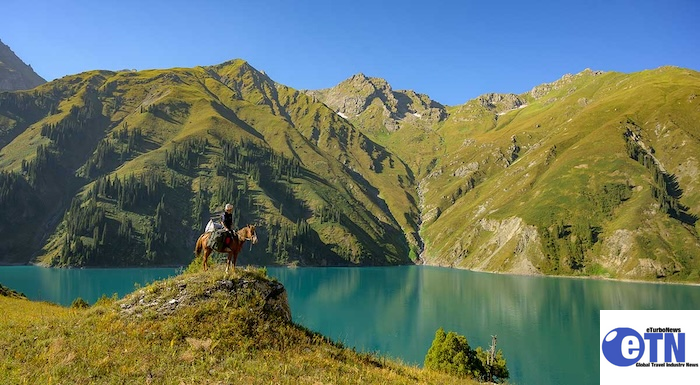
The country is more than 90 percent mountainous, dominated by the Tien Shan range. الصيف brings trekkers and horseback riders to alpine pastures and high-altitude lakes like Issyk-Kul, while winter draws a smaller but growing number of skiers to resorts near Karakol.
Equally central to its appeal is its nomadic heritage. Visitors can sleep in traditional yurts, watch eagle hunters at work and travel along routes that trace the ancient Silk Road.

“It’s one of the few places where you still feel like you’re discovering something,” said a German traveler encountered near a yurt camp on the southern shore of Issyk-Kul. “It hasn’t been packaged yet.”
Economic Stakes
Tourism now accounts for a growing share of Kyrgyzstan’s gross domestic product, estimated at just under 4 percent. The sector supports tens of thousands of small businesses, from family-run guesthouses to guides and transport providers.
For a country heavily reliant on remittances and extractive industries, the expansion of tourism offers a rare opportunity for diversification.
Still, challenges remain. Infrastructure outside major hubs is inconsistent, and the country’s rugged terrain complicates large-scale development. Seasonal fluctuations also limit year-round revenue, although officials are promoting winter sports and cultural tourism to address the imbalance.
Walking a narrow path
The government has signaled that it intends to avoid the pitfalls seen in other destinations overwhelmed by rapid growth. Policymakers have increasingly emphasized sustainability, community-based tourism and environmental protection.
That approach may prove critical. Much of Kyrgyzstan’s appeal lies in its fragile ecosystems and traditional ways of life — assets that could be easily undermined by unchecked expansion.
A Different Kind of Destination
As global travelers seek alternatives to crowded hotspots, Kyrgyzstan’s rise reflects a broader shift in demand. Increasingly, tourists are looking for places that offer not just scenery, but a sense of discovery.
Whether Kyrgyzstan can scale its tourism sector without losing that identity remains an open question.
For now, its growth suggests that even in a saturated global market, there is still room for destinations that feel — at least for the moment — largely untouched.