


Japan Airlines is testing humanoid robots to assist with baggage handling and ground operations, signaling a shift in aviation automation. While not fully replacing workers, the move reflects Japan’s labor shortage and a broader trend across airlines and tourism toward robotics-driven efficiency and human–machine collaboration.
Building on the Japan Airlines experiment, it becomes clear that JAL is not acting in isolation—it is part of a broader, global shift toward automation. However, its use of humanoid robots is unusually advanced compared to most airlines and tourism operatorswhich tend to rely on more specialized or limited robotics.
Japan Airlines: A Leap Toward Humanoid Laboratory
As discussed, Japan Airlines is testing humanoid robots at Tokyo’s Haneda Airport to assist with baggage and cargo handling.
- Robots perform physically demanding tasks like moving luggage
- Humans retain safety-critical roles
- Trial runs through ~2028
- Motivation: labor shortages and tourism growth
What makes JAL unique:
Unlike most aviation automation (which uses fixed machines), JAL is testing general-purpose humanoid robots that can operate in human-designed environments without major infrastructure changes.
Other Airlines: Automation Without Humanoids
1. Aircraft Inspection & Maintenance Robots
Companies like Airbus (and partners such as Air France Industries) have developed systems like Air Cobotwhich:
- Inspect aircraft fuselages
- Use sensors and cameras to detect damage
- Operate semi-autonomously in hangars
Key difference from JAL:
- These are task-specific robotsnot humanoid
- They replace inspection tasks, not general labor roles
2. Airport Service Robots (Customer Facing)
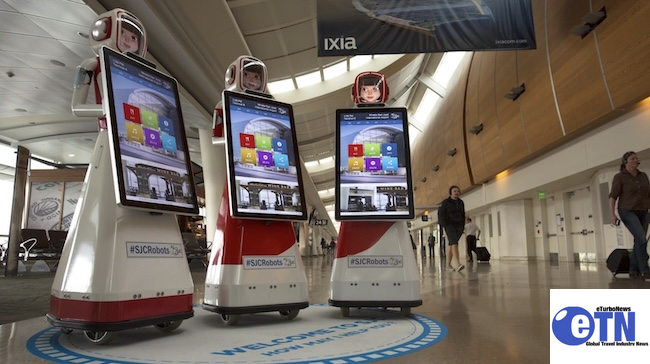
Airports worldwide have experimented with humanoid-style service robots like Pepper:
- Used in airports (eg, Montréal-Trudeau) to greet passengers
- Provide directions, recommendations, and basic assistance
- Deployed in banks, hotels, and retail as well =
Limitations observed:
- Struggled in noisy environments
- Low user engagement in some cases
- Often removed after trials
Comparison to JAL:
- Pepper focuses on customer interactionnot physical laboratory
- JAL’s robots target back end operationsa more impactful cost area
3. Autonomous Logistics Robots in Airports
Many airports already use non-humanoid automationincluding:
- Automated baggage systems
- Self-driving carts and tugs
- Cleaning robots
Research shows airports are steadily adopting Industry 4.0 technologies to improve efficiency and handle post-pandemic challenges.
Comparison to JAL:
- These systems are fixed or wheeled machines
- JAL is experimenting with flexible, human-like robots that could replace multiple systems
Tourism & Hospitality: Robots as Service Workers
1. Hotels Using Delivery and Service Robots


Hotels—especially in Japan—have been early adopters:
- Delivery robots bring items to guest rooms
- Robots assist with check-in or concierge services
- Example: HOSPI used in hotels and airports
Some “robot hotels” initially replaced staff—but later reintroduced humans due to technical limitations.
Comparison to JAL:
- Hospitality robots focus on guest experience
- JAL focuses on operational efficiency and labor shortages
2. Mixed Results in Tourism Robotics
Across tourism:
- Robots improve novelty and branding
- But often struggle with real-world complexity
- Many deployments remain partial or experimental
Even advanced humanoid robots like Pepper have been scaled back in some locations due to inefficiency
Key Differences: JAL vs Global Trends
| aspect | Japan Airlines | Other Airlines | Tourism Industry |
|---|---|---|---|
| Robot type | Humanoid, general purpose | Specialized machines | Service & delivery robots |
| Use case | Physical laboratory (baggage) | Inspection, automation | Customer interaction |
| goal | Solve labor shortage | Improve efficiency & safety | Enhance experience |
| Replacement level | Partial workforce substitution | Task automation only | Mostly supplementary |
| Maturity | Experimental but ambitious | More established | Mixed success |
Big Picture: Why JAL Stands Out
Japan Airlines represents a next generation phase of automation:
- From fixed machines → adaptable robots
- From task automation → role augmentation
- From customer-facing novelty → core operations
Most global players are still in earlier stages—using robotics to assist specific tasksnot to potentially reshape entire job categories.
Conclusion: A Preview of the Future?
JAL’s humanoid robot trial may signal where the aviation and tourism industries are heading:
- Short term: hybrid human–robot teams
- Medium term: expanded robotic roles in logistics and operations
- Long term: possible redefinition of frontline labor
But history suggests caution: many robotics experiments succeed technically yet fail operationally. The real test is not whether robots can work—but whether they can consistently outperform humans in cost, reliability, and flexibility.
Japan Airlines is effectively running that test in real time—and the rest of the world is watching.