


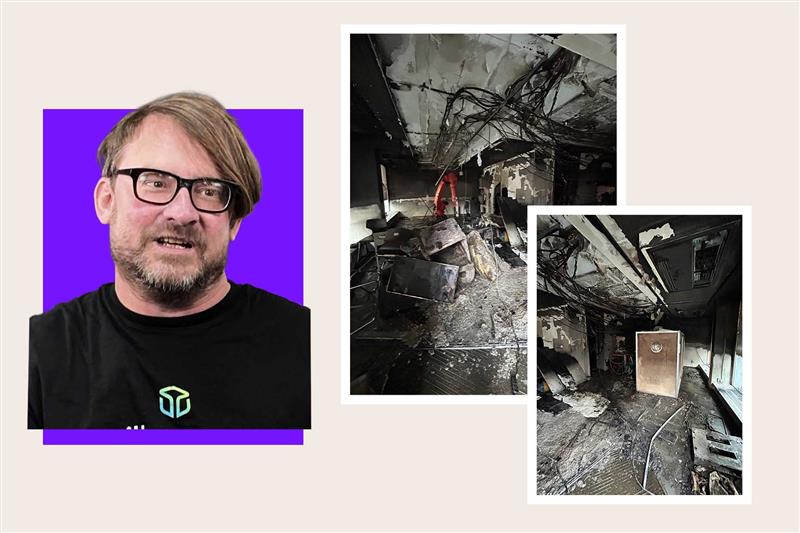
The opening ceremony of a young startup ends in the fire department: the pop-up store is on fire, the cause of the fire is unclear. Shortly afterwards, the next piece of bad news comes: the insurance won’t pay.

November 14th actually started as planned for Joost Meyer and his co-founder Federico Garrido. It was the big opening day that both had been preparing for a long time. “Everything was ready, even the adhesive letters on the pop-up store were attached,” says Meyer.
Meyer was standing in the hallway, ready to head out, when suddenly the phone rang. The landlady said there was a fire on Dahmengraben – the street where her pop-up store was located. The two founders didn’t know how bad it was at the time. They set off together.
“As we drove into town, a column of smoke rose. I just thought: If that’s us, then we’re screwed,” says Meyer.


From research to real life
His company Willowprint is a spin-off from RWTH Aachen. After four years of research at the university, Meyer and Garrido received their first funding from the state of North Rhine-Westphalia – with the mandate to turn theory into practice.
Read too

The pop-up store in downtown Aachen was supposed to be the first big step: a meeting space where research, startup culture and society come together. “There are a lot of young, creative minds in the area. We wanted to contribute something positive and become more visible,” says Meyer. Even in the first few days when Garrido was calibrating the robot arm, small children were flattening their noses on the window, he says.


3D printing without plastic
In the middle of Aachen’s pedestrian zone, the founders wanted to show what they are working on: 3D printing without plastic. Instead of melted plastic, Willowprint uses a paste made from wood fibers and natural binders that is recyclable and biodegradable. The material is pressed out of a cartridge layer by layer and dries in the air to form solid wood material. The result not only feels like wood, it behaves like it too.
Read too

The printed parts can be sawn, sanded or screwed together. The material can be ground up and used again, and only when that is no longer desired can it be composted. Willowprint wants to solve a basic problem of 3D printing: the plasticity.
Back to November 14th. When they arrive at Dahmengraben, they are greeted by a thick cloud of smoke. They can’t see the long-awaited robot arm, which was specially made for 3D printing and purchased with NRW funding, because of the smoke. “The bottom meter in the store was clear. The smoke rose above it and the fire department was on large-scale operations,” said Meyer. It is also initially unclear what the status of the back room in which Willowprint stored important materials is.
Fortunately, nothing happened to anyone, emphasizes Meyer. “But it was still a nightmare because we stood in front of our startup baby for three hours and had to watch helplessly as it burned down.”
Who is to blame?
At lunchtime the two are finally allowed into the damaged store. Everything is covered in soot and burned down, the materials in the back room are completely destroyed. Only the robot arm in the middle of the room survived the fire. “That orange robotic arm, the heart of our company, really glowed in the burned-out room.”
Read too


How do you as a founder deal with such a shock? What did Meyer and Garrido do in the hours after the fire? “We first held a crisis meeting. Until the cause of the fire was clarified, we were unable to act anyway,” says Meyer. But the meeting brought little insight because everyone was in shock. An entrepreneur friend then secured the fire site with OSB panels. From then on it was just a matter of waiting.
In addition, there is initially the pressure of the big question: Who is to blame? Is Willowprint partly responsible? Or was it a short circuit? “We were actually sure that we unplugged and checked everything the day before, but you can never be sure,” says Meyer.
Read too

Days of cleaning and tidying follow. The team cleans every corner of the room and polishes the robot arm in the hope that it still works. “We spent hours removing the soot from the circuit boards with Q-tips and scrubbing the robot. It looked great from the outside. But we still had to find out whether it worked inside,” says Meyer.
Insurance does not cover damage
A short time later there are the results of an expert investigation. The cause of the fire has finally been determined: a defect in the house’s electrical system, Willowprint is not to blame. At first there is relief, but as the cleanup work comes to an end comes the next piece of bad news: the insurance won’t pay. Although it is liable for the building, it is not liable for the tenants’ inventory.
Meyer always assumed that the insurance would pay. “That was the absolute lowest point. A punch in the stomach,” he remembers.
Read too
Three months later there is a feeling of optimism again
Today Willowprint is facing a reboot. “Everything is ready. We have signed the rental agreement for a new industrial hall,” says Meyer. Nevertheless, he mourns the pop-up store in the city center. “There was just a certain atmosphere of optimism there. Now we are in an industrial area, with not so much meeting space, but everything else fits in.”
There was also good news for the young startup on a financial level: at the beginning of February, NRW State Environment Minister Oliver Krischer presented Willowprint with a 600,000 euro check as part of an awards ceremony for the NRW “Green Foundation” funding. A financial injection that the startup desperately needed.


According to Meyer, the final property damage, which was not covered by insurance, amounted to around 90,000 euros. The new materials stored in the back room alone were worth 15,000 euros. Thanks to the funding, the financial basis is now secured and research can finally continue, says Meyer.
Read too

He is now looking forward with confidence: “We can now finally get going again – with financial security, calmly moving forward with our project and trying out new things.”