


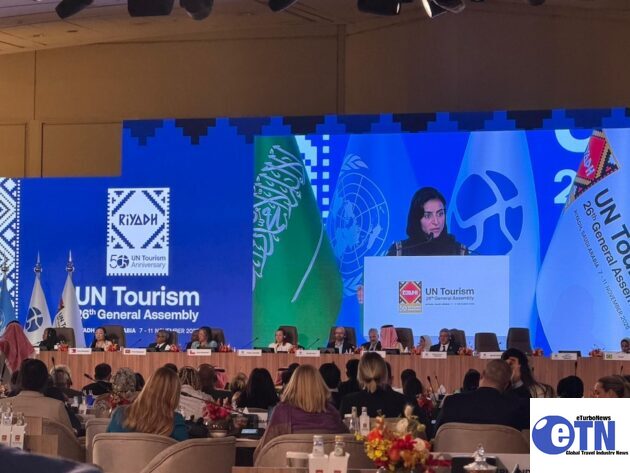
The world may simply stop notifying UN Tourism!
When Shaikha Al Nowais assumed office as Secretary-General of UN Tourism on January 1, the mood across much of the global tourism community was one of cautious optimism.
After eight years under the controversial leadership of Zurab Pololikashvili, many hoped the organization would finally turn the page.
Zurab’s tenure was marked by repeated allegations of opaque governance, questionable election procedures, and an increasingly centralized leadership style. Two former Secretaries-General publicly questioned his leadership and called for institutional reform. Throughout his time in office, many journalists, including eTurboNews, experienced a leadership that was largely inaccessible, with media requests frequently unanswered and transparency becoming increasingly difficult to assess.
Against this backdrop, the election of Shaikha Al Nowais came as a surprise.
Little known internationally outside diplomatic circles, she entered office promising to represent a new generation of leadership. Her candidacy reportedly benefited from strong support from the United Arab Emirates, whose growing global influence and financial capacity were widely seen as important factors during the campaign.
Seven months later, however, optimism has given way to growing concern.
No one questions that the Secretary-General is courteous, approachable in person, and softly spoken. The larger question increasingly being asked throughout the tourism industry is whether she possesses the experience, institutional knowledge, and global leadership necessary to guide one of the world’s most important tourism organizations through an increasingly complex geopolitical environment.
An Organization Representing Only Part of the World
UN Tourism remains an important institution within the UN system, but it no longer represents the entire global tourism community.
Major economies and tourism powers—including the United States, the United Kingdom, Canada and Australia—remain outside the organization, with no indication they intend to return. While UN Tourism has approximately 150 Member States, it represents considerably fewer countries than the United Nations itself. Collectively, many of the countries outside the organization account for a disproportionate share of global tourism investment, aviation, hotel development and outbound travel.
Rather than expanding its membership during its first seven months under new leadership, the organization has added no significant new members.
This inevitably raises questions about the organization’s global influence.
Does Leadership Mean Speaking—or Remaining Silent?
Perhaps the most troublesome issue is communication.
Throughout 2026, the Secretary-General has not granted interviews to major international media outlets, including CNN, Travel Weekly, or eTurboNews. Media access to UN Tourism events has also become increasingly limited, making independent reporting on the organization far more difficult.
The Secretary General was seen having been interviewed by Forbes Middle East.

No UN agency is legally required to grant interviews to journalists. However, the United Nations has long maintained communication principles emphasizing openness, transparency and proactive engagement with the media. The UN’s own media guidelines encourage honest dialogue with journalists and recognize the essential role of an independent press in explaining the work of the Organization.
If reports circulating within the tourism community are accurate—that the Secretary-General believes “the media will write what we want anyway,” and therefore interviews are unnecessary—such an approach would be inconsistent with the communication principles the UN itself promotes.
Transparency is not simply a public relations exercise.
It is fundamental to accountability.
Understanding the Institution You Lead
Another issue increasingly discussed privately within tourism circles concerns institutional knowledge.
Industry veterans have expressed surprise that the Secretary-General reportedly described UN Tourism as having always been a United Nations organization.
Historically, that is incorrect. UN Tourism actually has its history well documented:
Many younger tourism professionals may not realize that UN Tourism did not begin life as a United Nations agency.
The organization originated as the International Union of Official Travel Organizations (IUOTO) before becoming the World Tourism Organization (WTO) in 1975. Only in 2003 did it formally become a specialized agency of the United Nations after approval by the UN General Assembly.
That history matters because it reflects decades of cooperation built long before the organization joined the UN system. Leadership requires understanding not only where an institution is going, but also where it came from.
The organization originated as an independent international tourism body before becoming a specialized agency of the UN system in the early 2000s. Understanding this evolution matters because it explains the organization’s unique governance structure, its relationship with governments, and why several important tourism nations remain outside its membership.
Leadership begins with understanding the institution one has inherited.
Tourism Cannot Be Led Alone
Perhaps the most concerning reports emerging from industry conversations are suggestions that the Secretary-General views UN Tourism as the sole authority for global tourism and sees little need to cooperate with organizations such as the World Travel & Tourism Council (WTTC), IATA, CLIA or PATA.
If true, this represents a fundamental misunderstanding of how global tourism functions.
No single organization speaks for tourism.
- Governments need airlines.
- Airlines need airports.
- Hotels need tour operators.
- Destinations need investors.
- Communities need private-sector financing.
- International organizations need partnerships.
UN Tourism has traditionally represented governments, while WTTC has represented the major private sector. Those roles have never competed; they have complemented each other.
Recent events suggest those relationships have weakened. Leaders of organizations that routinely participated in major UN Tourism meetings have largely disappeared from the agenda. Even Gloria Guevara, now leading WTTC, attended the inauguration of UN Tourism’s new headquarters at the invitation of the Spanish Government rather than UN Tourism itself.
That symbolism did not go unnoticed.
Small Villages Cannot Replace Global Leadership
UN Tourism, favored by the Secretary General, such as Best Tourism Villages, are valuable initiatives. They deserve recognition. But awards alone do not create sustainable tourism.
Communities require investment, infrastructure, aviation access, training, financing, and partnerships with the private sector to thrive.
Global tourism today faces wars, geopolitical instability, changing trade relationships, visa barriers, climate challenges, and unprecedented technological disruption.
These issues require international leadership. Many observers struggled to identify UN Tourism’s voice on any of them.
UN Tourism Secretary General Speaks at International Events
Throughout her first seven months in office, the Secretary-General has maintained a visible presence on the international conference circuit, appearing as a keynote speaker or panel participant at numerous tourism summits, ministerial meetings, and global events.
While this visibility has kept UN Tourism represented on stage, many industry observers have noted that the messaging has remained largely consistent from one appearance to the next, focusing on familiar themes such as sustainability, innovation, and rural tourism.
What has been less apparent are major new initiatives, policy breakthroughs, or global partnerships that have demonstrably changed the direction of international tourism or strengthened UN Tourism’s influence within the sector. Visibility is important, but over time, leadership is measured less by speeches than by tangible outcomes and lasting impact, and is willing to answer hard questions by the media.
Has WTTC Filled the Vacuum?
As UN Tourism’s visibility has diminished, WTTC appears to have expanded its influence.
Under Gloria Guevara’s leadership, the organization has strengthened relationships with governments, destinations, and private industry. It has broadened its global outreach and increasingly serves as the forum where public and private sector leaders engage together.
Recent engagement with senior United States representatives—including discussions with Special Presidential Envoy Nick Adams regarding future cooperation—illustrates WTTC’s growing political reach.
- Destinations are joining.
- Private investment discussions continue to grow.
- Increasingly, industry conversations that once naturally centered around UN Tourism are happening elsewhere.
The Question No One Wanted to Ask: Are Tourism Leaders noticing UN Tourism?
Seven months ago, the tourism world hopes for renewal. Instead, many now ask a question that would have seemed unthinkable only a year ago.
Is UN Tourism still indispensable? Or has the global tourism ecosystem simply adapted and moved on? This is not a question any supporter of multilateral cooperation wanted to ask. A strong UN Tourism benefits governments, developing destinations, and international cooperation.