


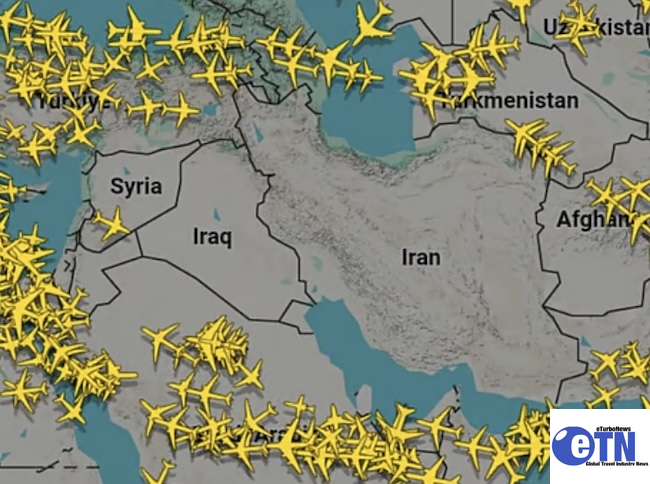
A fresh Iranian missile-drone strike on the UAE in the last 3 hours has raised urgent questions about the stability of recently reopened airspace in Dubai and Abu Dhabi. With airlines like Emirates and Etihad Airways Just restoring operations, analysts warned the fragile recovery could quickly reverse if tensions escalate again.
Just as the United Arab Emirates was beginning to restore normality to its aviation sector, a new Iranian missile strike has cast serious doubts about whether the country’s long-awaited reopening of airspace can hold.
Hours after authorities signaled a return to near-full operations at major hubs including Dubai International Airport and Abu Dhabi’s Zayed International Airport, air defenses intercepted multiple الإيراني projectiles targeting the UAE — the latest in a string of escalations that have repeatedly disrupted travel across the Gulf.
While officials say there were no major casualties and most threats were neutralized, the timing could hardly be worse.
A fragile reopening for Emirates Airlines and Etihad Airways
In recent days, flagship carriers Emirates and Etihad Airways had begun restoring routes after weeks of cancellations, rerouting, and airspace closures tied to regional conflict.
Airport authorities described operations as “scaling up,” with passenger volumes slowly returning and transit traffic — a cornerstone of the UAE’s global hub strategy — beginning to recover.
But industry insiders now warn that recovery may have come too soon.
“This reopening was always contingent on stability,” said one aviation risk analyst based in the Gulf. “What we’re seeing now is how quickly that assumption can collapse.”
Could airspace close again?
Dubai Airports | Connecting the World | DXB & DWC
Dubai Airports – Explore flight information, services, facilities, and more.
The key question facing airlines, regulators, and travelers is whether this latest strike will trigger a renewed shutdown.
So far:
- UAE airspace remains technically open
- Flights continue operating, although with increased caution
- Airlines are reviewing routes in real time
However, the system remains highly sensitive. Even a limited escalation could force:
- Immediate flight suspensions
- Rerouting away from high-risk corridors
- Temporary airport slowdowns or closures
“Airspace doesn’t need to be directly hit to be shut,” an aviation security consultant said. “Perception of risk alone can ground fleets.”
Tourism recovery at risk
The UAE had only just begun to repair damage to its tourism sector, particularly in Dubai and Abu Dhabiwhere hotel bookings and visitor numbers had fallen sharply during earlier waves of attacks. Now, that recovery may stall again.
Travel companies report:
- Early signs of new cancellations
- Clients requesting flexible rebooking
- Rising concerns about insurance coverage in conflict zones
“Tourism runs on confidence,” said a regional hospitality executive. “You don’t need sustained damage — just repeated shocks.”
A stop-start recovery cycle
Today’s strike reinforces what analysts are calling a “stop-start” recovery pattern for the UAE:
- Airspace closes → travel demand collapses
- Reopening begins → airlines ramp up
- New strike → uncertainty returns
This cycle has already played out multiple times in recent months — and may now repeat again.
Global ripple effects
The implications extend beyond the UAE.
As one of the world’s most important transit hubs, disruption to Dubai and Abu Dhabi affects:
- Europe–Asia connecting traffic
- Cargo and logistics routes
- Energy-linked travel tied to Gulf economies
Markets have already reacted nervously, with oil prices rising and global stocks dipping following reports of the strike.
What happens next for Aviation in Dubai, Abu Dhabi?
For now, UAE authorities appear determined to keep airspace open and maintain operations.
But the margin for error is thin.
Another strike — especially one causing damage near critical infrastructure — could force a rapid reversal of the reopening that airlines like Emirates and Etihad have only just begun.
“The reopening isn’t locked in,” the aviation analyst said. “It’s provisional — and events like this remind everyone how quickly it can be undone.”
Bottom line:
The UAE’s aviation recovery is underway — but after today’s events, it is no longer secure.