


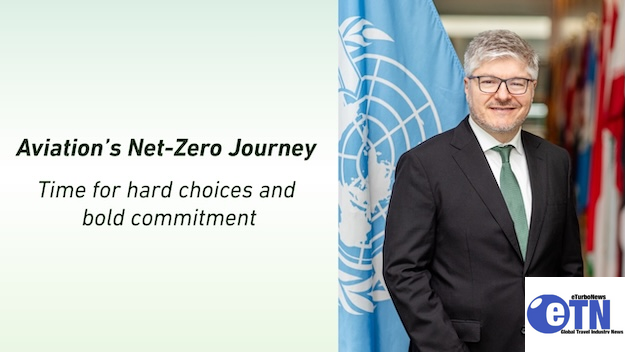
Global aviation stands at a critical crossroads as governments and industry leaders prepare for ICAO Aviation Climate Week. ICAO Secretary General Juan Carlos Salazar argues that achieving net-zero aviation by 2050 will require urgent investment, harmonized global standards, sustainable aviation fuel expansion, and unprecedented international cooperation to accelerate decarbonization efforts worldwide.
Juan Carlos Salazar, ICAO Secretary General, issued his views today on Aviation and Climate Change.
For decades, civil aviation has been an engine of globalization, prosperity, and human connection. Yet today, it faces a defining test: whether it can decarbonize quickly enough to remain both viable and valuable in a climate-constrained global economy.
As airlines, manufacturers, investors, and regulators gather for climate-focused discussions at the International Civil Aviation Organization (ICAO) later this month, the central question will no longer be whether aviation can decarbonize. Technologically and operationally, it can. The real question is whether the global community is prepared to make the difficult choices required — and to make them at the pace that today’s climate reality demands.
For ICAO, the answer can only be yes.
The aviation sector has already demonstrated that progress is possible. Incremental efficiency gains, early deployment of sustainable aviation fuels (SAF), and operational improvements have reduced emissions growth while supporting continued connectivity and economic development. But these efforts, while important, are no longer sufficient on their own. The transformation now required is systemic, global, and urgent.
If decarbonization proceeds unevenly or in a fragmented manner, the sector risks more than missing climate targets. It risks losing public confidence and political support at a time when both are essential for aviation’s long-term future.
ICAO’s Long-Term Global Aspirational Goal of achieving net-zero carbon emissions by 2050 provides a shared direction for governments and industry alike. Yet ambition without implementation will not deliver results. The coming decade must be defined not by new declarations, but by accelerated execution.
Achieving net-zero aviation will require sustained investment on an unprecedented scale. Encouragingly, recent years have brought a surge in financing, innovation, and research — from more efficient propulsion technologies and aircraft designs to operational digitalization and large-scale investments in cleaner energy pathways.
Among these solutions, sustainable aviation fuels are expected to play a decisive role. Current projections indicate that SAF could deliver more than half of aviation’s required emissions reductions by mid-century. But this transition will not happen automatically. Massive investments in production capacity, infrastructure, and supply chains must be mobilized now, especially in emerging and developing economies.
This is precisely why ICAO is expanding efforts to connect climate ambition with practical implementation
Through initiatives such as the Finvest Hub, ICAO is helping link aviation decarbonization projects with institutional and private capital, particularly in regions where access to climate finance remains limited. At the same time, ICAO’s Assistance, Capacity-building and Training for Sustainable Aviation Fuels (ACT-SAF) and Assistance, Capacity-building and Training for Long-Term Aspirational Goals (ACT-LTAG) programs are helping States strengthen the policy frameworks, technical expertise, and institutional capacity needed to participate fully in the energy transition.
Global coordination will also be indispensable. Investors and industry leaders require clear, harmonized regulatory signals if they are to commit to long-term transformation at scale.
ICAO has therefore continued developing and adopting global standards for cleaner aviation energy and more rigorous environmental standards for aircraft. These frameworks provide the predictability and confidence necessary to accelerate innovation while safeguarding environmental integrity. Robust sustainability criteria and certification systems for SAF are equally essential to ensure that rapid growth does not undermine public trust or environmental credibility.
Today, more than 150 ICAO Member States — representing over 99 percent of global air traffic — have already submitted action plans under ICAO’s environmental protection framework. This demonstrates unprecedented global alignment around aviation climate action.


International Civil Aviation Organization
The International Civil Aviation Organization (ICAO) is a United Nations agency which helps 193 countries to cooperate together and share their skies to their mutual benefit.
But alignment alone is not enough.
This June, delegates will gather for ICAO Aviation Climate Week, the first such meeting since States unanimously reaffirmed ICAO’s climate objectives last October. Governments, industry leaders, technical experts, and financial institutions will come together not simply to discuss ambitions, but to strengthen implementation.
Participants will have opportunities to engage directly with financing initiatives, develop partnerships, improve emissions monitoring and reporting capabilities, and participate in technical workshops designed to accelerate practical action. The outcomes of Climate Week could help determine the pace and credibility of aviation’s decarbonization efforts for years to come.
Aviation’s history has always been defined by moments of shared challenge and bold innovation. This is one of them.
If governments and industry choose cooperation with urgency through ICAO, a net-zero aviation sector within this generation remains achievable. If they do not, aviation risks being constrained not by a lack of ingenuity, but by a climate reality that no sector can escape.