


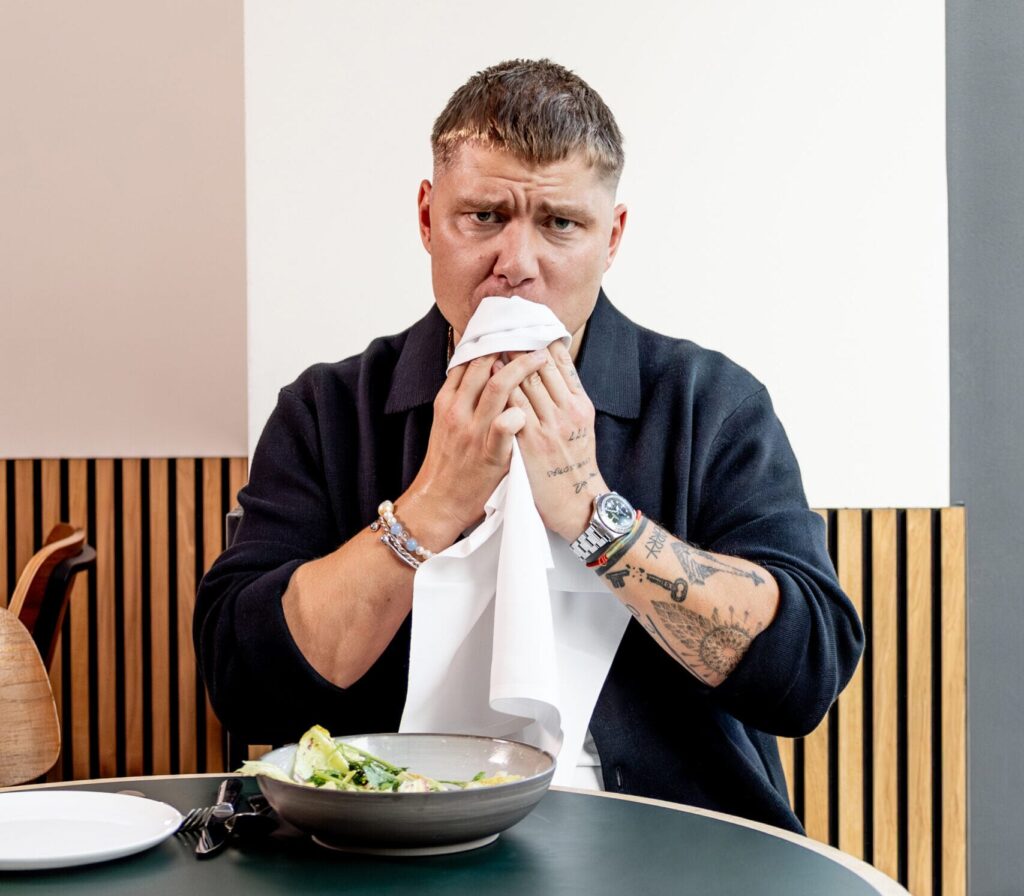

Andy Zingler grew up with restaurants, nightclubs and steak knives. For him, food was never a means to an end, but rather a lifestyle. Today, with almost 100,000 followers on Instagram, he is one of Germany’s most successful food creators – and struggles with pressure, depression and the question of what success actually means. A conversation about origins, hunger and the feeling of finally wanting to be seen.
Founder Scene: Andy, you became famous with food content. When did you first realize that food would play such an important role in your life?
Andy Zingler: My dad was a restaurateur. I actually grew up entirely in restaurants. When he had appointments or catering, I always spent the waiting time in the restaurant. I hung out there, snacked, people-watched. That was my place. Food was always there, gastro was always there.
What kind of restaurant did your father have?
Very different things, but mainly steak. A small steakhouse in the suburbs, in Schwarzenbek. And he also had nightclubs back then. When I was about six years old, I would go into the clubs in the morning before the cleaners came, when all the guests had left, and collect change. Around six or seven o’clock. That was completely normal for me.
From the restaurant to the ship and back again
When did it become clear to you: I wanted to go into the catering industry myself?
I wanted to be a chef. Early on. My dad didn’t want that.
Why not?
Because he knew exactly what this life was like. That maybe 0.5 percent of chefs have a really nice life – and the rest just don’t.
Did he stop you?
No, not at all. He always said: Do it. You can do it. You’ve done everything on your own so far.
And yet you’re not in the restaurant right now.
Out of reason. I trained in shipping, in a tramp shipping company – rented out ships, organized crew, ports, berths. Very structured.
How was that for you?
Actually really good. I even went out to sea for two months, I loved it. But an office job was never my thing. That was always more like what the system said: Do it. And I kept slipping into it. Gastro, then office again, then gastro again. Then my father suddenly died. I was 19 then.
What was the hardest part?
My father didn’t die suddenly. He had cancer for two years. Metastases that ate their way through the body, and in the end there was cancer everywhere. Death itself was almost tangible at some point – someone is gone. Point. The hardest thing for me wasn’t guilt or the feeling that I took something away from him. But that he is no longer there today. That he doesn’t see what I’m doing. That he doesn’t sit next to me, look at me and be proud of me. Or I can ask him how he sees things or would have done them. Because I would like to do a lot of things like him, the guy was just intense. I think that’s one of the best feelings ever – and that’s exactly what I miss every day.
What do you think he would say today if he saw what you were doing?
He would go completely crazy. If I told him that Lufthansa was flying me business class to New York or that Edeka was inviting me to Valencia – he would be so happy.
What importance did money have for him?
A high one because he had nothing. His mother was a war refugee. They built everything up. He had this one thing: He wanted me to earn 10,000 euros a month at some point. Not as a promise of happiness, but because he knew how much it relieved. This number was always in my head.
His salary: 2,000 to 25,000 euros per month
That would have been difficult in the catering industry.
Practically impossible as an employee. And that was my inner conflict: passion for gastronomy – and this mantra.
And today?
I have more than fulfilled this mantra.
How did social media come about?
I’ve always posted things. But for a long time I didn’t know that you could make money with it. We had this cooking show with my friend Felix Hartmann. Then I started the “lunchbox” where I just filmed my food every day. Suddenly it went viral. People recognized me, I was spoken to. We did an event, 300 people came. There was momentum.
When did you realize it could be more than just a hobby?
Until the first advertising transfer came. 2100 euros. Plus 4000 pending. That was about my catering salary. I asked myself: What do I enjoy more? The next day I quit.
I assume you were advised against this.
All. My mother too. My management tried to slow me down for three weeks. But I’m a gut feeling guy. And when someone tells me not to do it, it makes me more hot.
Were you afraid?
Yes. I borrowed money. The first month was weak. I had 18,000, 20,000 followers – it was actually completely crazy to quit.
How much do you earn today?
From 2000 to 25,000 euros per month. There are months when you pay more than you have. And months, you think: What the fuck.
How depression changed his life
Can you be proud of that?
Difficult. I miss that pat on the shoulder from my father. I often wish that his Proudness would pass over to me.
You also talk openly about depression on your site.
Because they shaped my life. Especially the time in the office job. I had panic attacks and my body shut down.
How did this show up?
I could no longer send emails. I sat in front of the computer and tried to press enter – and it didn’t work. I sat on the toilet in the office and cried. I was in bed with my roommate because I couldn’t cope on my own.
What was the hardest part?
The shame. This feeling: everyone else is getting their life together – except you.
And the total lack of feedback. In the restaurant someone says to you: ‘Thank you, nice evening.’ In the office you wait months for an email.
How did you get out of there?
Not at all at first. Cried a lot. Then friends. Medication. And at some point the decision: I have to go back to people. Gastro. Entertain. ‘Hey, let’s have a great evening today.’ That saved me.
Have you taken a break?
Three, four months. Go for a stroll. Drink coffee. Shut down the system.
What advice would you give to people who feel similarly?
Go outside. Don’t make everything about yourself. And do things that are fun – even if you think nothing is more fun. Your thoughts are not always yours. That is the depression.
Was there a key moment?
I went to therapy because of Kurt Krömer. When he spoke to Thomas Sträter. This sentence: ‘Don’t believe everything you think.’ Then I looked for a therapy place.
You’re feeling better today.
Yes. But I find these ‘you-made-it’ stories difficult. Some fight for ten years. If someone is out after two years and was lucky, that can put more pressure.
Social media is a new burden today.
Total. I am a 10 out of 10 cell phone addict. Nine, ten hours of screen time. Numbers, reactions, comments. My head never rests. And the mean thing: it’s my job.
Do you sometimes want to get out completely?
Not complete. I see the addictive behavior and accept it. But I need some time off. In January I’m doing two weeks completely offline.
Are you afraid of it?
No. All I know is that I will cry for the first few days. And then notice that I feel better.