


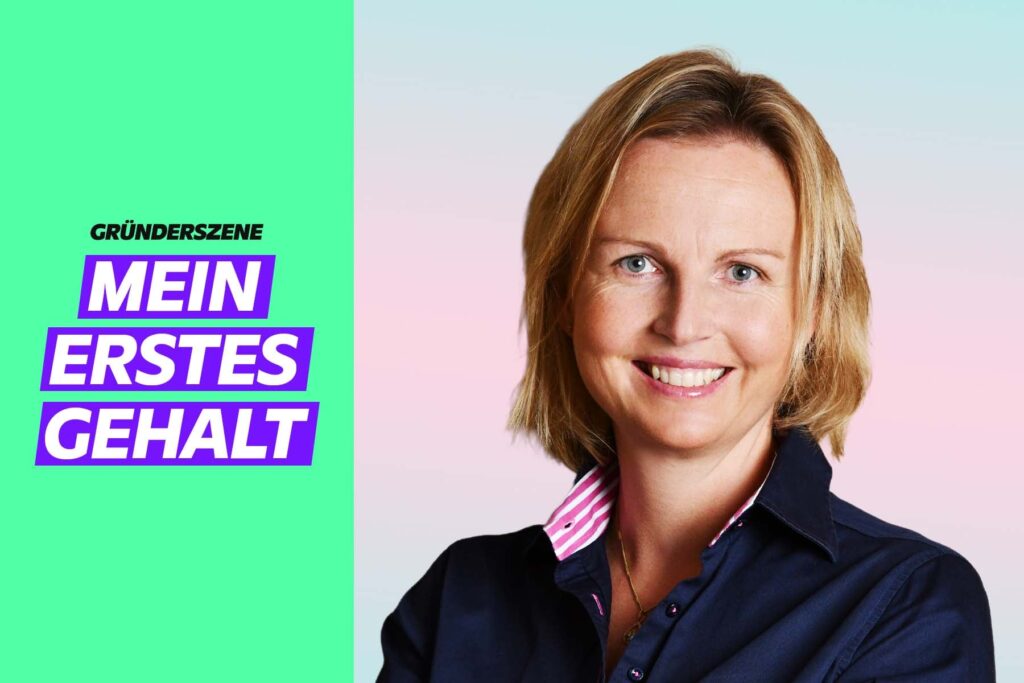
Four years without a salary: Jana Krotsch explains why, as a founder and mother of three children, she paid herself around 5,200 euros a month.


Jana Krotsch, collage: start-up scene
In our series, founders show when they paid themselves their first salary, how much it was – and why they chose this exact time. Narrated here: Jana Krotsch, founder of ubiMaster.
Jana Krotsch spent four years building her startup without paying herself a salary: in 2018, she founded the edtech company UbiMaster in Munich, inspired by her everyday life as a working mother of three schoolchildren.
Before founding the company, Krotsch worked, among other things, as a senior project manager at Munich Re. When she was in her early 40s, she quit, invested her severance payment entirely in the company and started as a solo founder. During this time, her husband was the main financial support for the family, and she also lived from reserves. It wasn’t until 2022 that she began paying out money from the company for the first time.
This is how UbiMaster works
UbiMaster is a digital tutoring platform through which students can get spontaneous support. You log in and within a few minutes you will be connected to a tutor – whether maths, German or English. The whole thing is not paid for by the families, but by partners such as banks or companies that integrate the offer. This makes it free for users and available at any time.
Here she talks about her first founder’s salary, when and how much it paid out, and how she determined the amount of the salary.
Founder scene: You founded a company as a mother in your 40s. What motivated you to do this?
Jana Krotsch: At the time, I asked myself whether I really wanted to do what I was doing until the end of my professional life, or whether I wanted to change something again. Through my children I realized how great the need for tutoring is and how much education still depends on the parents’ wallet. For my children, it wasn’t always just about achieving a class goal, but also about improving themselves. At the same time, I was often busy at work and couldn’t always help. Then the idea came: Can’t we solve this in a simpler way? I then consciously decided to quit and do something of my own. Many people around me had traditional careers and were therefore rather skeptical. Also because there were already many tutoring providers on the market – but with a different approach. Sometimes you feel alone. My husband supported me a lot during such phases and also advised me to always take a break from the business. This helped me to think more clearly again.
What was the biggest difference from the corporate world?
It was completely different. In a company you always have contacts with whom you can exchange ideas. As a founder, I was alone at the beginning, had no network and had to make many decisions myself. At the same time, it was incredibly exciting because something new happened every day. I learned a lot during this time, probably more than I have learned in many years.
What was your everyday life like with three children and a start-up?
You can’t fool yourself. Starting a business and looking after children at the same time does not work at the same time. You work at least as much as in a normal job, often on weekends too. We had support with childcare and an aupair. Nevertheless, it was an intense time. I worked a lot in the evenings and at night because the children were there during the day.
Read too


When did you receive your first salary – and how much was it?
I founded the company in 2018 and didn’t pay myself a salary until 2022. I only started when we had stable sales, employees and a financing round in sight. My first salary was around 5,200 euros a month. That’s probably on the high side for a female founder, but you have to see the context: I have many years of professional experience, come from the corporate world and have a family.
How did you live without a salary during that time?
At the beginning I received a start-up grant that lasted about a year. After that, we lived on savings and my husband used his salary to cover most of the running costs. I also invested my own money in the company. Additionally, we won, but these funds were intended for building the company, not for a founder’s salary.
Read too

Why did you start paying yourself a salary at this exact time?
The crucial point was that sales became more predictable. Business development was no longer as volatile but more stable. In addition, a financing round was approaching. As soon as investors come in, it is common to have a CEO salary anyway. That’s why it was the right moment.
How did the first salary feel?
It does something to you to have regular money in your own account again. It is also a piece of pride. But that’s not the only way I measure my success. For me, the important moments are when we see that we are reaching a lot of students and really making a difference.
Did you feel guilty about cashing out money?
No, because I didn’t do it until the company could support it. It simply didn’t work before.
How did you determine your salary level?
I looked at what was common in the start-up scene and compared that with my own situation. I come from a well-paying corporate career and have a family – that’s something to keep in mind. Later, coordination with investors also plays a role. Financial preparedness is also extremely important. For example, in the years without income, I didn’t pay anything into the pension insurance. A good start-up salary should be chosen so that you can live stably. If you are constantly under financial pressure, you cannot work creatively.
Looking back, would you do anything differently?
No, the timing was right. It didn’t work before because there wasn’t enough capital. It wouldn’t have made any sense later.
How did you as a family deal with the financial risk?
We talked about it very openly. I set myself a clear budget and said: I’ll invest it and see if it works. We are a family with three children and ongoing costs, so you have to be transparent. You should definitely clarify your financial situation beforehand and talk about it openly. A partner who supports this is very important. For me, the whole thing was a conscious investment, in the company but also in my life.
Read too

How well can starting a business and having a family be reconciled?
It brings a certain flexibility, but you also work a lot in the evenings and at night. It was a good time for me because my children were a little older. I would have imagined it would have been much more difficult with very small children.
What did the founding bring you personally?
Very much. I learned a lot. And I also see that I am setting an example for my children. My daughter once said that without me she might never have had the courage to pursue an entrepreneurial path herself. This is very nice feedback for me.