


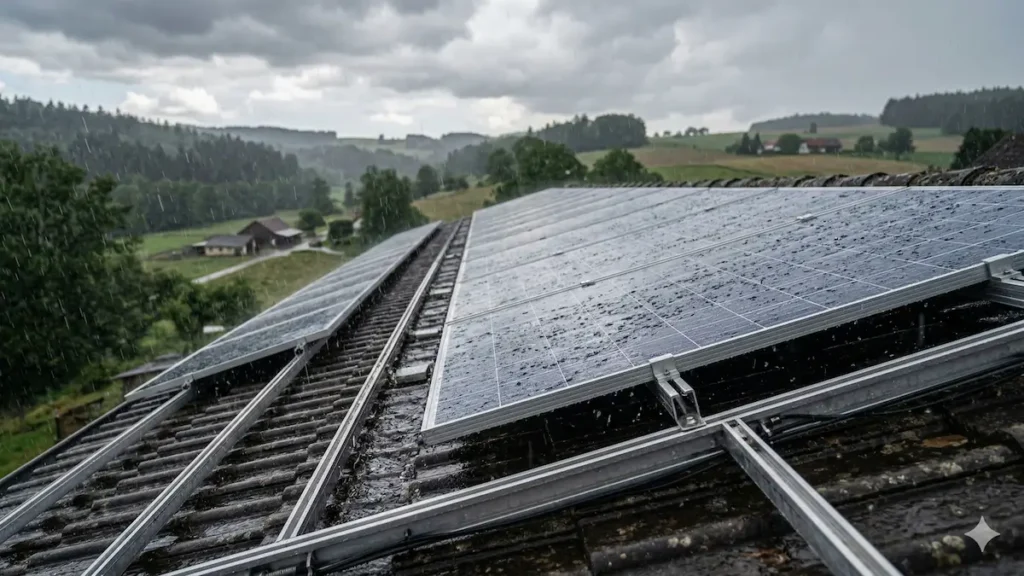
Researchers have developed a hybrid solar cell that generates electricity not only from sunlight but also from raindrops. This is made possible by combining perovskite technology with nanogenerators and a special polymer coating.
Conventional solar systems become significantly less effective when it is cloudy and raining. A research project is therefore combining perovskite solar cells with nanogenerators. These tiny generators harvest energy from falling water droplets. The hybrid approach currently exists as a functional prototype in the laboratory.
To do this, researchers produced an extremely thin layer of fluorinated polymers using a vacuum process at room temperature. The gas octafluorocyclobutane (C.) serves as the starting material4F8). The layer allows over 90 percent of the light to pass through and enables the cell to operate stably. Since the material has a lower refractive index than conventional glass, it also acts as an anti-reflective coating.
New hybrid solar cell produces electricity from raindrops
A raindrop hitting the new solar cell triggers a physical flow of electricity. First, negative charges migrate from the water to the polymer surface. In the second step, ions from the liquid accumulate on the surface and stabilize the charge distribution. This process creates an electrical double layer (EDL) at the interface.
Optimized individual tests of this layer achieved voltage peaks of up to 110 volts. The integrated hybrid prototype delivered peak values of twelve volts per raindrop in combined operation. The movement of the water changes the electrical capacity in the millisecond range and triggers electrostatic induction. This induction feeds energy into a common electrode made of FTO (fluoro-tin oxide).
The charge transport material Spiro-OMeTAD forms the center of the prototype. This component decomposes upon direct contact with traditional epoxy resins for sealing. The fluorinated polymer layer serves as a separating layer and maintains the photovoltaic function. This means that the solar cell remains functional even with additional industrial encapsulation with resin.
Durability and technical limitations
Perovskite cells achieve efficiencies (PCE) of 17.9 percent in pure solar operation. Under simulated rain conditions and half the intensity of the sun, this value drops to around 11.45 percent in the hybrid prototype. These numbers illustrate the technical challenges in balancing both energy sources. Researchers are currently trying to minimize these power losses by improving the design of the interfaces.
The surface withstood more than 17,000 drops in the research facility without any functional loss. However, prolonged use resulted in charge saturation on the surface, temporarily reducing performance. Users regenerate the system by drying and resetting the surface. In a long-term test, the sealed cell remained stable for over 300 hours under humid conditions.
The module survives complete submersion in water for at least 15 minutes. Nevertheless, the technology remains a research project with further hurdles such as long-term corrosion of the electrodes. The prototype demonstrates the technical feasibility of multisensory energy power plants. Future systems could combine different energy sources from the environment.
Also interesting:


Interest rate hit at NIBC!
Open yours now free NIBC daily money and receive up to 2.75 percent interest for your money – with daily availability!
Secure interest now
Requirements apply, advertisement