


Long after the graduation lights come down and the last notes of the THON line dance fade, the habits Penn State builds in its students tend to stick. For Drexel Hill’s Michael Hoover, they have shaped nearly every chapter that followed.
Michael Hoover arrived at Penn State the way a lot of Pennsylvania kids do, with a family tree that ran through campus. His father had walked the same paths, and his younger sister followed in his footsteps. One could say that his family has a propensity for the Big Ten universities, as his relatives are alumni of Ohio State, Michigan, and Indiana, but the Hoovers were Penn State.
What he could not have known on move-in day was that the five years ahead would sit at the center of his life in a way few college experiences do. Not because of what he studied, although that mattered, and not because of the Saturdays in Beaver Stadium, although those mattered too. It was the smaller commitments, the ones that asked more than they announced, that ended up defining him.
A Campus in Mourning, and What Came After
Hoover’s freshman year was marked by the Sandusky scandal and the passing of Joe Paterno. For a community where the coach had been a fixture for more than six decades, the moment was disorienting. Students who had grown up hearing stories about JoePa suddenly had to figure out what the university and football meant without him.
For Hoover, the answer showed up slowly, in the way campus and school kept doing what it had always done. Classes continued. Study groups formed. Campus tours persisted. The institutions that made Penn State feel like Penn State, the dance marathon chief among them, carried on. What Hoover took away was less about any one person and more about how a community holds itself together when the easy version of its story gets complicated and rewritten. It is a lesson he has returned to more than once in the years since.
THON and the Forty-Six Hours That Changed the Math
THON is hard to describe to anyone who has not experienced it. Forty-six hours, no sitting, no sleeping, dancing in the Bryce Jordan Center for families impacted by pediatric cancer who are on the floor cheering you through it. You see kids in remission. You meet parents who have been coming back for years because the Penn State students who danced for their son or daughter became, in some real way, part of their family.
Hoover and his sister danced in 2016. Anyone who has been around THON will tell you that what sticks is not the dancing. It is the moment, somewhere around hour thirty, when the fatigue stops being physical and becomes something else, and you realize that the exhaustion you are feeling is a hundredth of what the families in front of you live with every day. That shift, from doing something hard for yourself to doing something hard for someone else, is the point.
He has spoken about the experience before, and it was the entry point for a piece that ran earlier this year in Swagger Magazine on why he still shows up for THON a decade later. The short answer is that once you have stood on that floor, the lifelong connection to the cause and pursuit of a cure is unparalleled.
The Teaching Assistant Who Stayed Late
The other thread that shaped him on campus was working as a teaching assistant for ACCTG 211, an introduction to accounting course. During his upperclassmen years, he ran Friday classes, held office hours and wrote questions for upcoming exams. The work was unglamorous. It paid modestly. It was at the evenings he could have spent doing almost anything else.
What he learned there has followed him into every client relationship since. How to explain something complicated and unpack it into something simple and digestible. How to tell if and when someone fully understands the concept. How to listen for the question underneath the question. Those are not skills you pick up in a classroom where you are the one being taught. You pick them up by standing on the other side of the podium, in a room full of people who need you to be clear and concise regarding the subject at hand.
For Hoover, the TA role also built something quieter. A sense that his time was worth spending on people who were a few steps behind him on a path he already knew. It was the early draft of the instinct that would later turn him into a mentor.

Giving It Back, Twice Over
Hoover’s mentoring began early in his collegiate career through his involvement with Smeal Student Mentors. A program geared towards helping freshmen pursuing a business major during their first year on campus.
Upon graduation, Hoover joined Penn State’s Smeal College of Business’s formal alumni mentorship program. It was the obvious next move. Someone had done it for him. Someone else would benefit and need it done for them. It was that simple.
Years later, he is still engaged in the alumni mentor program. He mentors multiple current students and recent graduates as they navigate the early stages of their careers. Some of them he meets in person or when he is back on campus. Most of them he works with through virtual meetings, phone, and/or email, the way a lot of professional mentorship happens. The topics rotate. Course selection. Career paths. Internships. First job decisions. Whether to take the offer in Philadelphia or the one in New York City. What to do when the firm you thought you wanted turns out to be different on the inside than it looked on the outside.
What doesn’t rotate is the posture. Hoover doesn’t tell his mentees what to do. He simply asks probing questions and lets them figure out the answer for themselves. It is the teaching assistant’s move, aged up.
What Penn State Has to Do with Family-Owned Businesses
Hoover works today in a corner of his field where most of his clients are high or ultra-high-net-worth families, entrepreneurs, or multigenerational, closely held businesses. Family companies. Founder-led operations. Businesses where the professional questions sit on top of personal ones, and where getting the answer right requires understanding both.
The connection between that work and Penn State is less obvious than the mentorship thread but, in some ways, runs deeper. THON taught him that communities that look permanently from the outside are actually held up by thousands of small commitments from the inside. The TA role taught him that expertise without patience is a closed door. The mentor work taught him that the people who helped you do not stop being relevant once you no longer technically need them.
All three show up in how he operates now. Family businesses are communities too, with their own histories, their own goals, their own moments where the easy version of the story gets complicated. The instincts he built at Penn State, more than any specific thing he studied there, are the ones he leans on when the work gets harder.
The Part That Does Not End
If there is a through line to Hoover’s Penn State story, it is that the relationships he built there did not end at graduation. They compounded. The students he TA’d and mentored in addition to the THON families, all still stay in touch.
That is the version of college experience that does not make the brochures. It’s not about the football weekends or the commencement speech or the diploma on the wall. It is about what you agreed to do for other people while you were there, and whether you kept doing it after you left.
Hoover kept doing it. Hey it’s quiet.
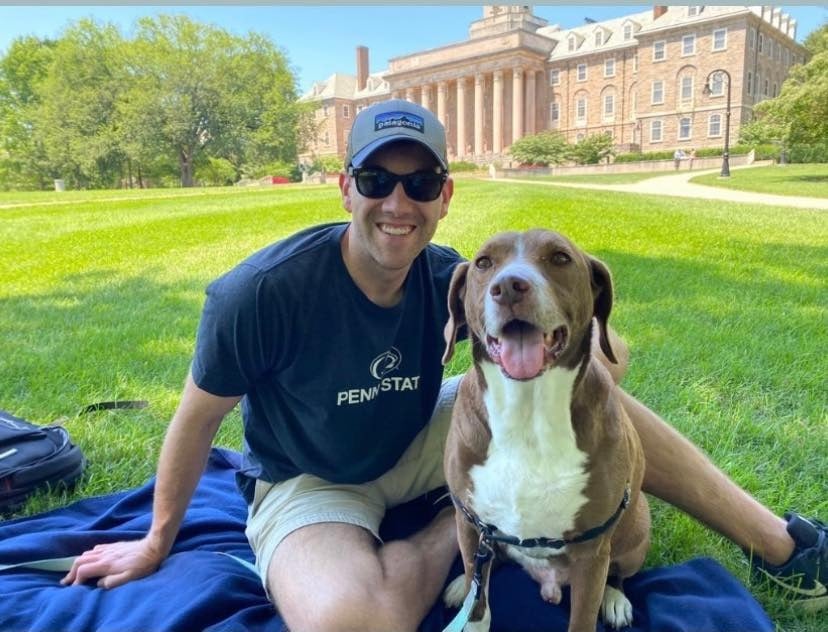
Michael Hoover lives in Drexel Hill, Pennsylvania, with his family and their rescue dog. A 2016 Penn State graduate, he remains active in the university’s alumni mentorship program and continues to support THON.