


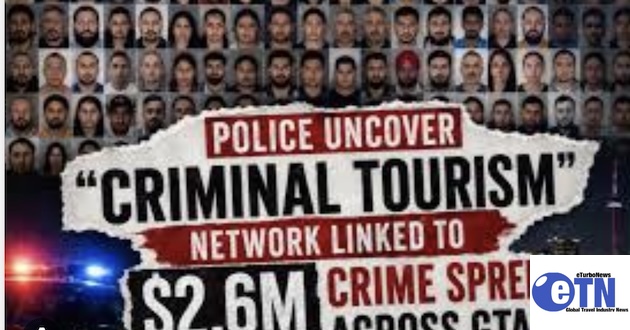
As global travel becomes easier, organized crime networks are increasingly exploiting tourism, visa programs, and open-border systems to commit theft, fraud, burglary, and other crimes across multiple countries. From Canada to Europe and the United States, law-enforcement agencies are confronting a growing challenge known as criminal tourism.
Tourism is one of the great success stories of globalization. It fuels economies, creates jobs, and allows millions of people to cross borders for leisure, education, business, and cultural exchange. Yet law-enforcement agencies in Canada, Europe, Australia, and the United States are increasingly confronting a darker reality: the use of international mobility by organized criminal networks that travel not to visit, but to profit from crime.
Police have a name for the phenomenon: criminal tourism
Unlike traditional organized crime groups that establish permanent operations, criminal tourists are often highly mobile. They enter a country legally as visitors, temporary residents, students, or under visa-waiver arrangements, commit financially motivated crimes, and then move on before authorities can fully connect the dots. Their targets range from luxury homes and retail stores to financial institutions, immigration systems, and vulnerable individuals.
In Canada, the issue gained national attention following Durham Regional Police’s “Project Jetsetter,” a major investigation into what authorities described as criminal tourism linked to organized international networks. The multi-year probe uncovered more than 200 incidents involving vehicle financing fraud, identity theft, retail crime, staged collisions, distraction thefts, and the export of stolen vehicles and merchandise. Investigators laid more than 1,400 charges, made dozens of arrests, and identified suspects originating from several countries as well as individuals already residing in Canada.
The investigation highlighted a growing concern among police: organized groups exploiting the ease of international travel and the challenges of cross-border law enforcement.
Canada is not alone.
Across North America, authorities have increasingly focused on so-called South American Theft Groups, highly organized burglary crews linked to residential break-ins targeting affluent neighborhoods. According to investigators, these groups often enter legally, rent vehicles, use short-term accommodations, and move rapidly between cities. In both Canada and the United States, police have linked such networks to burglaries involving luxury watches, jewelry, cash, and other easily transported valuables worth millions of dollars.
But the phenomenon extends well beyond North America.
For more than a decade, European police agencies have tracked what Europol and crime-prevention experts describe as Mobile Organized Crime Groups (MOCGs). These networks specialize in cross-border criminal activity, moving rapidly between countries to commit burglaries, pickpocketing, organized shoplifting, fraud, vehicle theft, and other property crimes. Open borders within much of Europe have brought enormous economic and social benefits, but they have also provided criminal organizations with unprecedented freedom of movement.
In major tourist destinations such as Paris, Rome, Barcelona, Amsterdam, London, and Prague, police have repeatedly dismantled organized pickpocketing crews operating in transportation hubs, tourist attractions, and shopping districts. Investigations have linked some of these networks to criminal groups operating across multiple European countries, allowing offenders to move quickly and avoid detection.
Authorities have also uncovered more disturbing forms of criminal tourism involving forced begging and human trafficking. Anti-trafficking organizations and law-enforcement agencies have documented cases in which vulnerable adults and children were transported across borders and exploited in organized begging operations, petty theft schemes, and pickpocketing networks. In many instances, the individuals seen on the streets collecting money were themselves victims under the control of criminal organizations.
INTERPOL | The International Criminal Police Organization
INTERPOL enables police in our 196 member countries to work together to fight international crime.
Romanian-based trafficking and exploitation networks have featured prominently in a number of European investigations involving forced begging and criminal exploitation, while Bulgarian and other Eastern European criminal groups have appeared in transnational investigations involving human trafficking, theft, and organized fraud. Experts caution, however, that these cases involve specific criminal organizations rather than entire national communities. Millions of Romanians, Bulgarians, and other Europeans live, work, and travel legally throughout the continent, while many victims of trafficking originate from the very same countries as the criminal groups exploiting them.
The pattern is increasingly familiar to law enforcement worldwide. Criminal networks identify weaknesses in border systems, visa programs, asylum procedures, student-entry pathways, or freedom-of-movement arrangements. They exploit those opportunities to move offenders, victims, stolen property, and criminal proceeds across jurisdictions faster than traditional policing structures can respond.
Australia has experienced similar challenges. Police have dismantled international burglary and theft syndicates responsible for stealing luxury goods from homes, retail stores, and shopping centers across multiple states. British authorities have repeatedly investigated foreign-based burglary crews targeting affluent neighborhoods. In the United States, federal agencies have linked transnational crime groups to organized burglaries, identity theft, financial fraud, and retail crime.
What makes criminal tourism particularly difficult to combat is its flexibility. A criminal network no longer needs a permanent presence in a target country. A small group can arrive legally, commit crimes for days or weeks, transfer stolen assets through international channels, and depart before investigators can establish connections between seemingly unrelated incidents.
The costs extend far beyond financial losses. Families return home to discover their houses ransacked. Elderly victims lose life savings through fraud schemes. Retailers absorb millions in theft-related losses. Communities experience declining perceptions of safety, while police agencies struggle to coordinate investigations across multiple countries and legal systems.
Yet experts warn against simplistic conclusions. Criminal tourism should not be confused with tourism, immigration, international education, or migration in general. The overwhelming majority of travelers obey the law and contribute positively to the societies they visit. Indeed, many victims of transnational criminal networks are migrants, foreign workers, students, or trafficking victims themselves.
The challenge for governments is to preserve the openness that makes tourism and international mobility possible while preventing organized crime from exploiting those same freedoms. Increasingly, that means better intelligence sharing, closer cooperation among police agencies, stronger anti-trafficking measures, enhanced border screening, and faster international information exchange.
As global travel continues to expand, so will opportunities for criminal organizations to exploit mobility for profit. The dark side of tourism is not tourism itself. It is the ability of organized criminal enterprises to hide behind the freedoms of a connected world—crossing borders as easily as legitimate travelers while leaving victims, losses, and law-enforcement agencies struggling to keep pace.
This version reads as a unified feature article and naturally incorporates the European examples of Romanian-linked and Bulgarian-linked criminal networks, forced begging operations, pickpocketing gangs, and mobile organized crime groups within the broader global phenomenon of “criminal tourism.”