


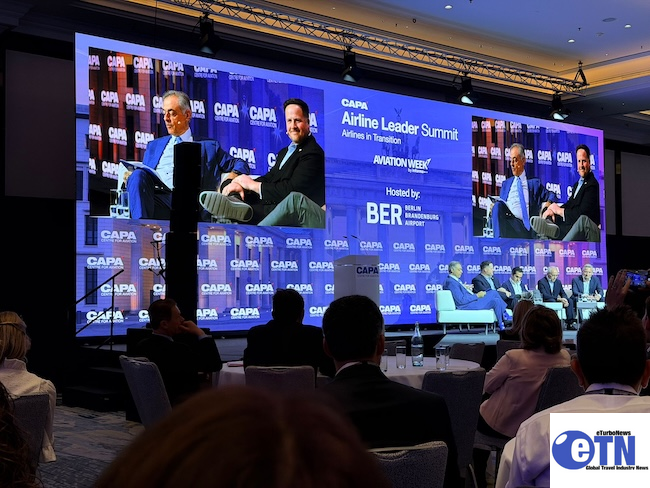
Airline leaders at the CAPA Airline Leader Summit – Airlines in Transition outlined how the industry must evolve beyond seat sales. From operational excellence to trust-building, loyalty innovation, and strategic partnerships, the discussion revealed how airlines can future-proof their business models and compete in an increasingly customer-centric aviation landscape.
At the CAPA Airline Leader Summit in Berlin – Airlines in Transition, one of the most forward-looking sessions—“Airline 2050: Beyond the Seat – Building the Future-Ready Airline”—brought together top executives to examine how airlines must evolve beyond traditional seat-based models. Moderated by Michael Bell of Korn Ferry, the panel featured leaders from across Europe and the United States, each offering a distinct perspective on navigating an increasingly complex aviation landscape.
The discussion drew heavily on a Korn Ferry white paper, which identified three pillars critical to the airline of the future: customer relationship management, financial resilience, and strategic partnerships. Yet, as the conversation unfolded, a clear theme emerged—before airlines can innovate, they must first execute flawlessly.
Operational Excellence: The Non-Negotiable Foundation
Across all panelists, one point was agreed: operational reliability is the bedrock of success. Greg Anderson of Allegiant Travel Company emphasizes that no amount of innovation can compensate for poor execution.
Airlines serving smaller and less frequent markets face amplified consequences when disruptions occur. A single cancellation can erode trust across an entire community. Anderson pointed to Allegiant’s turnaround—from operational struggles in 2021–2022 to becoming one of the top-ranked US airlines—as proof that disciplined execution pays off.
Investments in predictive maintenance and operational systems have been central to this shift, ensuring reliability while maintaining the low-cost structure that defines Allegiant’s business model.

CAPA Airline Leader Summit – Airlines in Transition 2026
If you have a group of 5 or more, we do offer group discounts – You could even earn yourself a free ticket!
Contact me today:
Shivaun Kilbane (Delegate Relations Manager) – ✉ sh***************@*****ma.com
Financial Resilience: Surviving—and Winning—Through Crisis
The COVID-19 pandemic served as a stress test for the industry, separating airlines with strong balance sheets from those without. Dimitris Gerogiannis of Aegean Airlines highlighted how financial discipline enabled survival—and even strategic growth—during the downturn.
Rather than resorting to drastic layoffs, Aegean retained key staff and invested in capabilities that accelerated its recovery once demand returned. The lesson, Gerogiannis argued, is clear: liquidity is not just defensive—it is offensive. Airlines with cash reserves can innovate, invest, and reposition while competitors retreat.
Trust: The Industry’s Most Valuable—and Least Tangible—Asset
While ancillary revenues, loyalty programs, and co-branded credit cards have become standard across the sector, panelists agreed these are no longer differentiators. Trust, however, remains uniquely powerful.
“Trust cannot be commoditized,” Gerogiannis noted, emphasizing that it is built through consistent service and employee empowerment. At Aegean, frontline staff are encouraged to resolve customer issues directly, reinforcing a culture where service quality drives long-term loyalty.
This sentiment was echoed across the panel: airlines that deliver predictability and reliability earn repeat customers—and with them, more stable revenue streams.
Monetization Beyond the Seat: The New Competitive Frontier
Airlines are increasingly shifting focus from ticket sales to holistic customer monetization. Anderson highlighted Allegiant’s success with ancillary revenues, particularly co-branded credit cards, which now represent a significant portion of profitability.
Meanwhile, Carlos Muñoz of Volotea pointed to subscription-based models as a powerful evolution in loyalty strategy. Volotea’s “Mega” program has attracted around one million subscribers, accounting for up to 40% of passengers.
Unlike traditional frequent flyer programs, subscription models foster ongoing engagement. Customers who pay annually are more receptive to offers and communications, creating a deeper, more predictable relationship.
Unlocking Untapped Loyalty Potential
Despite widespread adoption of loyalty programs, many airlines are only scratching the surface of their potential. Joerg Michael Eberhart of ITA Airways revealed that while ITA’s Volare program has four million members, meaningful engagement reaches less than 3%.
This gap represents a major opportunity. As airlines refine data analytics and personalization strategies, converting passive members into active participants could significantly boost ancillary revenues and customer lifetime value.
Partnerships: From Commercial Alliances to Operational Ecosystems
Partnerships—long a cornerstone of the airline industry—are evolving in scope and importance. Beyond traditional alliances and codeshares, airlines are increasingly relying on non-commercial partnerships to deliver seamless customer experiences.
Eberhart stressed that ground handlers, airport staff, maintenance crews, and even emergency services are extensions of the airline brand. Passengers rarely distinguish between airline and partner, making these relationships critical to overall service quality.
Muñoz added that strategic airline partnerships—such as Volotea’s collaborations with ITA Airways and Aegean Airlines—can unlock network synergies and improve efficiency, particularly in underserved regional markets.
Small markets, big opportunities
For airlines like Volotea and Allegiant, secondary and tertiary cities are not limitations—they are strategic advantages. In smaller communities, airlines can achieve “hometown carrier” status, building deeper relationships and stronger brand loyalty.
“In small cities, reputation is everything,” Muñoz explained. Every operational decision is magnified, and every customer interaction contributes directly to the airline’s standing within the community.
This localized trust translates into higher repeat customer rates—a metric Anderson noted has grown dramatically at Allegiant, now reaching nearly 70%.
National Identity as a Differentiator
As global competition intensifies, airlines are also rediscovering the value of cultural identity. ITA Airways, under the influence of the Lufthansa Group, is leaning into its Italian heritage to create a distinctive onboard experience.
From authentic Italian cuisine to curated wine selections, the goal is to immerse passengers in Italy from the moment they board. Eberhart argued that this emotional connection can be more impactful than high-end luxury offerings, particularly for international travelers seeking an authentic experience.
The Road to 2050: Trust, Technology, and Transformation
As the session concluded, a consensus emerged: the airline of 2050 will look fundamentally different—but its core principles will remain the same.
Operational excellence will continue to be the foundation. Financial resilience will determine who survives the next crisis. And trust—earned through consistent delivery and meaningful engagement—will define long-term success.
What is changing is the competitive battleground. Airlines are no longer just transportation providers; they are becoming customer-centric platforms, monetizing relationships through data, partnerships, and personalized experiences.
In this evolving landscape, those that successfully integrate reliability, innovation, and human connection will not just adapt—they will lead the future of aviation.