


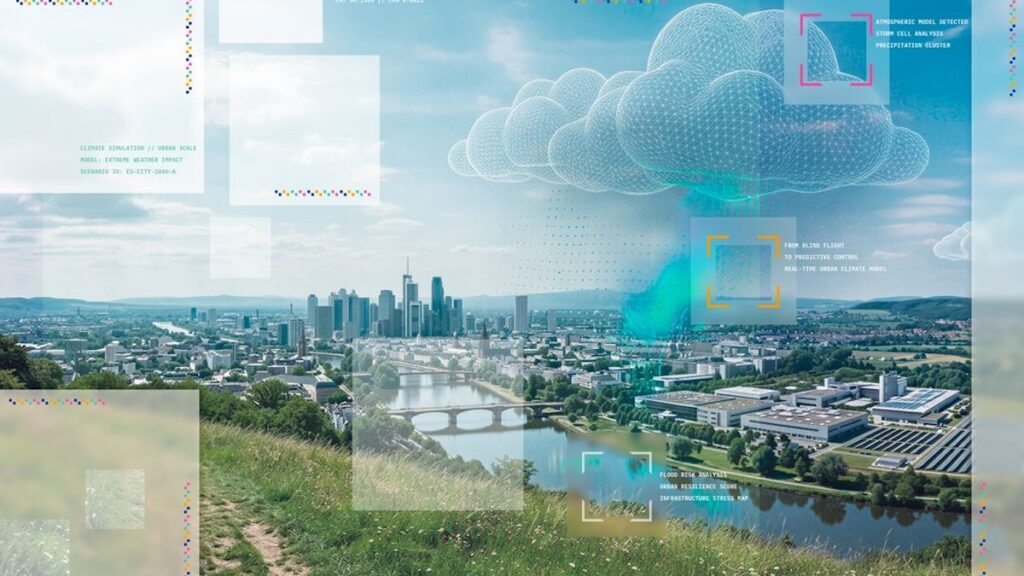
German cities control their sewer networks with average values, even though they were built for extreme events. Researchers at the DFKI in Kaiserslautern want to resolve this contradiction with generative AI. Synthetic data simulates heavy rain events for which there are currently hardly any real measured values.
Scenes of overloaded sewers and flooded streets are becoming more and more common across the country. These events reveal a paradox in infrastructure planning, as wastewater systems are designed for extreme cases, but their day-to-day management is largely based on averages. Scientists warn that this lack of accurate information makes effective preparedness nearly impossible at a time of growing climate risks.
Because: Municipalities have so far managed vital water infrastructure largely without detailed knowledge of rare but devastating extreme events. Historical data rarely reflects such heavy rainfall events, and large-scale measurement campaigns are often considered too expensive or not accessible to the public. This situation is like flying blind, in which cities have to bear the consequences of unpredictable weather changes.
How synthetic AI data improves heavy rain forecasting
According to experts at the German Center for Artificial Intelligence (DFKI), generative AI models offer a way out of this data puzzle. The systems would learn real distributions and use them to generate synthetic time series that could also plausibly represent rare extreme cases.
The research results show that such artificially generated data would massively increase the precision of prediction models. According to the study, some models are already able to achieve the quality of real measurement series using only AI-generated data. For cities and municipalities, this would mean that they would have access to a much more reliable basis for their precautionary measures.
DFKI tests AI models directly on the Kaiserslautern sewage system
At the DFKI in Kaiserslautern, Andreas Dengel is driving this project forward as managing director and head of the “Smart Data & Knowledge Services” department. Together with various research areas, the scientists are testing their AI systems under real conditions directly on the sewage system of the city of Kaiserslautern.
This practical approach is intended to ensure that the theoretical models can withstand the rigorous demands of urban infrastructure. The transfer lab with the Federal Institute of Hydrology (BfG), which started on January 13, 2026, is important for this development.
As part of this cooperation, the experts are pooling their skills to accelerate digital change in the water industry. A core goal of the collaboration is the long-term strengthening of hydrology and water quality in order to create well-founded options for action for politics and administration.
What digital twins can do in heavy rain
Through the use of artificial intelligence, so-called digital twins of the urban infrastructure become significantly more resilient to climate stress. Although AI does not replace engineers, it does fill the critical gaps in the data base. The simulated models allow the load limits of sewer systems to be precisely analyzed during heavy rain and weak points to be identified at an early stage.
The simulation of extreme scenarios is considered a crucial step on the way to a climate-resilient city. Andreas Dengel, Managing Director of DFKI Kaiserslautern, said:
Infrastructures are built for extremes but run on average data. AI enables the simulation of such events in advance – a crucial step towards climate-resilient cities.
React or take precautions: Why municipalities must act now
Ultimately, according to experts, the question of the use of these technologies is of a political nature. Cities must decide whether they want to continue to learn reactively from damage that has already occurred or plan proactively based on simulated scenarios.
In times of tight municipal budgets, synthetic data offers a cost-effective method of equipping one’s own infrastructure against the consequences of climate change. In the face of climate change, the implementation of forward-looking planning is no longer just an option, but a mandatory obligation for those responsible. By using AI, municipalities could regain their ability to act and better protect their citizens from natural hazards.
Also interesting: