


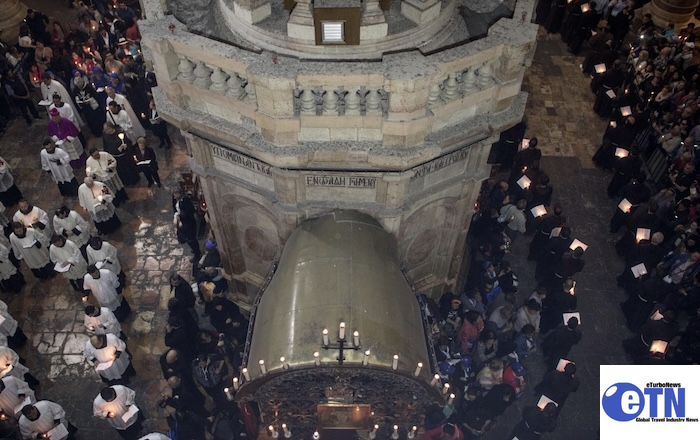
In divided Jerusalem, the Orthodox Easter Holy Fire ceremony unites pilgrims from across the world. As war shadows the region, the sacred flame becomes a powerful symbol of hope—linking the Church of the Holy Sepulcher, the desert silence of Mar Saba Monastery, and a global faith that endures.
The Holy City Awakens
Every spring, the ancient stones of Jerusalem absorb more than sunlight—they hold the weight of longing, prayer, and fragile hope.
In a time marked by conflict and division across the region, the arrival of Orthodox Easter feels different. The crowds that gather at the Church of the Holy Sepulcher are not just pilgrims—they are witnesses to something larger than ritual. They come from countries often separated by politics, language, and even war, yet stand shoulder to shoulder in one of the most contested cities on earth.
For a brief moment, the lines that divide seem to soften.
The Descent of Fire


Inside the church, silence falls. Then comes the ritual of the Holy Fire—a flame said to emerge miraculously from the tomb of Christ.
When the light appears, it spreads rapidly from candle to candle, from person to person. In that instant, differences dissolve into a shared act: receiving and passing on light.
In times of war, this act takes on a deeper resonance. The flame becomes more than a miracle—it becomes a metaphor.
A fragile light in a place often overshadowed by darkness. A reminder that faith can move across boundaries even when people cannot.
A Gathering of the Divided

Orthodox Easter in Jerusalem is one of the rare moments when the global Orthodox world converges physically in one place.
Pilgrims arrive from Eastern Europe, the Balkans, the Middle East, Africa, and beyond—regions that, in many cases, are themselves grappling with conflict or political tension. Yet here, in narrow stone streets, they move together in shared rhythm.
Even within Jerusalem—a city divided by history, religion, and geopolitics—the celebration creates fleeting unity. Israeli authorities, local Christian communities, Armenian, Greek, Arab, and other Orthodox traditions all intersect in a delicate, complex choreography.
It is not perfect harmony. But it is coexistence—visible, tangible, and deeply symbolic.
Beyond the City: Silence and Continuity


Just a few kilometers away, across another set of political and physical boundaries, stands the ancient Mar Saba Monastery in Palestine.
Here, in the stillness of the desert, Orthodox monks continue traditions that have endured for over 1,500 years. Their chants echo through stone corridors carved into cliffs overlooking the Kidron Valley.
While Jerusalem pulses with crowds and ceremony, Mar Saba offers a different kind of witness: continuity.
In a land shaped by conflict, the monastery stands as a quiet testament that faith has survived empires, wars, and divisions before—and may yet endure beyond them.
A Global Flame
The Holy Fire does not remain in Jerusalem. Within hours, it is carried by plane to Orthodox communities across the world—from Greece to Russia, from the Balkans to the Middle East.
In each place, believers receive the same flame lit in the Holy Sepulcher.
In a fractured world, this act creates a powerful sense of connection: one light, shared across borders. One ritual, linking millions.
A symbol of hope
Orthodox Easter in Jerusalem is not untouched by the realities of war. Security is tight. Movement is restricted. The tensions of the region are never far away.
And yet, the celebration persists. That persistence is, in itself, a kind of miracle.
Because in a place where divisions run deep—between nations, religions, and peoples—the simple act of passing a flame from one person to another becomes something profound.
- It is a gesture of trust.
- A moment of unity.
- A quiet defiance of despair.
In Jerusalem, in the desert monastery of Mar Saba, and across the global Orthodox world, the message is the same:
Light can still emerge from darkness. And sometimes, even in the most divided places on earth, it can bring people—if only for a moment—together.