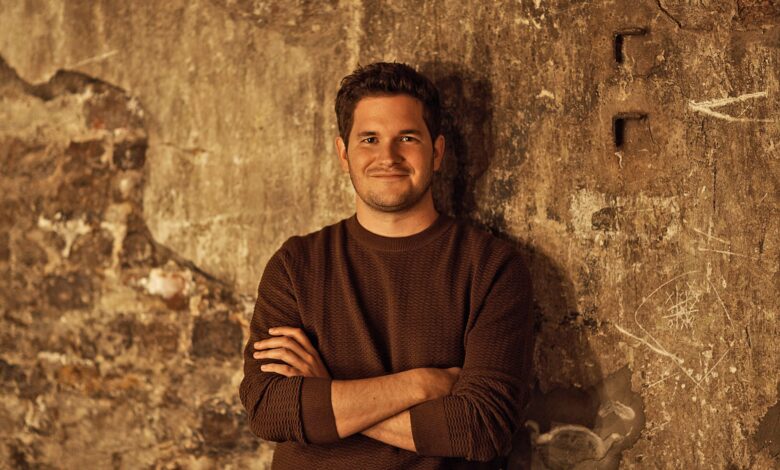
No classic lectures and exams: At the Code University in Berlin, students work on their own projects from day one. Thomas Bachem explains why he founded it.

A university without traditional lectures, exams or compulsory attendance: Instead, students work in teams on their own projects from day one and design their own everyday study life. Everything is designed so that students can start their own business while they are studying. This is how the concept of the Code University of Applied Sciences in Berlin-Neukölln can be easily summarized.
Code is a state-recognized but private university with a focus on tech and product development. You can study here for a bachelor’s and master’s degree. For example: “Software Engineering”, “Business Management & Entrepreneurship” or “Innovation Design”.
Read too

“I wanted to create a Hogwarts for hackers and for innovative-thinking young people,” says Thomas Bachem in the latest episode of ours Podcasts Royal GS. Bachem founded the university in 2016 together with Manuel Dolderer and Jonathan Rüth, after he founded the German Startup Association in 2012 and founded and led several startups to their exit.
Why Thomas Bachem wanted to found a university
Bachem himself studied business administration at a private university in Cologne, the Cologne Business School. He consciously didn’t want to study computer science or mathematics, he says. That was too theoretical for him. So he acquired a business background and learned programming through peer groups at university and online communities. He always benefited the most from that. That’s why Bachem wanted to create a community where, according to him, “really highly talented young people come.”
Audio player not available
In order to display embedded audio content, your consent, which can be revoked at any time (via the switch or via “Revocation tracking and cookies” at the bottom of the page), is required for the processing of personal data. Data can be transferred to third countries such as the USA (Art. 49 Para. 1 lit. a GDPR). By switching to “on” you agree. You can find further information in our data protection declaration.
He needed a place for that. And the only option was to have your own university, because many people want to study after high school and get a university degree. An alternative educational offer without a possible qualification was therefore out of the question, “then you miss out on a lot of the absolute top shots,” says Bachem. “And I definitely didn’t want to create a mediocre community for top talent.”
At the beginning there was a lot of mistrust
So he founded Code – not an easy task. You don’t just found a university in Germany. Both state recognition and accreditation of the study programs are required for the degrees to be valid.
At the beginning, Bachem and his co-founders encountered a lot of mistrust from the Berlin administration. “I was 30 and wanted to start a university. My two co-founders both had long hair tied in a braid. And we came in like that. They really didn’t take us seriously at all,” says Bachem.
He then went through his political network and finally convinced the administration, he says. It was recognized there that the founders wanted to change education and were not looking for profit.
Build a university like a startup
In addition to a learning concept, Bachem and his co-founders created a business plan for Code and collected money from private individuals. Bachem describes the Code model as social entrepreneurship – the university must be able to support itself financially. “That means we built the code on paper as a GmbH and also did the financing rounds, just like with other startups,” he says. “But I told everyone very openly: This is an impact issue for me. The money isn’t gone, but it probably won’t come back either, and certainly not in multiples.”
Read too

At the beginning, 26 people from the startup bubble supported the development of the university – partly also financially. These include Florian Heinemann, founding partner at VC Project A, Rolf Schrömgens, founder of Trivago, entrepreneur Benjamin Otto and Udo Schlömer, founder of the Factory.
Bachem has found that fundraising for education is difficult in Germany. But: “Entrepreneurs especially love it when they can sow the seeds for something that then becomes much bigger,” says Bachem. “And in case of doubt, whether that brings them a lot more money or not is not that important if, relatively speaking, the sums are not that big for them.”
Trust Fund
In 2023, however, the code ran out of money, says Bachem. The economic crisis also had an impact on the startup scene. The responsibility of constantly collecting money to keep the university running weighed heavily on him. In the meantime, Bachem was even in the hospital, he says.
At the end of 2023, he therefore decided to divide his shares in Code, which were 50 percent, among five other people – and with it the responsibility. According to Bachem, the five people include: Schrömgens, Heinemann, entrepreneur Stephan Schambach, Flix founder Daniel Kraus and entrepreneur Petra Becker.
Read too

All three Code founders are no longer operationally involved in day-to-day business – and Bachem thinks that’s a good thing. “The departure of us founders opens up spaces that can be filled by others.”
Starting with 80 students, Code now has more than 600 students, ten percent of whom, according to Bachem, are founding a startup or agency. “We now have a total of well over 120 start-ups,” says Bachem.
All episodes at a glance
Audio player not available
In order to display embedded audio content, your consent, which can be revoked at any time (via the switch or via “Revocation tracking and cookies” at the bottom of the page), is required for the processing of personal data. Data can be transferred to third countries such as the USA (Art. 49 Para. 1 lit. a GDPR). By switching to “on” you agree. You can find further information in our data protection declaration.