


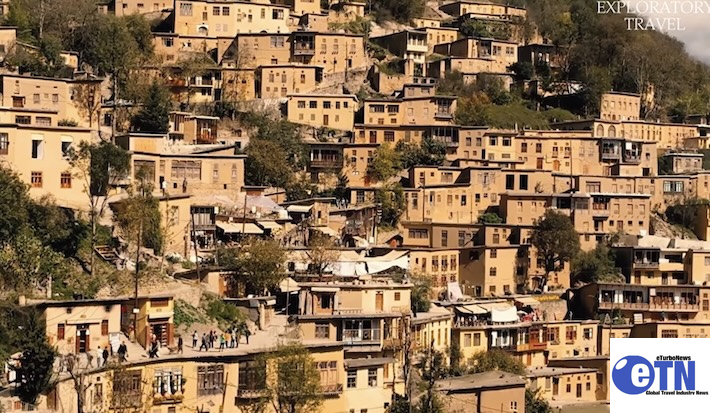
Beneath the headlines, far from the cities and the modern rush, another Iran endures in stone, smoke, mountain light, and the quiet labor of everyday life.
There is an Iran the world rarely lingers on.
Not because it is hidden exactly, but because it does not fit the tempo of modern attention. It does not arrive as an alert. It does not break into the day with urgency. It does not speak in the language of escalation, strategy, crisis, or spectacle. It exists instead in long mornings, in steep paths, in copper kettles, in walls repaired by hand, in roofs that double as streets, in chambers carved into rock, and in dinners cooked on the same hearths that warmed families centuries ago.
This is the Iran beneath the headlines.
The Iran of Kandovan, where families still live inside volcanic stone cones hollowed into homes. The Iran of Masuleh, where one household’s rooftop is another household’s street. The Iran of Uraman Takht, where limestone homes rise like terraces from the mountain itself. The Iran of Abyaneh, where iron-red walls harden with every storm. The Iran of Meymand, where hand-carved cave chambers still hold winter fires. The Iran of Makhunik, built low into the earth as if to disappear into it. The Iran of Palangan, where trout streams run through a canyon settlement and evening smoke settles slowly into the valley air.
It is an Iran of astonishing continuity.
And that is what makes it so moving. Not simply that it is beautiful, though it is. Not simply that it is ancient, though it is. But that it is still lived in. Still touched. Still warmed. Still repaired. Still cooked in. Still walked through. Still inherited.
For all the noise that surrounds Iran in the global imagination, there remains another rhythm of life here: quiet, resilient, and older than almost anything the modern world knows how to talk about.

The distance between a headline and a home
War can feel close on a map and impossibly far away in a kitchen.
That may be one of the deepest truths running through these villages. Far from capitals, far from military language, far from the circuitry of modern media, life is still governed by older urgencies. The bread must be made. The animals must be fed. The spring water must be carried. The fire must be lit before the cold comes in. Fruit must be dried for winter. Soup must simmer long enough to warm the stone. Children must be called home before dark.
In places like these, conflict may exist somewhere beyond the mountain range, beyond the television screen, beyond the nearest city, beyond the political horizon. It may be real. It may matter. But it has not yet displaced the daily architecture of life.
And daily life is powerful.
That is what the documentary understands so well. It opens with a challenge to perception: what looks from a distance like a barren mound of earth turns out to be inhabited, warm, domestic, alive. “But no, this is Iran,” the narrator says, shifting the image from emptiness to presence. Inside those stone towers, people are “still cooking dinner tonight,” just as they have done across millennia.
That sentence contains the whole emotional logic of the film.
Not denial. Not romantic escape. Recognition.
Recognition that life can continue in places the world has flattened into symbols. Recognition that history is not only the story of states and conflict, but of hearths, thresholds, walls, routes, recipes, and repeated gestures. Recognition that for many people, the central facts of existence remain stubbornly local: weather, water, food, family, stone, fire.
A voice that moves like a camera, and a camera that moves like memory
What makes IRAN: The Hidden Village Life That Nobody Talks About so affecting is not only what it shows, but how it speaks.
The narration is patient, descriptive, and deeply atmospheric. It does not hustle the viewer from one fact to the next. It dwells. It layers detail. It uses physical specifics to create emotional truth: six-foot-thick walls, blackened ceilings, narrow passages, low doorways, mineral springs, walnut wood fires, drying fruit, handmade noodles, stone ledges, copper vessels. The voice is literary, but not inflated. It is attentive rather than performative. It lets geology and domestic life share the same sentence.
Again and again, the script collapses the distance between architecture and routine. A home is never merely a structure; it is a choreography of inherited movement. A wall is not just a wall; it is a record of climate, adaptation, labor, and time. A kitchen is not simply where food is prepared; it is where language, memory, and habit are passed between generations.
The effect is intimate and expansive at once.
This is documentary narration as slow revelation. It does not tell the viewer what to think so much as train the viewer where to look. At soot not as dirt, but as an archive. At a roof not as roof, but as shared civic ground. At a doorway, not merely as an entrance, but as an agreement between climate and custom. At stone not as an inert backdrop, but as a collaborator in human survival.
That style is central to the story’s heart. The film refuses spectacle in order to make endurance visible.


Kandovan: dinner inside the stone
Kandovan may be the image that stays with people longest.
From a distance, the village looks almost impossible: cone-shaped rock formations rising from a valley like weathered towers. But inside those formations, domestic life unfolds with extraordinary calm. Families live within volcanic cones shaped over time by lava, ash, wind, and rain. Entire homes are arranged within walls nearly six feet thick. Hearths are cut directly into stone floors. Narrow internal passages connect rooms. Smoke rises from openings at the top as morning fires are lit.
The film lingers on the details that transform the scene from marvel into home.
Children move between chambers. Elderly residents sit at carved doorways, watching light shift on the hillside opposite. Tea is prepared on coal embers in copper vessels that seem to belong to the cave itself. The narrator describes ceilings darkened by decades of soot not as neglect, but as the “accumulated record” of meals cooked there, a domestic archive written in smoke.
That phrase is one of the documentary’s finest because it shows how it sees the world. Nothing here is primitive in the dismissive sense. Nothing is reduced to quaintness. Everything is interpreted through continuity, adaptation, and intelligence.
And that is part of the article’s larger point too: far from the assumptions of the modern gaze, these villages do not represent backwardness. They represent deep knowledge of how to live in one place for a very long time.


Masuleh: where rooftops become streets
In Masuleh, the mountain determines everything.
The slope is so steep that conventional urban logic falls away. Houses are stacked in terraces so that each roof forms the walking surface for the level above it. The result is architecture as shared terrain. Streets and roofs become the same thing. Movement across the village means moving across other people’s domestic surfaces. Privacy and community are not opposites here; they are braided together through design.
The film captures this beautifully.
A child runs across a neighbor’s roof as though it were a playground, because functionally it is. A woman hangs laundry beside the chimney stack of the family below. Men pause over shared walls to speak. Fog drifts through the lower alleys. The smell of soup made with herbs, lentils, spinach, and handmade noodles rises through the cold air.
There is a line in the film that says the mountain does not interrupt daily life here. It organizes it.
That is exactly right. And it is true in ways larger than architecture. The settlement teaches a worldview. You do not flatten the hillside. You learn to belong to its angle. You do not demand the land become easier. You build a life that acknowledges what the land allows.
Palangan: a village held between canyon walls


Palangan lives on two opposing cliff faces with a river below and mineral springs feeding channels through the settlement.
Even in summary, it sounds improbable. On screen, it feels almost mythic. But the documentary grounds it in routine. Women descend to collect spring water and pause at other households along the way. Men return with trout from the cold-water channels. Fish are grilled over walnut wood on terrace levels where families gather outdoors. The smell of wood smoke and river fish drifts through the canyon before the meal itself begins.
And then there is the sound.
Tea is taken near the water’s edge where voices must lean close to be heard over the current. Kurdish sung poetry travels outward, strikes the canyon wall opposite, and returns altered by the mountain. It is one of the film’s most beautiful observations: a voice briefly belongs to the landscape before it belongs again to the person who first sang it.
In scenes like these, the documentary turns geography into atmosphere and atmosphere into feeling. It makes the viewer understand that remote life is not empty life. It is full of acoustics, textures, and social crossings the modern city has largely forgotten how to notice.
Uraman Takht: shared heat, shared labor
Uraman Takht rises from the Zagros like a carved throne.
Its homes are built in receding tiers from dry-stacked limestone anchored by walnut beams, designed to move slightly with the earth instead of resisting it rigidly. This alone is a lesson in humility before terrain. But the film’s attention is less on engineering as abstraction than on how architecture shapes community.
Stone pathways connect every household. Firewood is carried by hand. Open terraces become spaces of gathering, cooking, and ceremony. During the winter festival of Pir Shaliyar, enormous clay pots filled with lamb and wild walnut are slow-cooked communally, with every family contributing labor rather than ingredients. The dish belongs to no one household because the effort belonged to everyone.
That is a profound social idea embedded in material life.
Not simply sharing, but co-making. Not charity, but mutual structure. A village assembled through work, heat, sound, and obligation. These are forms of abundance modern life often mistakes for inconvenience.
Abyaneh: the red village where rain strengthens the walls
Abyaneh seems at first glance almost painted into the mountainside.
Its color comes from iron oxide in the local clay and stone, so concentrated that from certain angles the village appears visually inseparable from the earth beneath it. But the remarkable fact is not just how it looks. It is how it behaves. Rain hardens these walls rather than eroding them. Every storm leaves the village stronger.
It is hard not to hear metaphor in that.
Inside, tradition survives in details too specific to be invented by nostalgia. Women wear white floral headscarves and layered skirts in daily life, not just during festivals. Wooden doors still have separate knockers producing different sounds for male and female visitors. Summer rooftops become drying fields for apricots, grapes, figs, and pomegranate seeds that will sustain households through winter.
The documentary is especially good on these small acts. It understands that culture is not preserved only in ceremonies. It lives in Tuesday mornings. In what is worn to market. In how sugar is taken with tea. In the practical beauty of fruit drying in sun high above a mountain road.
Meymand and Makhunik: living close to the earth
In Meymand, chambers carved into sandstone are still inhabited seasonally, not as museum exhibits but as ancestral homes. Blankets are folded on stone ledges. Pots rest in old hearth depressions. Children draw on cave walls. Families return in winter and move through the carved spaces with inherited certainty: this niche for grain, this cut for ventilation, this wall for warmth.
The film is wise enough not to exoticize the caves. It shows them as lived intelligence.
In Makhunik, that intelligence takes another form. Here, houses are built partly below ground, with tiny doors that require anyone entering to bow. The practical reason is thermal control and defense; the emotional effect is humility. The architecture asks the body to acknowledge the threshold. Inside, the central hearth governs all arrangement. The room is too small for distance. Family gathers within arm’s reach because geometry leaves no other option.
The documentary describes Makhunik’s food culture as an extreme expression of self-sufficiency, a system designed to need as little as possible from outside the valley. But it does not frame this as deprivation. It frames it as a philosophy of sufficiency made beautiful.
That distinction matters.
What these villages know that the modern world forgets
Across all seven settlements, the same lesson appears in different forms.
None of these communities tried to dominate the land. They did not level what was difficult, reroute what was inconvenient, or impose a grid where the earth refused one. They learned the behavior of local materials. They observed wind, sun, rainfall, slope, temperature, and seismic movement. They built not for visual statement, but for survival over time.
The volcanic stone of Kandovan insulates. The iron-rich clay of Abyaneh hardens with rain. The limestone of Uraman absorbs movement through its joints. The soot-dark cave ceilings of Meymand help reinforce and regulate the interior environment. The slope of Masuleh becomes not an obstacle but the organizing principle of the whole settlement.
This is not accidental ingenuity. It is civilizational memory.
It is what happens when a people remain in one place long enough to understand not only how to endure, but how to make endurance graceful.
There is another lesson too: interdependence is not a moral accessory in these villages. It is the structure of survival itself. Roofs are shared pathways. Walls radiate heat between homes. Water routes bring people past each other. Labor is distributed because no single household can manage everything alone under these conditions.
Modern life often imagines resilience as independence. These villages suggest the opposite. The connected whole is what survives.
The world is not only what makes the news
That may be why this documentary has resonated so strongly with viewers. It offers relief, yes, but not escapism. Something deeper.
It restores proportion.
It reminds the viewer that a nation is never exhausted by the story most often told about it. That under the language of politics and conflict there are still places shaped by domestic time, by inherited craft, by old ecological bargains, by food systems, by weather, by kinship, by walls that have held through centuries.
It also reminds us that “far away” is not just a matter of miles.
War can be far away because the nearest concern is the evening fire.
Because the road is long and the signal weak.
Because the mountain organizes the day more forcefully than the state.
Because what must be done before sunset matters more than what analysts said at noon.
Because a family still has to dry fruit on the roof, carry water from the spring, stir the soup, mend the wall, wash the glasses, bring in the children.
This is not ignorance. It is scale.
And scale changes everything.
From the perspective of global systems, these villages may appear peripheral. From the perspective of life, they are central. They preserve knowledge about climate, materials, community, and human adaptation that the rest of the world, in many ways, is only beginning to relearn.
A heartwarming truth, written in stone
What lingers after the film ends is not just visual admiration. It is gratitude.
Grateful that such places still exist.
Gratitude that someone took the time to look at them carefully.
Gratitude that beneath all the flattening narratives, another Iran remains visible to anyone willing to see more than a headline.
An Iran of mountain kitchens and stone thresholds.
Of canyon songs and walnut smoke.
Of fruit drying on rooftops.
Of children running where roofs become streets.
Of cave chambers still warm from winter fires.
Of walls that do not crumble in rain, but strengthen.
Of people who are still, tonight, cooking dinner in the rock.
In that image is something profoundly heartwarming, and perhaps profoundly necessary.
Because the modern world has become so fluent in rupture that continuity can feel almost miraculous.
Yet here it is.
Not untouched by history, but shaped by it.
Not frozen in time, but living through it.
Not outside the world, but outside the narrow way the world is so often described.
And so these villages offer more than beauty. They offer a correction.
They tell us that the world is not only what alarms us.
It is also what endures.
It is the hand repairing the wall.
The kettle on the coals.
The child on the rooftop path.
The old doorway worn smooth by generations.
The shared meal.
The slow evening.
The village that still fits the mountain.
The fire lit again.
Far from the headline, far from the city, far from the modern hunger for constant disruption, there is still an Iran where life goes on as it has for hundreds of generations.
And in those hidden villages, the world is still, in the deepest sense, okay.