


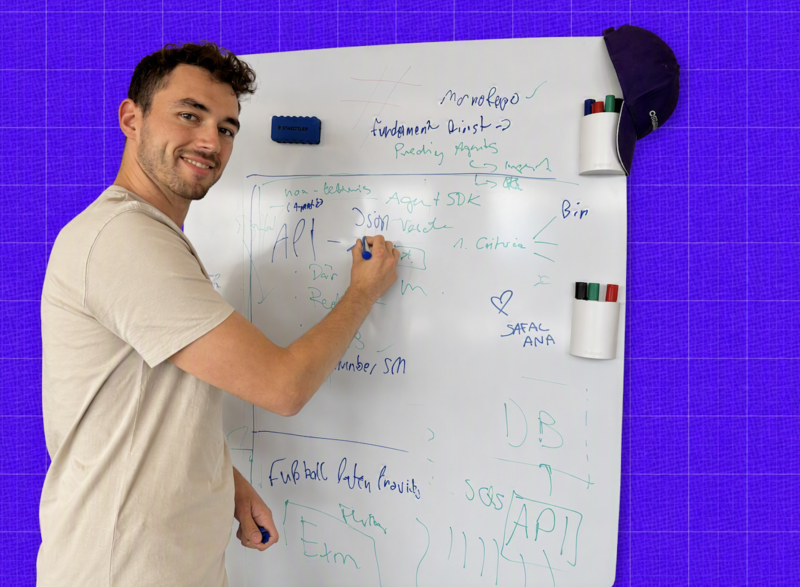
Hundreds of users in the test phase: Our summer camp fellow Vincent Betz is writing a blog to make his app known.


He generated 500 users in just five days. His app is still in the testing phase. “I want to get in touch with real users as quickly as possible – even if the product is not yet perfect,” says Vincent Betz. “I need user input” for his vision of a new betting platform in Germany.
Vincent is a fellow of our summer camp “Start-up scene is looking for super founders”. For ten weeks, eight participants will build their own consumer apps using various AI models.
“Startup scene is looking for super founders” is a ten-week startup fellowship from Gründerszene. Eight selected fellows develop consumer startups in Berlin using artificial intelligence – from the idea to the first product. During the program, the fellows work together in the Axel Springer high-rise and are accompanied by experienced entrepreneurs, investors and experts. Partners like OpenAI, Vercel, Dash0 and DHL support them with technology, know-how and mentoring. Gründerszene documents the entire journey with articles, videos and social media content – and shows up close how the next generation of startups is being created today. All resulting products belong to Axel Springer.
The 25-year-old creates an online game where people can bet on future events: Prediqu. The platform works like a betting game for sporting events. Except that people can also give tips on news, celebrities and everyday topics on his app.
For every correct prediction, users collect points and can compete with friends in rankings. In the long term, the predictions of many users should produce reliable data that shows which developments society considers likely.
Read too


Vincent validates his app with friends
A week after the start of the summer camp, he puts his “minimum viable product” (MVP), the first version of the website, live. Users can bet on the kebab price, election results and investments. First of all, only with virtual points instead of money to avoid gambling regulations. Vincent keeps the layout simple. It is based on competitors such as the market leader Polymarket.
“You should get in touch with real users as quickly as possible – even if the product is not yet perfect,” says Vincent. He needs user input. “Once someone can use the product and say what they like and don’t like, it’s worth launching.”
He therefore shares the MVP with his friends and on social media. “Many people found the kebab price index funny,” he says. They also point out errors. For some questions you cannot give tips. Others cannot log in. “There were a lot of little problems at the start.”


Market fit: The founder is looking for the right target group
Now Vincent asks a fundamental question: Who is he actually building the platform for?
“The biggest challenge of the past few days was finding the right niche to start,” he says. “I could concentrate completely on sport or football. I know my way around there, the target group understands the concept and already uses such offers.”
Vincent is looking for a middle ground: “Other users shouldn’t jump ship immediately because they think the offer is only for sports fans.” That’s why he talks to people who have already built sports prediction or community apps. He asks: “What topics are working? Where is there a lot of engagement and traffic?”
He continues to collect feedback. Users write to him which functions they would like. Some ideas ended up directly in the product. This creates a live tracker where users can predict every minute whether gold or Bitcoin is rising or falling. “It’s a bit pointless, but it’s funny because something happens all the time,” says Vincent.
A data provider supplies the trackers for Bitcoin or gold. He has set up an interface for this. He also uses such an interface for election results or the Sunday question. The app automatically updates the results. For reality show results, an AI agent reads news articles and sends Vincent the results. He enters them into the system manually.
He wants to incorporate more such minute-by-minute bets in the future. They are intended to keep people on side and enable spontaneous votes and resolutions.
In the long term, the technology will also be used on news websites. Readers could make predictions about elections, sporting events or other current topics directly under articles. Media companies would integrate the solution into their offerings and pay for it.
Read too

The app needs users
First of all, Vincent wants to establish his side. For this he needs users. He achieved 500 visits to his page after just a few days with the help of social media posts, some with Gründerszene as a co-author.
Half of users find it via Google. Vincent optimizes the visibility of his app in search engines and chatbots with an integrated blog. He has the know-how for outreach from his time studying at the US University of Berkeley. In the meantime, Vincent even built and sold a startup for visibility in AI systems.
“If someone searches for a topic that I write about on the blog, ChatGPT has a higher chance of citing my page or directing users to my site. This works on a similar principle for Google SEO.” He plans the content within a few minutes and then instructs the chatbot to write a text.
The platform still functions as a website. But “most people will not make predictions permanently on their laptop, but on their smartphone,” says Vincfent. That’s why he wants to bring the app to the App Store and the Play Store.
Vincent’s top learning of the week
Vincent’s most important learning: “You need functions that keep users on the platform for as long as possible. Users absolutely have to come back. If someone places a bet today that doesn’t end for 15 days, I want to bring them back to the platform exactly then – for example via a notification. When they come back, they can take part in further surveys straight away.”
His conclusion of the week: “Of course you’re never really satisfied. But now I always know what I can work on next. There are thousands of open tasks. I’m especially happy that the first people have used the platform.”
Goal for the third week: “I hope that the app will be available in the stores in about two weeks. However, I don’t have complete influence on that. Apple in particular checks apps very closely. It may well be that changes are required and the publication will be delayed by a few weeks as a result.”
Do you have questions or want to talk to the fellows about their product? Write to them here.
“Start-up scene is looking for super founders” powered by Dash0, DHL, OpenAI & Vercel.