


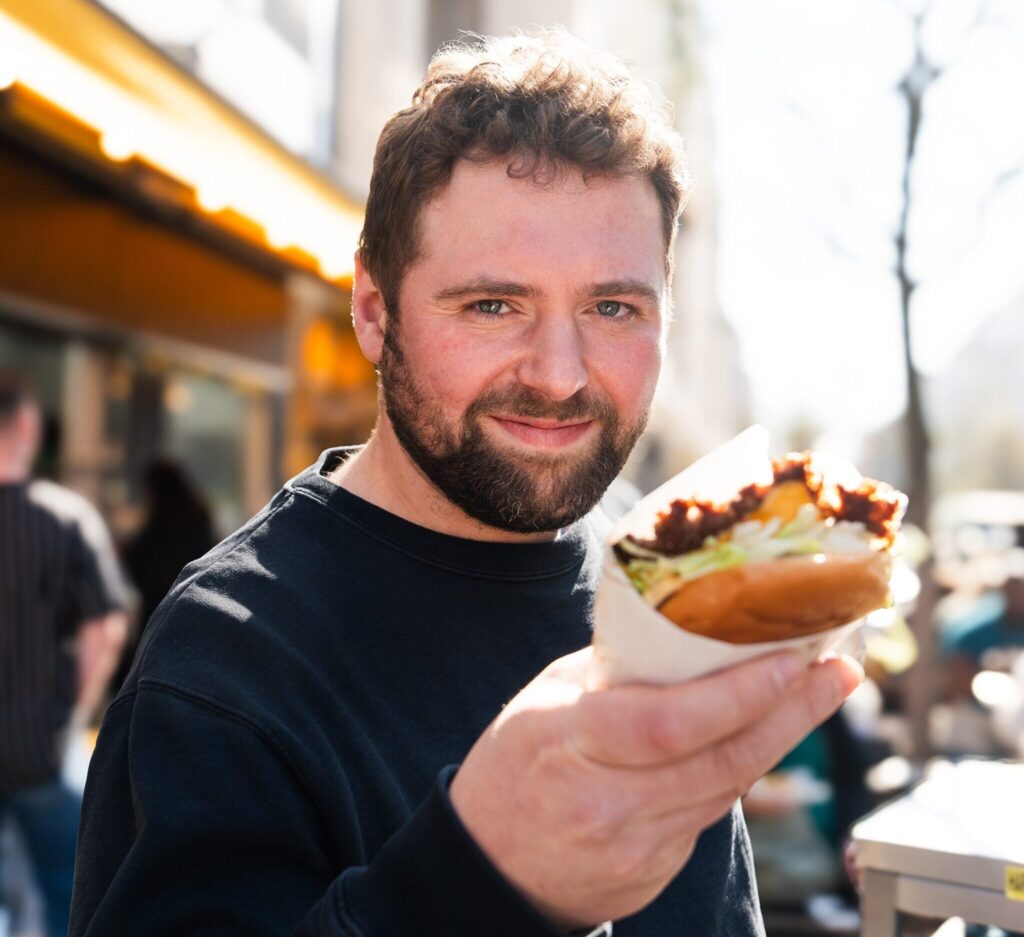

Vladislav Gachyn once worked in a star kitchen. White jacket, precise handles, plates like works of art. But then he and his colleague Kajo Hiesl made a decision against haute cuisine – and in favor of burgers. Fine dining became fast food. What began as a documentary about fries became one of the most exciting burger stories in Germany. Today their company “Goldies” has 15 branches across Germany, made it into KaDeWe – and dreams of even bigger things: one day being mentioned in the same breath as McDonald’s and Burger King. We met him for an interview.
Founder Scene: Vladislav, what does the perfect burger look like for you?
Vladislav Gachyn: A relatively thin, crispy patty fried on the griddle with a soft bun that is nice and chewy, almost slippery and doesn’t fall apart. With ketchup, mustard, onions and homemade pickled gherkins.
How did you come up with the idea of getting into the burger business?
I was 26, came from a star kitchen background and cooked in a three-star restaurant with my current business partner. He wanted to open a shop in Berlin, I also wanted to open a shop in Berlin. Then the thought came: Why don’t we get together?


And why fast food? You came from the star kitchen.
At first we wanted to open a fancy restaurant because we could. But then we thought: In Berlin you always have to reinvent yourself, you always have to do the latest hot shit, you always have to keep up with the times. This is difficult. That’s why we decided to make fast food. Because hardly anyone from the Michelin-starred kitchen makes fast food.
The original idea wasn’t a burger at all, but fries.
Exactly. We happened to see a documentary on TV about fries and thought: Crazy, fries are just a side dish everywhere – with every fast food meal, with every currywurst, with every schnitzel. We wanted to put these fries on a pedestal they’ve never been on before. We never wanted to make burgers.
The first store almost made them bankrupt
How did you finance the founding?
Back then, we teamed up with someone who had a master’s degree in business administration because we were both chefs and had no idea about starting a business. We spent a year writing a business plan. Then we quit our jobs and applied for the start-up grant. We tried to get a loan – but of course we didn’t get one. So I went canvassing and looked for someone among my friends who had enough money and would vouch for us. Only then did we get the loan.
How much do you need at the beginning?
Back then we started with 120,000 euros. And I would say today: If you’re going to take the risk, then take twice as much, because it was very tightly calculated.
What did you spend the money first?
We did the renovation ourselves. We invested a total of 17,000 euros in the entire shop construction. Without kitchen. We tiled the tiles ourselves. That took a month and a half. Full-time because there wasn’t that long of a rent-free period.
And then the first blow came.
This was too much stress for our business partner. Kajo and I are used to this in the kitchen. We know what it’s like to work 15 or 16 hours without a break. This was an enormous burden for him and he quickly burned out. From one day to the next we were left with a big loss. Our partner had broken away and Kajo and I had no idea about numbers. We were almost broke before we even got started. We had no choice but to continue selling food. And over the next two years we taught ourselves everything, step by step.
How much did you work during this time?
At first I worked 18 hours a day. On Sunday I slept all day.
What did you earn during this time?
Neither of us had any savings, nothing. Our first salary was 2,000 euros gross. You can eat fries and unhealthy stuff all day long, but you can’t do that forever. For the first few years we couldn’t travel, nothing at all. We were chained to this store.
Smashburger hype caused meter-long queues
When did the burger come?
I slowly noticed that a new wave was coming to America, the Smashburger hype. That’s where George Motz’s first videos came from. And suddenly I was in a rabbit hole. I was trapped on the internet for months and then traveled there myself.
And then?
We were the first shop in Germany to get Martin’s Buns – for me the best burger buns in the world. First, we introduced a “Smashburger Friday” and only offered it on Fridays. That was very well received. Then we walked past a place that used to be a really good burger place, but was no longer doing well and was being sold. We took it over and sold Smashburger there. That was exactly the time when food YouTube became big in Germany. A few food YouTubers came along – and that was a catalyst. In the summer there were suddenly queues for the subway.
Read too


What did you see financially with the second store?
I don’t remember exactly, but of course it was great for us at the time. People were lining up, we were making incredibly high sales every day. With the second store, we also implemented many of the lessons we learned from the first. Instead of 20 sauces, we only had four. This was immediately noticeable in the numbers and the margin. Suddenly it was really fun.
15 stores, KaDeWe and international plans
How are you positioned today?
There are now three of us owners. We have a clear division. We have a very good, ever-improving structure. We do all the stores ourselves. Above all, we also do franchises. But only with selected partners, it’s a long process for us. We are currently growing completely organically.
How many employees does Goldies have today?
More than 300.
And how many stores are there currently?
We are at 15 stores. We want to open 15 new stores this year. Some rental contracts have already been signed.


Growth always brings with it the question of quality assurance. How do you protect yourself from the pitfalls that other franchise chains have experienced?
System is everything. McDonald’s shows the way. That’s a different dimension, but the quality is always the same there. We optimize our processes every day. Training is incredibly important. And the selection of people who work for us is crucial.
What does your franchise selection process look like?
We receive a lot of applications, but only a few ultimately make it through the process. Operational class is important to us – in other words, well-founded gastronomy experience. Many people come knocking who have a lot of money but no experience. We reject that.

What is the long-term goal – in three or five years?
We want to take a permanent place in Germany alongside Burger King and McDonald’s. We want to be part of the quick-service gastronomic landscape in Germany.
How do you want to achieve that? Do you need external capital?
At the moment we are growing out of cash flow. Very healthy and steady – and we can carry on like this.