


Washington DC-Madrid — On a gray morning near Penn Station in New York, Gloria Guevara sat with a laptop full of numbers that, in another era, might have told a triumphant story. Global tourism was rebounding. Demand was strong. The world was moving again.
But the United States — long the crown jewel of international travel — was slipping.
Within hours, Guevara would board a train to Washington, where she would carry those numbers into meetings with policymakers, industry leaders, and, notably, officials connected to the White House. She was not there as a diplomat in the traditional sense. She held no government title. She represented no flag.
Yet in today’s fractured geopolitical climate, few figures occupy a more delicate or consequential position in global tourism than Guevara, the chief executive of the World Travel & Tourism Council.
She is, in effect, the industry’s unofficial ambassador — balancing the economic interests of hundreds of the world’s most powerful travel companies while navigating a political landscape that grows more volatile by the day.
The Voice of Business in a Political Storm
The WTTC is not a government body. It does not set visa policies or border controls. It does not issue travel advisories. But it represents more than 200 of the largest private-sector players in global tourism — from airlines and cruise lines to hotel giants like Marriott International.
That distinction matters.
In an era when governments are increasingly constrained by domestic politics, the private sector often retains a different kind of influence — quieter, but no less powerful. It can lobby, persuade, invest, and, crucially, signal confidence or concern.

World Travel & Tourism Council
The World Travel & Tourism Council (WTTC) represents the Travel & Tourism sector globally.
Guevara understands this leverage intimately.
A former tourism minister of Mexico and adviser to Saudi Arabia, she has spent years learning how to translate business priorities into political language. At WTTC, that skill has become essential.
“She is the bridge,” said one industry executive who attended recent meetings in Washington. “Between what governments want to do and what the industry needs to survive.”
A Vacuum of Leadership — and a Rapid Response
The urgency of Guevara’s recent US mission is underscored not only by the data she carries, but by the relative silence elsewhere.
The newly appointed secretary-general of UN Tourism, Shaikha Al Nowais, has yet to issue substantive public statements on a series of global developments reshaping travel — including shifting US entry policies and the ripple effects of the Iran conflict on global mobility.
That silence has created a vacuum. Guevara has stepped into it.
Since taking the helm at WTTC, she has moved, as one colleague put it, “at 100 miles an hour” — convening industry leaders, engaging governments and positioning the council as a steady, pragmatic voice amid escalating uncertainty.
Where multilateral institutions often tread cautiously, Guevara has necessarily been direct.
Her message to US officials is simple: perception matters, and right now, the perception is deteriorating.
Inside Washington: Access and Influence

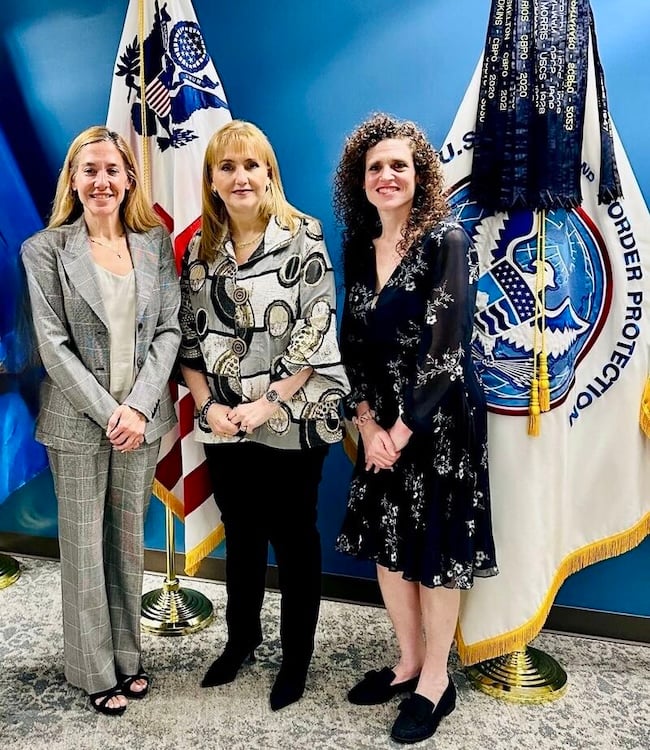
During her recent visit to Washington, Guevara’s schedule reflected the breadth of her mandate — part industry advocate, part economic envoy.
Among those she met were Diane J. Sabatino, Executive Assistant Commissioner of the Office of Field Operations, and Kimberly Weissman, Senior Communications Adviser at US Customs and Border Protection.
The conversations, according to people familiar with them, were not only about challenges, but also about what is working. Chief among those successes: Global Entry.
Developed by the US administration and CBP, the program has become a benchmark for trusted traveler systems worldwide — combining security with speed through advanced biometric technology.
“It’s very secure and seamless,” Guevara said in private remarks shared with associates. “It takes me less than one minute to go through airports in the US — facial recognition is so effective. Remarkable.”
For Guevara, Global Entry represents more than convenience. It is proof that security and efficiency need not be at odds — and a model that could be expanded.
“There is an opportunity to scale this initiative and benefit millions of international travelers,” she has emphasized in discussions with officials.
The Numbers Behind the Concern
The data she brought to Washington underscores the urgency.
While global tourism grew robustly last year, the United States lagged behind. International visitor spending declined. Arrivals dropped by millions. And perhaps most concerning, sentiment — harder to quantify but no less critical — has shifted.
“Many foreign travelers no longer feel welcome in the United States,” Guevara said in recent discussions, echoing concerns voiced by airlines, hoteliers, and tour operators.
The timing could hardly be worse.
The US is on the cusp of what should be a historic tourism boom: the FIFA World Cup 2026, the country’s 250th anniversary, and the centennial of Route 66.
Yet industry leaders fear those opportunities may be slipping away.
The Politics of Perception
The issue is not solely a matter of policy, but of how policy is experienced — and perceived.
Stricter visa processes, increased border scrutiny, and political rhetoric have combined to create what some analysts describe as a “psychological barrier” to travel.
Henry Harteveldt, a travel industry analyst, put it bluntly: travelers may trust American hospitality once inside the country, but increasingly worry about getting in. That concern is not theoretical. It is already shaping behavior.
Canadian travel to the US has declined sharply. European visitors are reconsidering itineraries. Some international soccer fans are reportedly planning to watch World Cup matches in Canada or Mexico instead.
Industry Pushback — Carefully Calibrated
Not everyone agrees on how to respond.
The US Travel Association has taken a firm stance against campaigns discouraging travel to the United States, framing them as economically harmful and politically motivated.
In a statement issued yesterday, the organization argued that while concerns about entry policies are valid, efforts to portray the US as broadly unsafe cross a line.
“That’s not advocacy. That’s sabotage,” the group said.
It is a position that reflects the delicate balancing act facing the industry: acknowledging real challenges without amplifying them to the point of self-inflicted damage.
Guevara walks that line with notable precision.
She does not engage in overt political criticism. Instead, she emphasizes competitiveness, economic impact, and global trends — language that resonates across ideological divides.
The Power — and Limits — of the Private Sector
Her recent visit to Washington included high-level meetings that focused on practical solutions: streamlining entry processes, improving traveler experience and reinforcing the message that the United States remains open for business.
The fact that those meetings occurred at all speaks to WTTC’s unique position.
Unlike national tourism boards or government agencies, the council represents capital investment, jobs, and economic growth. In Washington, that carries weight.
“American jobs matter,” Guevara has said. “And tourism is jobs.” Yet even with its influence, the WTTC cannot dictate policy.
Its power lies in persuasion — in presenting data, aligning stakeholders, and making the economic case for change.
That is why Guevara’s role is so complex. She must advocate without alienating. Critique without provoking defensiveness. Push for change while maintaining access.
It is diplomacy without the protections of diplomacy.
A Defining Test for Global Tourism
For Guevara, the stakes extend beyond the United States. What happens here could set a precedent.
If one of the world’s most established travel markets can falter due to policy perception and political climate, it raises questions for every destination.
Can tourism remain resilient in an era of rising nationalism and security concerns?
Can the private sector effectively advocate for openness when governments face pressure to tighten borders?
And who speaks for the industry when global institutions fall silent?
“They Must Listen”
Back in Washington, as Guevara moves between meetings, her tone remains measured but urgent. The opportunity, she insists, is still there.
“If the United States ensures people feel welcome,” she has said, “they can still turn this around.” If not, she warns, the country risks missing one of the greatest tourism opportunities in its history.