


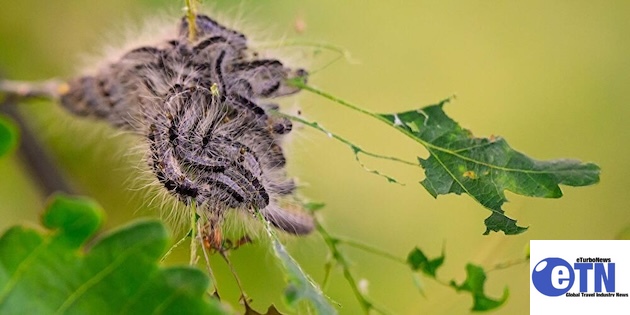
Berlin is battling one of its worst outbreaks of poisonous oak processionary caterpillars, prompting authorities to deploy hazmat-style crews equipped with protective suits and industrial vacuum systems. Parks and green spaces have been temporarily closed as officials warn residents and tourists about severe health risks linked to the insects’ toxic airborne hairs.
BERLIN, Germany – Disturbing scenes unfolding across Germany’s capital are drawing attention from residents, tourists, and public health officials alike as authorities battle what experts describe as one of the most severe outbreaks of the poisonous oak processionary caterpillar in recent years.
Television footage and social media images show workers dressed in full-body protective suits, respiratory masks, and specialized equipment resembling asbestos-removal gear. Equipped with industrial vacuum systems, cleanup crews have been removing toxic caterpillar nests from trees throughout Berlin, creating an unsettling spectacle that has alarmed many residents and visitors.
The outbreak has led to the temporary closure of several parks, sports facilities, and green spaces across Berlin in recent weeks. While the images may appear dramatic, city officials stress that the response is necessary because the caterpillars pose a genuine health hazard.
Tourism Landmarks Remain Unaffected
In response to international media inquiries, Berlin tourism officials confirmed that the infestation has not impacted the city’s major attractions.
Tobias Maul, spokesman for Visit Berlin, told eTurboNews that there are currently no reports indicating that iconic landmarks such as the Brandenburg Gate, the Berlin TV Tower, or Museum Island have been affected by the infestation.
However, authorities are urging both residents and tourists to remain vigilant and follow public health guidance issued by Berlin’s Senate Department for Science, Health and Care.
Officials advise avoiding known infested areas between mid-May and the end of July, paying attention to warning signs, and never touching caterpillars, nests, or webs.

Districts warn park visitors about oak processionary moths
The oak processionary moth has infested hundreds of trees in Jungfernheide. Several Berlin districts are now warning against the poisonous caterpillars.
What Is the Oak Processionary Caterpillar?
The culprit behind the outbreak is the oak processionary caterpillar (Thaumetopoea processionea), the larval stage of a gray-brown moth native to Central Europe.
The species feeds primarily on oak leaves and thrives in warm conditions. Female moths lay between 100 and 200 eggs high in oak tree canopies during the summer. The caterpillars emerge in April or May and pass through six developmental stages before becoming moths.
Berlin’s extensive population of oak trees in parks, residential neighborhoods, and along city streets provides ideal habitat for the insect.
The caterpillars are known for moving in long nose-to-tail processions, giving the species its name. They construct large communal nests that can remain visible long after the moths emerge.
Tiny Hairs, Serious Health Risks
Although the adult moth is harmless, the caterpillars themselves become dangerous beginning in their third larval stage.
At this point, they develop thousands of microscopic defensive hairs known as “urticating hairs.” These hairs contain a toxin called thaumetopoeinwhich can trigger severe allergic and inflammatory reactions in both humans and animals.
The hairs are only 0.1 to 0.3 millimeters long and are equipped with tiny barbs that allow them to easily penetrate skin and mucous membranes. Even more concerning, they can become airborne and travel considerable distances on the wind.
Exposure may result in:
- Severe skin rashes and intense itching (caterpillar dermatitis)
- Redness and blistering
- Eye irritation and inflammation
- Dizziness and fever
- Persistent coughing
- Respiratory distress
- Asthma attacks
- In rare cases, life-threatening anaphylactic shock
Medical experts note that symptoms may not appear immediately and can develop hours after exposure.
Even abandoned nests remain hazardous because toxic hairs can linger in the environment for years.
Climate Change Fueling Expansion
Scientists say the outbreak reflects a broader trend observed throughout Europe.
The oak processionary moth is native to the region, but warming temperatures and milder winters have significantly expanded its range and increased survival rates. Climate and researchers public health authorities increasingly cite climate change as a key factor behind more frequent and intense infestations.
Germany, the Netherlands, Belgium, France, and parts of the United Kingdom have all reported growing problems associated with the species over the past two decades.
The German Weather Service has even incorporated the insect into a specialized early-warning system that models caterpillar development stages throughout the country.

DDR Museum Turns 20: Keeping the Memory of Divided Berlin Alive in the City of Freedom
Berlin’s DDR Museum celebrates 20 years preserving East German history, reminding visitors how freedom triumphed over division and dictatorship.
Specialized Cleanup Operations
Because of the health risks, ordinary tree maintenance crews cannot safely remove nests.
Berlin’s districts have hired specialist contractors trained in hazardous-material procedures. Wearing protective suits and filtered breathing equipment, workers use powerful vacuum systems to extract nests and contaminated material from affected trees.
The operations resemble asbestos-removal work because the objective is similar: prevent dangerous microscopic particles from becoming airborne and spreading further.
Authorities emphasize that residents should never attempt to remove nests themselves, even on private property.
Public Health Advice
Berlin health authorities recommend:
- Following official warning notices and posted signs.
- Avoiding infested areas from mid-May through late July.
- Staying on designated paths.
- Keep children and pets away from affected trees.
- Never touching caterpillars, nests, or webs.
- Not attempting nest removal without professional assistance.
- Immediately wash clothing after suspected exposure.
- Shower and wash hair thoroughly.
- Seek medical attention if symptoms develop.
- Calling emergency services in cases of breathing difficulties, severe allergic reactions, or asthma attacks.
Outbreak Expected to Ease Soon
Officials say the most acute phase of the outbreak should soon begin to decline as the caterpillars complete their seasonal life cycle. The oak processionary caterpillar season typically ends in July.
Nevertheless, experts warn that abandoned nests may continue to pose risks long after the visible caterpillars have disappeared, making ongoing monitoring and professional removal essential.
For now, Berlin remains open to visitors, and its major tourist attractions continue operating normally. Yet the sight of hazmat-suited crews vacuuming toxic nests from city trees serves as a stark reminder that climate-driven environmental challenges are increasingly becoming part of everyday urban life across Europe.