


Perovskite solar cells are considered a cheap alternative to silicon cells. But how long do they really last? Previous laboratory tests often produce distorted results because they produce aging processes that do not occur in reality. A team of researchers from the Helmholtz Center Berlin has now conducted a 20-month outdoor test to find out which test method best reflects actual aging.
The potential in the solar industry is great because the mass production of perovskite solar cells is considered extremely cost-effective. In direct comparison to conventional silicon solar cells, production also requires significantly less energy.
However, large-scale use in practice requires that the modules provide consistent performance over decades. To date, however, this necessary durability in outdoor use cannot be guaranteed with absolute certainty.
The degradation of perovskite solar cells in an outdoor test
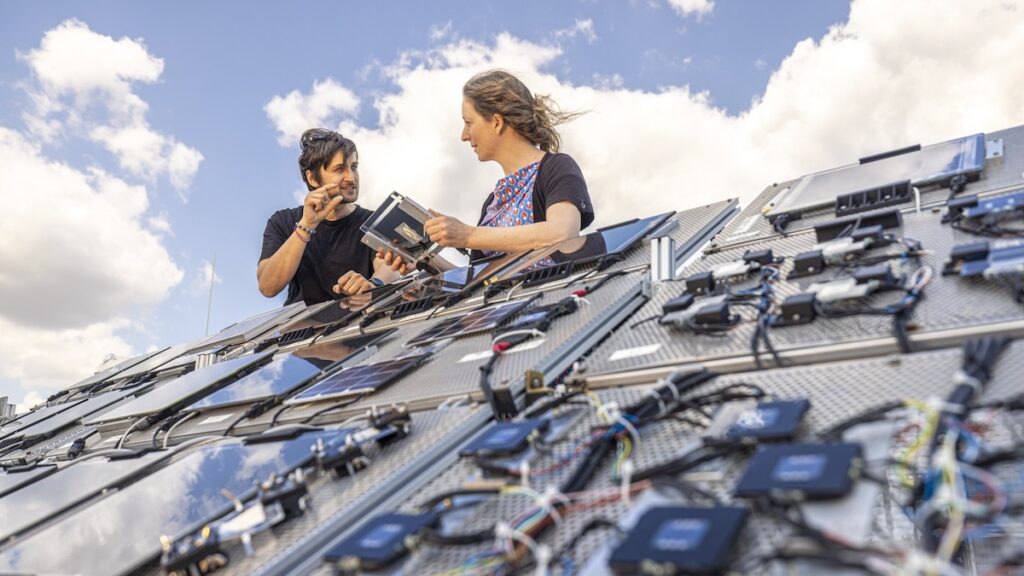
In a comprehensive outdoor aging test, the modules were exposed to real environmental conditions over a period of 20 months. A research team from the Helmholtz Center Berlin identified three central mechanisms that affect the stability of cells: so-called phase segregation, copper corrosion and the formation of edge patterns.
The most important factor turned out to be phase segregation, in which the chemical material composition of the perovskite changes. As a result, circular domains with diameters of a few micrometers are formed.
The other two phenomena, namely copper corrosion and the formation of specific edge patterns, are primarily related to the chosen cell design. They offer a direct starting point for future optimization of the module architecture.
Laboratory tests for perovskite solar cells on the test bench
In order to simulate years of aging in fast motion, laboratories standardly use artificial acceleration methods. Typical operating temperatures are in the range of 65 to 85 degrees Celsius in order to specifically accelerate the chemical processes.
However, these established methods often do not accurately replicate the real degradation processes that occur in nature. Aging under no-load conditions with changing electrical biases leads to significant variations in the spatial extent of corrosion.
In addition, the high temperatures of 65 to 85 degrees Celsius in the laboratory cause an additional aging mechanism. This does not occur at all in cooler, real outdoor use, which distorts the test results.
Intense light as a reliable parameter
A more promising approach is to increase the light intensity from one sun to 2.3 suns in a realistic time-lapse test. With this method, the spatial trend of natural aging is precisely preserved without artificial disturbing effects distorting the process.
Accelerated photoaging thus acts as a valuable tool for the rapid screening of new materials and optimized cell designs. In this way, technological development is massively promoted. Carolin Ulbrich explained the current state of research:
We do not yet have the perfect solution for reliable predictions of long-term stability. But we are one step further, we now know that more intense light is a key parameter for accelerating aging processes.
Although a perfect solution for predicting stability is still missing, global market readiness is gradually approaching. The potential for future solar production “Made in Europe” has therefore become more tangible.
Also interesting: